Where an Agent's Marketing Tool Chain Needs a Causal Check
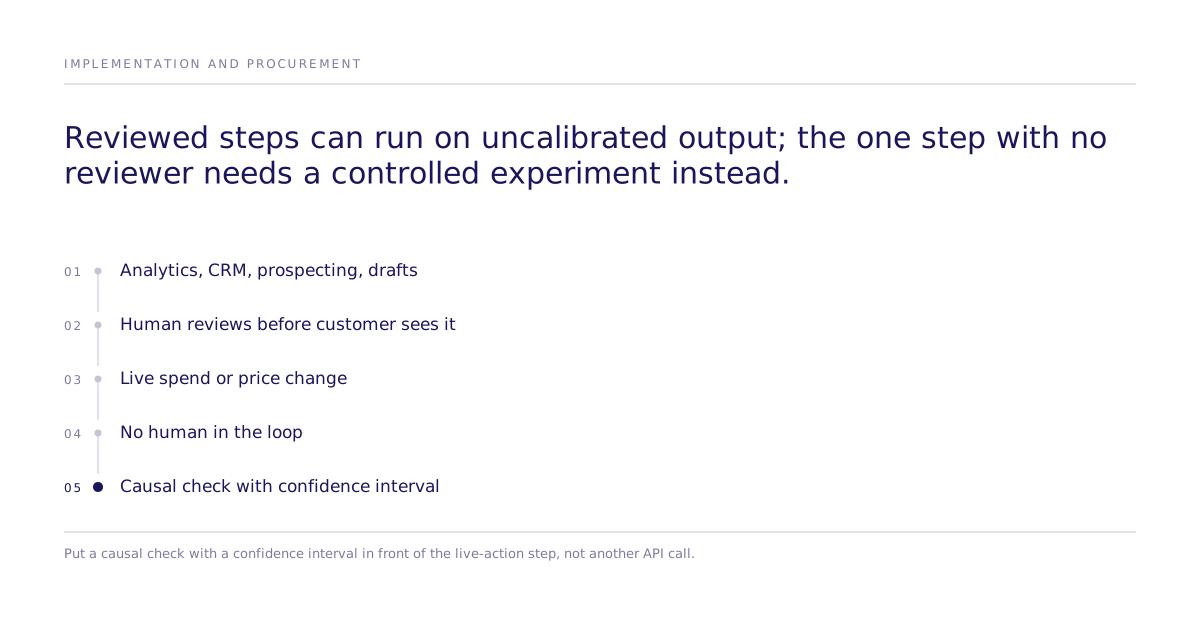
Put one causal check in front of the step where an agent is allowed to spend money, change a price, or ship a message on its own. Every other tool in the chain can run on uncalibrated output, because a human still reviews the result before it reaches a customer. The step that removes that review needs the strongest evidence behind it.
What changed when marketing tools became callable APIs
The Model Context Protocol standardizes how an AI agent discovers and calls a third-party tool, so any compatible agent can reach a service's API without a custom integration (Anthropic, "Introducing the Model Context Protocol"). The specification defines how a server advertises its tools and how an agent negotiates a call against them (Model Context Protocol Specification).
That single standard is why a marketing operations or RevOps team now faces a procurement question: which tools in the chain are safe to call and act on without a person in the loop, and which one has to stop and get checked first.
Where is uncalibrated tool output a fine default?
Most of a marketing agent's tool chain tolerates being wrong, because the output lands somewhere a person still reads before it changes anything customer-facing.
| Step in the chain | What the agent does with it | Who reviews before it reaches a customer |
|---|---|---|
| Analytics query | Pulls a report or a funnel number | A person reading the summary |
| CRM read/write | Updates a contact or moves a deal stage | The rep who owns the account |
| Prospecting search | Builds a candidate contact list | A person qualifying the list |
| Draft content or reply | Produces a document or an email draft | An editor or the sender |
| Spreadsheet write | Logs a result for later review | Whoever opens the sheet |
| Live spend or price change | Commits budget or changes what a customer sees | Nobody, if the agent is allowed to act directly |
The first five rows fail safely: a person catches the error before it reaches a customer. The last row does not, because nothing sits between the tool's output and the customer.
The step that needs the check
An agent wired to call a research tool as one more API in its loop can turn a wrong positioning read, a wrong price test, or a wrong channel call into a live action at machine speed, with no review step in between. Removing the human from that step raises the bar on what the agent is allowed to act on, because the tool feeding that decision is now the only check left.
The evidence that belongs in front of a live action is a randomized comparison, not a single-pass tool response. A controlled experiment tests one change against a holdout, replicates the result, and reports a confidence interval instead of a point estimate.
Where does Subconscious fit, and where doesn't it fit yet?
Subconscious runs a randomized, replicated experiment on a simulated market and reports the result with a confidence interval, which is the check an agent's live-action step needs. Subconscious can also test or validate a study with real human participants, so a team can move from the simulated read to a real-human check on the same causal question without redefining what they're asking.
Subconscious is not shipped today as a callable tool inside an agent's own loop. It is a decision-validation step that a person or a workflow invokes before the live action fires. A team should place it there: as the gate before the irreversible step, not as another unsupervised API call.
What should you check before wiring the stack?
Before connecting a research or analysis tool into a live-action chain, confirm three things: what the tool's output is based on (a single model pass, or a controlled comparison with a replication and a confidence interval), who or what acts on that output next, and whether that next action is reversible. If the action is a live price change, a live campaign change, or a live message to a customer, the tool feeding it needs the stronger evidence, and a human or a workflow gate belongs between the check and the action until that gate is proven safe to remove.
See how the underlying experiments are built and reviewed on the research page, and how a study moves from question to result on how we work. Ready to test one live-action step against this kind of check? Book a walkthrough.