AI Research for Pharma: Pressure-Test Positioning Before Launch
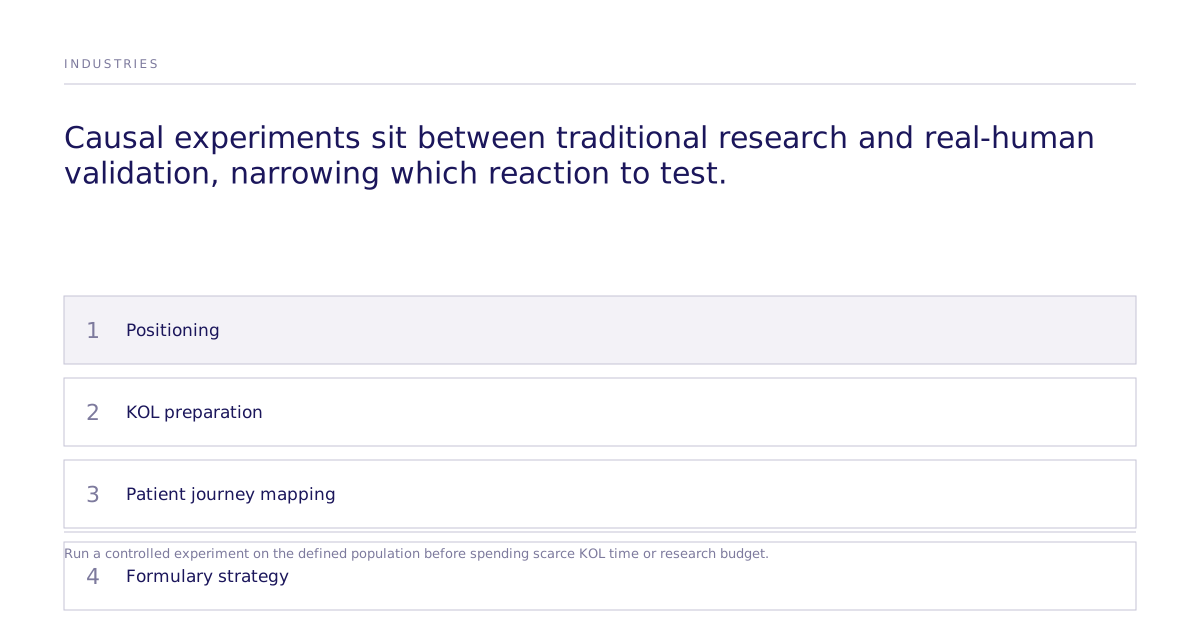
A pharma commercial or brand launch lead has one shot at first-impression positioning with prescribers, and the people whose reactions matter most, KOLs, formulary committees, target patients, are the hardest population to reach on a launch timeline. A full KOL advisory board takes months to convene, and physician time for pharma advisory work is compensated at negotiated hourly rates that scale with specialty and seniority, which is part of why teams ration how many real conversations they can afford before locking a strategy. Payer market research is a mature category, mock P&T panels, payer advisory boards, and recruitment of sitting and former P&T members, but the real committee's group deliberation and vote can't be observed, and sample for a specific plan's sitting members is thin.
The result is a structural gap. Positioning, KOL prep, patient-journey assumptions, and access strategy all get locked well before a team can test them against the population that will actually react to them.
Which reaction is worth testing before you commit
The decision this fits is narrow: which prescriber, KOL, patient, or formulary-committee reaction should a team pressure-test with a controlled experiment before locking launch positioning, an advisory-board narrative, or an access strategy. A wrong positioning bet burns the launch window, and a wrong read on committee objections burns scarce KOL goodwill and advisory-board budget on the wrong questions.
Subconscious runs controlled experiments on defined prescriber, patient, or payer populations to compare positioning, message, or access alternatives before a team commits budget. Point of proof: the causal experiment method and replication record, not case claims from any single prior vendor. A simulated reaction from this kind of experiment is a hypothesis to test, not evidence. It requires validation with real human research before it informs a regulatory or promotional claim, and it does not replace real KOL relationships or clinical evidence.
How does drug launch positioning research work?
Traditional launch research runs sequentially, HCP qualitative, message testing, conjoint analysis, sometimes an ATU study, and produces results in batches on a fixed timeline. That sequence still matters. What it doesn't offer is a way to iterate on positioning language between formal rounds.
A causal experiment lets a team compare defined positioning alternatives against a defined prescriber population before locking the detail aid: lead with efficacy versus safety versus convenience, and see which framing produces a measurably stronger directional response, and where that response differs across prescriber segments. The output is a comparison between tested alternatives for a population specified in advance, not a prediction of what any individual prescriber will do.
Why is real KOL time so scarce and valuable?
Real KOL time is scarce and relationship-sensitive. Every conversation used to test an argument is goodwill not spent on substantive advisory work. Independent analysis of KOL engagement describes the recurring tension between a KOL's role as an independent expert and their financial relationship with the sponsoring company, which is part of why real advisory conversations are worth protecting for issues that need a real expert's judgment, not for rehearsing how an argument lands.
"Two recent business intelligence reports on how drug companies identify, recruit, train, and pay their opinion leaders state that influential doctors can earn up to $400 an hour."
Ray Moynihan, BMJ (source)
A controlled experiment against a defined set of prescriber or KOL profiles, grounded in publication record, therapeutic-area focus, or stated position where that information is available, can surface which parts of a discussion guide are likely to generate real debate before the actual advisory board meets. Naming this boundary lets a team judge what the exercise can and can't tell them. This is preparation, not a substitute for the advisory relationship: what a team learns is where an argument is weak, not what a specific named KOL will say.
Patient journey mapping
Traditional patient-journey research recruits real patients, conducts depth interviews, and synthesizes findings, and it stays necessary, especially for rare diseases where patients are hard to recruit, and chronic conditions where the journey spans years longer than a single research cycle can observe.
A causal experiment can compare hypotheses about where patients experience friction at each journey stage, pre-diagnosis, diagnosis, first treatment, switching, long-term management, against a defined population, before the team commits its real-research budget to the stages that turn out not to matter. The result narrows where depth interviews should focus. It doesn't replace them.
Why is formulary committee research so hard?
Formulary committees are structurally hard to research directly, which is exactly why access strategy often gets built on assumption rather than evidence. A controlled experiment against a defined set of formulary-relevant profiles, a cost-focused reviewer, a clinically oriented physician member, an outcomes-oriented medical director, can test how a cost-effectiveness argument, a competitive-positioning claim, or a specific prior-authorization framing lands, before the real committee sees it.
| Launch stage | Traditional research | Where a causal experiment adds a comparison |
|---|---|---|
| Pre-launch | HCP qualitative, ATU study | Compare positioning alternatives against a defined prescriber population |
| KOL preparation | Advisory board sessions | Compare discussion-guide framings before the real session |
| Patient journey | Depth interviews | Narrow which journey stages need the interview budget |
| Formulary access | Payer research, P&T briefings | Compare cost and access framings against defined committee profiles |
The limit sits next to the comparison in the table above so a buyer can weigh both at once. This does not predict what any real committee will decide. It surfaces which objections and questions a team should be ready to answer.
Where this stops being a hypothesis
A method proves itself by publishing what it can't do alongside what it can. A simulated prescriber, KOL, patient, or committee reaction answers one question: is this argument, positioning, or framing strong enough to be worth testing further. It is a hypothesis-generation and comparison tool, not a source of clinical or regulatory evidence, and a result from it should never be attributed to a real named individual.
Before any insight from this kind of experiment informs a regulatory claim, a promotional claim, or a final launch decision, it needs validation with real human participants, real prescribers, real patients, or real committee-adjacent reviewers, depending on the question. The causal question being tested stays the same across that step; what changes is the population answering it.
Start with one launch or access decision your team needs to make, name the population and the alternatives you're weighing, and bring it to a Subconscious working session.