What Promotion Mechanics Are Used in FMCG/CPG?
A revenue growth management lead choosing the mechanic for next quarter's promo calendar decides which lever moves volume without training shoppers to wait for the next deal. FMCG and CPG brands draw from a short list of mechanics: straight price discounts, BOGO, multi-buy, bonus packs, coupons and rebates, loyalty-point multipliers, and bundles. Choosing among them is the decision this article answers: which mechanic to test before it goes on the calendar.
That choice usually runs on category habit and manufacturer defaults: a category manager copies last year's calendar because testing every mechanic in-market is slow and expensive. This article treats the decision differently: pick and test the mechanic before the trade budget commits, not after the redemption report lands. Randomized experiments analyzed with discrete choice models answer the question before the calendar prints: which mechanic changes behavior, and by how much.
- No mechanic wins universally. The right one depends on category, price tier, and shopper segment, which is why testing beats copying last year's calendar.
- Randomized experiments analyzed with discrete choice models (McFadden DCE, Mixed Logit, ICLV) isolate which mechanic caused a shift in choice, not just which one correlates with higher scan sales.
- Our best configuration reaches 87% of the measured human ceiling on one study: 0.832 rank correlation against the published human result, where two independent samples of real humans reach 0.959. Across all 43 studies that pass design filters the mean is 0.73, per the causal fidelity paper. A rank-correlation number without its limits is marketing copy. The 87% figure holds on the study it was measured against, and it isn't a guarantee for a market or category the model hasn't been checked against.
- Stated preference for deep discounts tends to run higher than what shoppers actually redeem, so any willingness-to-pay read needs a hypothetical-bias caveat unless the design pays out real money.
What promotion mechanics do FMCG and CPG brands actually use?
Straight price discounts (10 percent off, $1 off) are the default because they're simple to execute and easy to measure. BOGO and multi-buy offers (buy two, get one free; three for $5) trade margin for basket size and tend to pull volume forward rather than grow the category. Bonus packs (20 percent more, same price) protect the shelf price point while still moving units, which matters in categories where a visible price cut signals lower quality. Coupons and rebates shift the discount to a subset of shoppers willing to clip or clip digitally, which segments the spend but adds friction. Loyalty multipliers and bundles are newer additions, useful where retailer data partnerships make targeting possible.
Each mechanic has a different mix of trade cost, margin impact, and shopper perception. The mechanic that lifts volume in salty snacks without cannibalizing full-price sales can flatten volume in a category where shoppers already stockpile on deal, like paper goods or laundry care.
How do you test promotion mechanics before committing trade dollars?
Run a randomized experiment, not a bigger regression on historical scanner data. A discount that runs during a holiday week and one that runs in a slow month aren't comparable: redemption rate and lift both mix the mechanic's effect with distribution, seasonality, and competitor activity happening in the same window. Separating "this mechanic caused this outcome" from "this outcome happened while this mechanic was running" takes a randomized manipulation.
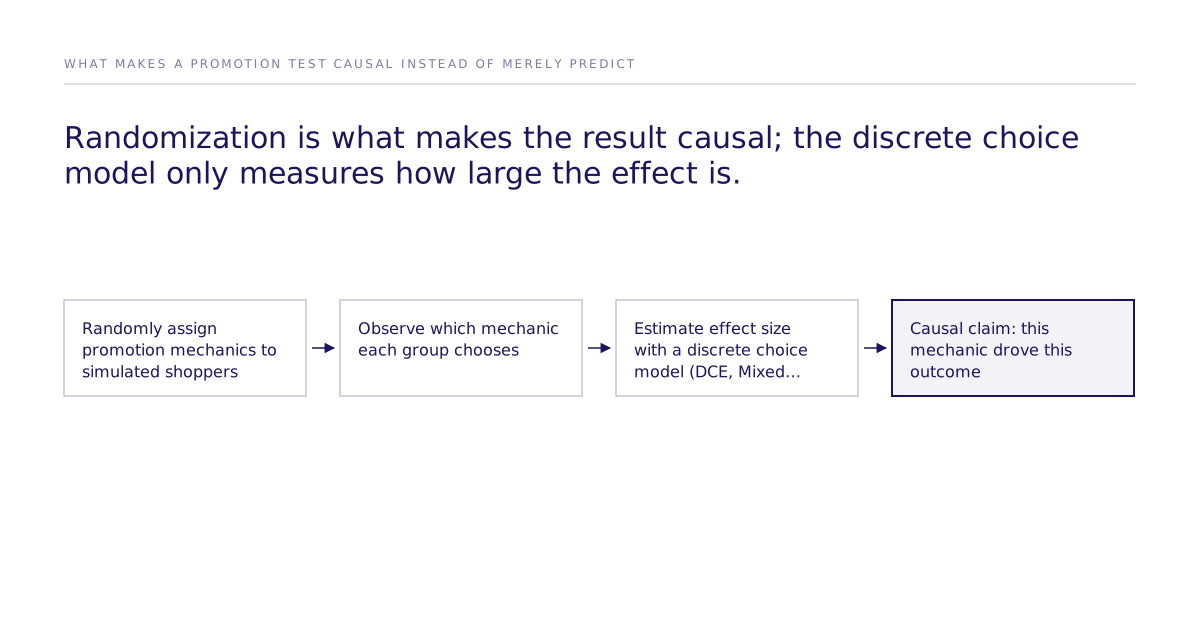
Present each simulated shopper segment with a different mechanic, or combination of mechanics, as if it were a real shelf choice, then analyze the resulting choices with an estimator built for discrete alternatives. McFadden discrete choice models give a fast baseline read on which mechanic wins share across a large candidate set. Mixed Logit adds shopper-level variation, so a value-driven segment and a loyalty-driven segment can show different sensitivities to the same discount depth instead of being averaged into one number. ICLV goes further and folds in latent attitudes, like perceived price fairness or quality erosion, that explain why a mechanic underperforms even when the discount is deep enough on paper.
| Method | What it estimates | Preference heterogeneity | Attitudinal drivers | Best for |
|---|---|---|---|---|
| McFadden discrete choice | Baseline choice shares across mechanics | No (pooled) | No | A fast first pass across a wide set of candidate mechanics. |
| Mixed Logit | Choice shares plus individual-level variation in discount sensitivity | Yes | No | Segmenting response once the mechanic list is narrowed. |
| ICLV (Integrated Choice and Latent Variable) | Choice shares plus the role of attitudes like price fairness | Yes | Yes | Diagnosing why a mechanic like BOGO underperforms a straight discount. |
A flat discrete choice model carries the IIA assumption: it treats every mechanic in the test as substituting proportionally for every other one, whether the alternative is a BOGO or a modest coupon. That rarely matches how shoppers actually trade off similar options. Mixed Logit and ICLV loosen this by modeling shopper-level heterogeneity, but the assumption doesn't disappear entirely. It only relaxes within segments. Treat preference-share output from a flat logit as directional for close substitutes, not a fixed law. A deeper walkthrough of when each estimator fits lives in methods and validation.
How accurate are simulated promotion tests against real shopper behavior?
Our best configuration reaches 87% of the measured human ceiling on one study: 0.832 rank correlation against the published human result, where two independent samples of real humans reach 0.959. Across all 43 studies that pass design filters the mean is 0.73, per the causal fidelity paper. Publishing the ceiling next to the score is what lets a buyer check the method against their own category. It is a validation result, not a guarantee for a promotion mechanic in a market or category the model hasn't been checked against. Published human studies can sit inside a model's training data; the replication protocol is built to catch that overlap, not to let the number wave it away. Current results across categories are visible on the public leaderboard, which is the place to check before treating any single study as settled.
Does the say-do gap distort promotion mechanics research?
Yes, when the question asks shoppers what they'd pay or which discount they'd wait for, because stated willingness to pay runs higher than what people actually redeem at checkout. This is hypothetical bias, and it shows up specifically as shoppers claiming they'd hold out for a deeper discount than the one that actually changes their basket. A discrete choice design that presents mechanics as competing shelf options, rather than asking shoppers to name a price, narrows this gap because it forces a real trade-off instead of an open-ended guess. It still isn't the same as an incentive-aligned design, where a real purchase is on the line. Any willingness-to-pay figure from a standard DCE should carry that direction of bias explicitly, not get reported as a clean number. A confidence interval attached to a simulated promotion test covers the effect within that simulated population under the tested conditions; it isn't a bound on what will happen in the real market until the same design has been checked against a human holdout.
Building a promotion-mechanics test before the calendar locks
Start with the mechanics actually under consideration for the category, not a hypothetical long list; three to five candidates is enough for a first pass. Randomize which mechanic each simulated shopper segment sees, run the McFadden discrete choice baseline to rank them, then move the top two or three into Mixed Logit to see whether a value segment and a loyalty segment disagree. If a mechanic underperforms in a way the numbers alone don't explain, an ICLV pass on attitudes like price fairness usually shows why. Check the result against the leaderboard for category precedent, and look at case studies for how other CPG teams structured a similar test before treating the read as final.
Take the two mechanics most under debate for the next promo cycle and run them through this sequence before the trade budget commits. For help scoping the test, book time with the team.