Testing Healthcare Launch Decisions Before the Qualitative Study Starts
A medtech or pharma commercial team planning a device or program launch usually has to lock positioning, HCP messaging, or a patient support program design before qualitative research can confirm any of it. IRB approval alone can take months to clear, and patient, HCP, and caregiver recruitment is a separate bottleneck. Causal action testing gives that team a way to compare positioning or messaging alternatives against defined patient, HCP, and caregiver populations before the traditional research cycle finishes.
Why is healthcare research access the real bottleneck?
Traditional healthcare research is slow for structural reasons, not process failures. Finding patients who match a specific condition, then persuading enough to enroll, costs real time and budget. HCP advisory boards are difficult to convene on a launch timeline. Payer committees are unreachable outside formal submission cycles. Caregivers are worn down by the caregiving role itself and rarely respond to research invitations.
The practical result: most launch positioning, patient journey design, and HCP messaging decisions get made on outdated qualitative data or internal assumptions, because rigorous research arrives after the decision is locked.
What can a causal test compare before qualitative research happens?
Causal action testing reports which alternative is more likely to change engagement or preference, tested against defined patient, HCP, or caregiver populations.
| Population tested | What the test compares | Decision it informs |
|---|---|---|
| Patients at different journey stages (newly diagnosed, treatment-experienced, considering switching) | Reactions to a support program, information sequencing, and stated concerns | Patient journey design and support program content |
| HCPs with different prescribing behaviors (early adopters, conservative prescribers) | Which messages or value propositions land, and with whom | Detail aid messaging and launch positioning |
| Caregivers (spouses, adult children, parents) | Decision-making influence and stated concerns | Messaging that accounts for caregiver influence, not just the patient |
Caregivers in particular are chronically underrepresented in healthcare research, which is one reason their perspective is often missing from launch decisions entirely.
A device launch example
A medtech company launching a new glucose monitoring device must know, before launch: what patients think about giving up the device they already use, which features actually drive that decision versus which ones patients would shrug off, whether endocrinologists find the clinical data package convincing enough to prescribe, and whether the onboarding flow makes sense to someone who isn't a diabetes educator.
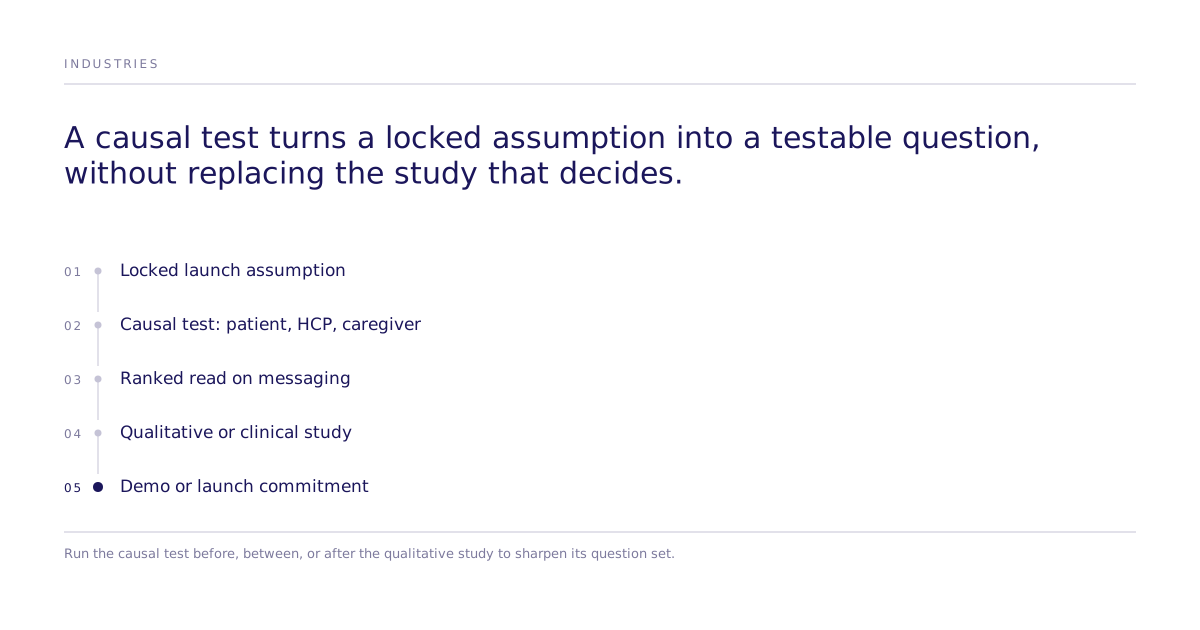
A traditional qualitative research cycle for questions like these runs for months, involves multiple vendor relationships, and returns results after the key decisions are locked. Running a causal test first, comparing patient personas across diagnosis stage, device familiarity, and age alongside HCP personas across prescribing style, produces a ranked read on messaging and positioning before that cycle completes. That output does not replace the qualitative study that follows. It sharpens which questions that study needs to answer, so the real qualitative study starts pointed at the open question rather than the obvious one.
What this does not do
Three limits matter more than any efficiency claim:
- It is not a substitute for clinical evidence. It does not generate clinical evidence, and no regulator or promotional reviewer should see it framed that way.
- It does not use real patient data. No PHI is required to define a patient population for a causal test. The population is built from stated attributes like diagnosis stage, treatment history, and demographic factors, not from identified patient records.
- It is for commercial strategy, not regulatory submission. Messaging, positioning, and program design are in scope. Anything destined for a regulatory dossier, an IRB-governed protocol, or a payer submission runs through the qualifying human process for that decision.
Where this fits in a launch research plan
The highest-value use isn't a one-off pre-launch check. Teams get the most out of causal testing for healthcare launches when they run it before a qualitative study to sharpen its question set, between studies to test a new hypothesis without restarting the full research process, and after a study to check edge cases or adjacent segments the original study didn't have time to cover. In every case, the causal test moves a team from a locked assumption to a testable question, and the qualitative or clinical study that follows has the final word before a demo or launch commitment gets made.