Agency vs. in-house marketing measurement: where causal action testing fits
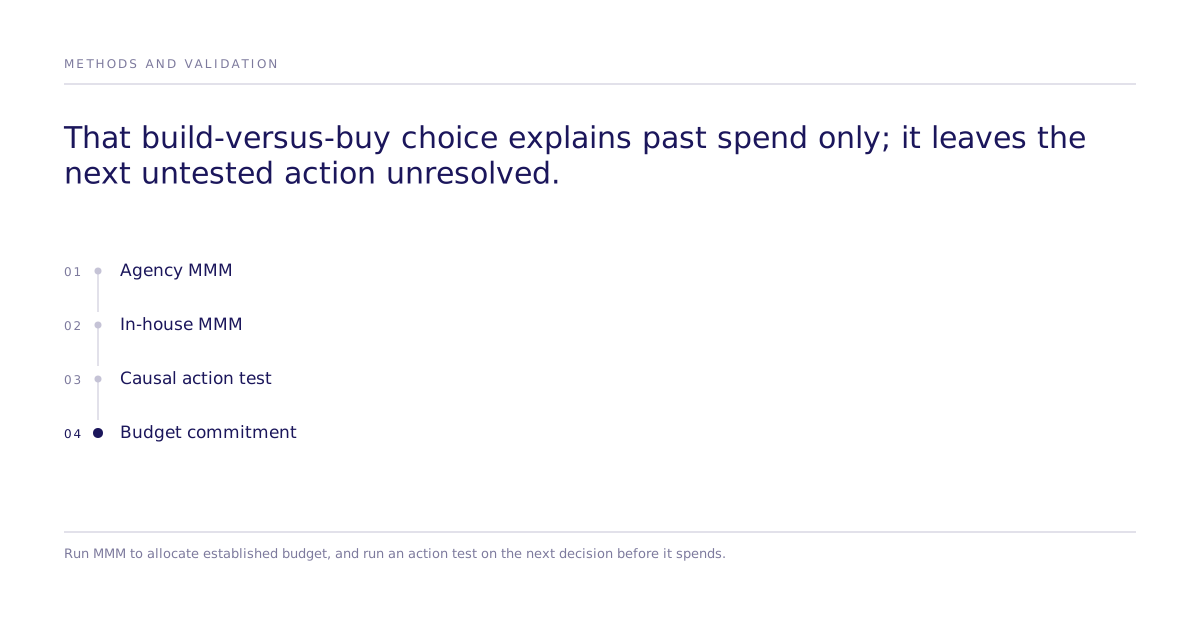
A marketing analytics or data-science leader deciding how to measure effectiveness usually frames the choice as agency versus in-house. That framing hides a second, more consequential decision: whether the team can test its next pricing, message, or channel action before committing budget, not just explain last quarter's spend.
The build-versus-buy question most teams ask
An option's upside is marketing until its cost sits next to it in the open. In-house marketing gives a team control over data and domain knowledge tailored to the brand. It also means hiring and retaining specialized talent, and maintaining a measurement practice as methods evolve. Agency partnerships offer diverse expertise, established tooling, and an outside perspective, with less transparency into the underlying model.
Open-source, Bayesian tools have narrowed that tradeoff for the modeling layer itself. PyMC-Marketing is an open-source Python package for marketing mix modeling (MMM) and customer lifetime value (CLV) built on Bayesian methods, which gives a team transparency into assumptions and uncertainty that a black-box agency model does not expose (PyMC-Marketing documentation). Choosing to build on tools like this is a real option for a team with the statistical and engineering capacity to run it.
What does that decision actually buy you?
Marketing-mix modeling, whether run by an agency or built in-house on an open-source stack, fits response curves to media and pricing history that support both retrospective channel-contribution estimates and forward-looking budget-allocation scenarios across known channels. A model's fit to historical spend is only useful once its boundary is stated plainly. It does not answer a different question a team faces every week: whether a specific new message or channel choice, one with no spend history yet, will move the outcome before the team commits capital to it.
Committing engineering headcount and a multi-quarter build to a measurement stack, or a multi-year agency retainer, while still deciding the next pricing or message change on guesswork, is the cost of treating build-versus-buy and pre-commitment testing as one decision instead of two a team can resolve separately.
Where the two approaches sit relative to each other
| Question | Agency or in-house MMM | Causal action testing |
|---|---|---|
| What it explains | Historical contribution of known channels and spend | The causal contrast between defined alternatives in a designed test |
| When it runs | After spend history exists, informing retrospective and forward-looking scenarios | Before budget commits |
| Primary output | Estimated channel contribution and budget-allocation scenarios | Comparison between defined alternatives |
| Best fit | Ongoing budget allocation across established channels | Deciding a next price, message, or channel choice |
Subconscious.ai is a causal behavioral platform built for the second row: it helps teams test product, pricing, messaging, and go-to-market actions before committing capital. Stating what a tool does not do is what lets a buyer check the fit before they commit budget to it. That is not a replacement for marketing-mix modeling software. Subconscious does not attribute historical media spend, and it does not provide agency-style campaign execution or management.
A concrete way to think about the split
A team weighing agency versus in-house measurement can keep both tracks:
- Use marketing-mix modeling, agency-run or in-house on a package like PyMC-Marketing, to understand how existing channels have performed and to allocate an established budget.
- Use a controlled action test against a defined audience to decide whether the next price point, message, or channel is worth funding at all, before that spend becomes part of next quarter's contribution estimate.
Treating measurement and testing as competing purchases, rather than complementary steps, is what leads teams to over-invest in retrospective tooling while still guessing on the decision in front of them.
Where does this fit for a team already building the case?
A team that has already decided to build or buy marketing-mix measurement can still test the specific action under consideration before it becomes part of that measurement history, independent of whether the modeling stack is finished. Reviewing recent case studies or the underlying research is a reasonable next step, and a short demo shows what a single action test looks like in practice.