Bayesian Marketing Measurement When Individual Tracking Weakens
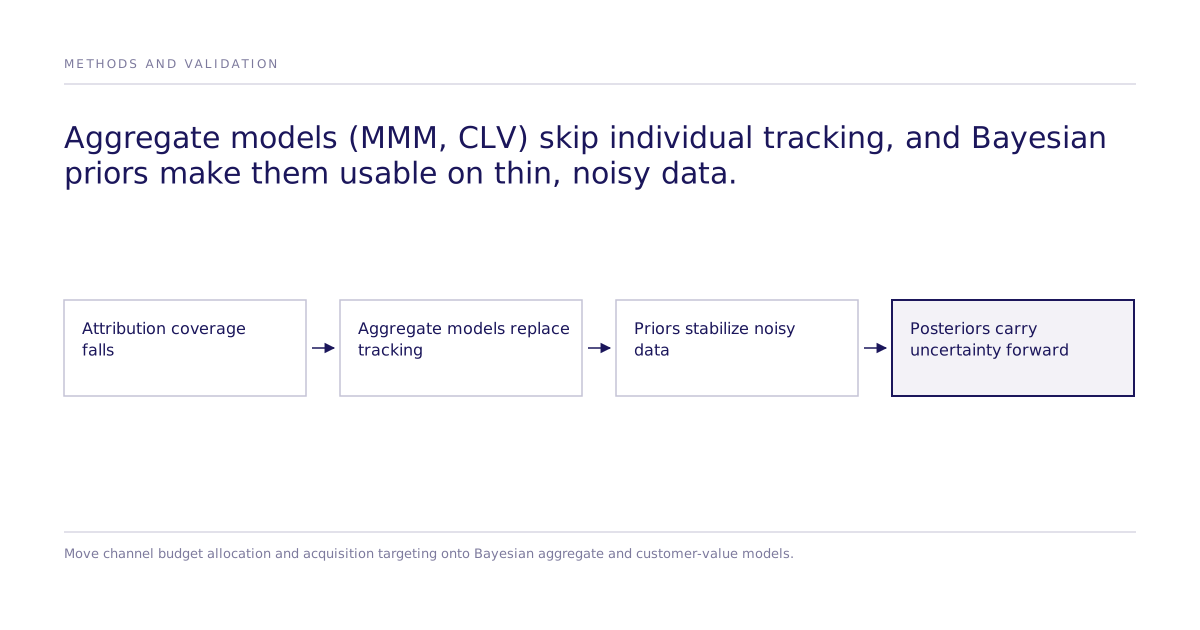
When individual-level attribution loses coverage, marketing teams should not treat the remaining tracked journeys as the whole market. Channel-aggregate models can estimate contribution without reconstructing individual paths, while customer-value models can keep acquisition tied to longer-run value. Bayesian methods make the uncertainty and assumptions in both decisions explicit. They do not rescue poor data or turn estimates into causal proof.
For a marketing analytics leader allocating budget, or a data science lead building measurement in-house, the decision is whether to move budget allocation and customer-value targeting onto aggregate, uncertainty-aware methods.
Why did individual-level attribution stop being reliable?
Regulatory constraints (GDPR, CCPA) and platform-level changes (Apple's iOS 14.5 App Tracking Transparency opt-in, Safari, Firefox, and Brave blocking third-party cookies by default) have pushed identity coverage for individual-level attribution well below cookie-era levels (Usercentrics, 2026). Chrome did not fully deprecate third-party cookies as originally planned; Google reversed course in 2025 and retired the Privacy Sandbox APIs instead. The practical effect for marketers is the same: multi-touch, pixel-based attribution now sees a shrinking, biased slice of real customer journeys.
Get the diagnosis wrong and the cost compounds every budget cycle. Spend gets reallocated toward channels that still report clean attribution data, not the channels actually driving outcomes. Acquisition gets optimized for signup volume instead of long-run customer value.
What is channel-aggregate modeling?
Media Mix Modeling (MMM) estimates each channel's contribution to an outcome, such as signups or sales, using aggregated spend and outcome data rather than individual tracking. It separates revenue movement caused by ad spend from movement caused by seasonality, holidays, or macroeconomic conditions, and models the point at which additional spend on a channel stops paying off. Because it never requires resolving an individual user's path, MMM fits a post-cookie, post-ATT measurement environment. Marketers are reinvesting in it for exactly this reason (Marketing Agent Blog, 2025).
Customer Lifetime Value (CLV) modeling addresses a separate but related problem: two customers acquired at the same cost can generate very different revenue over time, so maximizing signups is not the same as maximizing business value. CLV models predict future purchase frequency, churn, and expected monetary value per customer, letting a team target acquisition spend toward customers likely to be worth more, not just more customers.
Why Bayesian methods fit this problem
The open-source PyMC ecosystem, a NumFOCUS Sponsored Project since 2016, is a recognized approach for fitting both MMM and CLV models under sparse or noisy data:
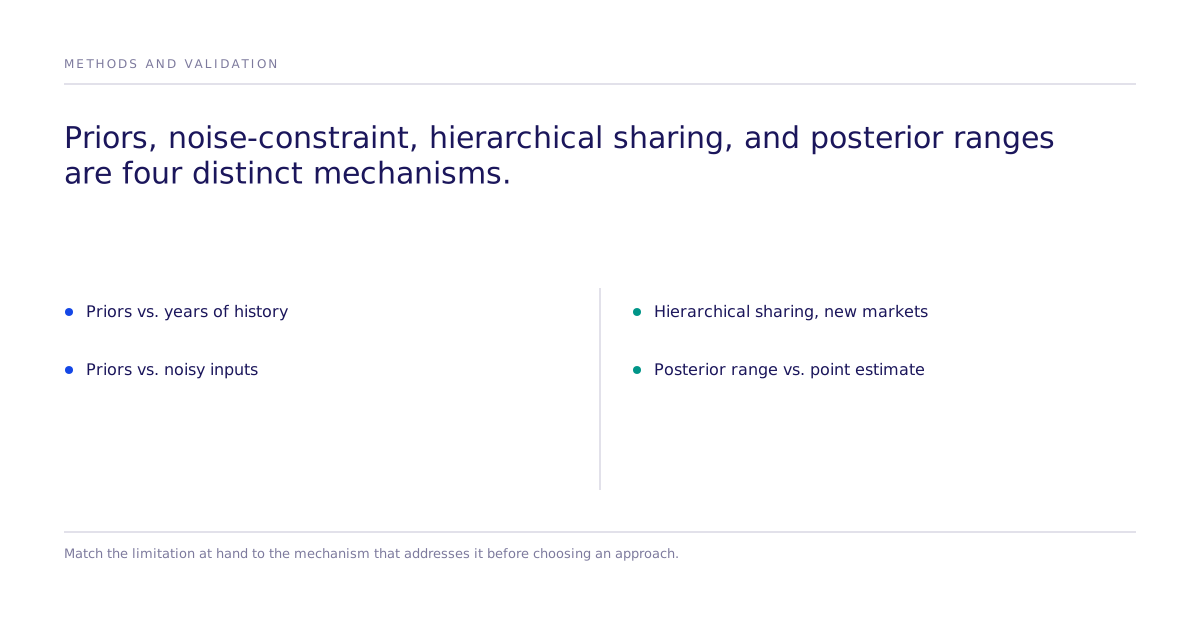
- Priors let a model produce usable estimates before years of history accumulate. A frequentist MMM typically needs two or more years of historical data to produce reliable estimates. A Bayesian model incorporates prior knowledge: domain expertise, industry benchmarks, prior model runs. It can return a usable estimate with as little as a few months of data, with certainty tightening as more data arrives.
- Priors constrain results under noisy, aggregated inputs. Marketing data is often monthly and imperfect. A method that fits parameters purely to the data it's given can produce unstable results when that data is thin or noisy; priors keep estimates within a domain-plausible range.
- Hierarchical structure helps new products and markets. A model that shares statistical strength across related categories can produce a reasonable estimate for a new market or product line with no dedicated history, by borrowing patterns from related, established ones.
- Posteriors carry uncertainty into the decision. A Bayesian model returns a full posterior distribution over plausible values, not a single point estimate. Budget and acquisition decisions can then weigh a range of outcomes instead of treating one number as fact.
A neighboring causal discipline, not an MMM product
Subconscious does not build MMM or CLV models and does not offer budget optimization or channel measurement products. The connection is narrower: both disciplines treat uncertainty as something to quantify and report, not something to average away. Subconscious runs randomized experiments against a simulated population to test the causal effect of a specific action or message on that simulated population before it ships, returning an effect estimate with a confidence interval that reflects sampling variability within the simulation, rather than a single predicted number. A study built this way can move from a simulated run to a real-human validation study, confirming a result against real respondents before budget commits, without changing the underlying causal question being asked. That validation step is not automatic usability testing or a clinical trial; it answers the same causal question with a different population.
Guardrails for the budget decision
Bayesian priors reduce the data needed to get a usable estimate; they do not eliminate the need for good outcome and spend data, and a badly specified model with strong priors can still produce confidently wrong estimates. Aggregate channel modeling and individual-level testing answer different questions: one is an observational estimate resting on identification assumptions, the other is a randomized estimate of a narrow, tested effect.
Before changing the allocation
Before reallocating a channel budget or an acquisition target based on any model's output, see how Subconscious tests a specific action's causal effect or check the current leaderboard of tested claims and their confidence intervals.