Bayesian Modeling for Modern Marketing: Solving Real-World Attribution & CLV Challenges
Cookie deprecation and shrinking first-party tracking have made channel attribution harder to trust. A marketing analytics lead choosing between a linear-regression attribution model and an uncertainty-aware Bayesian one is really choosing between a single confident number and a range that says how confident that number actually is, conditional on the model; neither a coefficient nor a posterior resolves the confounding introduced when spend tracks expected demand or when tracking data itself is missing.
Why does the point estimate break first?
A linear regression fit to customer acquisition cost (CAC) or channel effect returns one coefficient per channel. That coefficient looks precise, but it hides how much of it is signal and how much is noise from a shrinking, cookie-restricted data set. A budget reallocation built on that single number can move spend into a channel whose true effect range includes zero; a regression's standard errors and confidence interval can show that, but interpreting what that range means, and propagating it through the nonlinear adstock and saturation transforms typical of a media response curve, is where the linear approach runs out of road.
Black-box machine learning models make the same mistake in a different shape: they can fit the historical pattern well and still give no account of which inputs the prediction actually depends on, or how sure the model is.
What does a Bayesian model add?
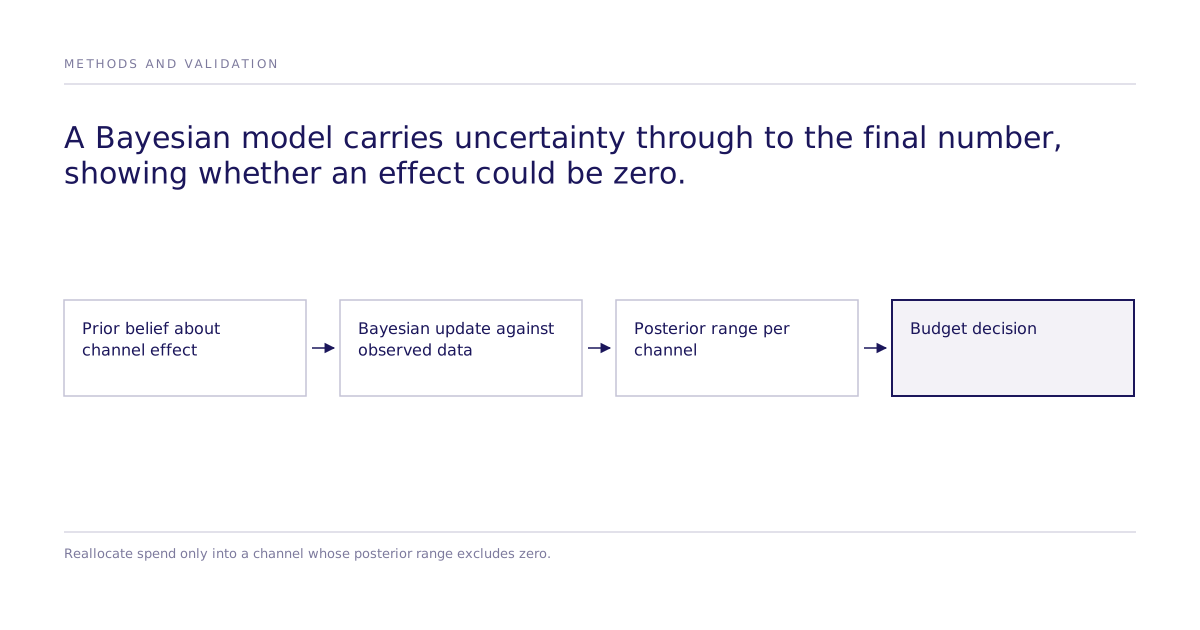
A Bayesian approach to media mix modeling starts from a stated prior, expert knowledge about plausible ranges for a channel's effect, then updates that prior against observed data, and returns a posterior distribution instead of a point estimate. Google's applied research on media mix modeling with carryover and shape effects documents this approach for advertising response curves that persist and decay over time (Bayesian Methods for Media Mix Modeling with Carryover and Shape Effects, Google Research). A parallel treatment applies the same hierarchical structure to marketing attribution specifically, modeling channel similarity and time-varying effects rather than a single fixed coefficient per channel (Bayesian Modeling of Marketing Attribution, arXiv).
The practical difference shows up in three places:
| Question a budget decision depends on | Linear regression | Black-box ML | Bayesian model |
|---|---|---|---|
| Does the output state its own uncertainty? | Yes, but only through the linear model's own assumptions | No: one prediction | Yes: a posterior range that also propagates through nonlinear transforms |
| Can it incorporate known structure (seasonality, channel hierarchy) before fitting? | Limited | Indirectly, via features | Directly, as priors |
| Can a stakeholder see whether an effect could be zero? | Not from the coefficient alone | Not from the prediction alone | Only if the model doesn't impose a non-negativity prior; many carryover/saturation specifications rule out zero by construction |
Where the shared thesis lives, and where it stops
The underlying argument, report which action moves which outcome with quantified uncertainty rather than a single confident estimate, is the same argument behind Subconscious's approach to testing marketing and product decisions: controlled experiments on simulated markets with causal-effect estimation, reporting uncertainty where the study design supports it. A scope stated plainly is what lets a buyer check whether a tool fits their problem before they adopt it. Subconscious does not build media mix models, does not estimate carryover or adstock effects, and does not forecast customer lifetime value. That distinct econometric workflow means a team evaluating a Bayesian MMM specifically should read this as a framing explainer, not a comparison of interchangeable tools.
What does transfer is the discipline of testing a decision, such as a price change, a message, or a positioning claim, as a controlled experiment and reporting the confidence interval around its effect, a coverage guarantee that rests on the randomization in the experimental design, distinct from the credible interval a well-specified Bayesian attribution model reports around a channel's contribution, which rests on the model and its priors. Teams that want to see how that discipline applies to a specific action can review the research behind the approach or see it applied on the leaderboard.
Limitations
The misses belong next to the hits, so a reader can see exactly what this piece does not claim. This explainer is about method fit, not tool selection. It does not recommend a specific Bayesian modeling library, replace an attribution or CLV vendor evaluation, or claim that causal experiments on simulated markets substitute for time-series marketing mix modeling. Teams with an active attribution or CLV modeling need should evaluate that decision on its own econometric merits; the how we work page describes the separate class of decision Subconscious tests.