How to Tell If a Causal Vendor's Probability Model Is Auditable
A data science leader vetting a causal behavioral platform for a paid pilot needs one question answered before budget moves: can this vendor show the exact path from its modeling assumptions to a testable probability estimate, or does the output arrive as an unexplained number? A pilot spent on an opaque model cannot be defended internally when someone asks how the number was produced.
Why isn't "AI insights" a good enough answer?
Generic "AI insights" framing treats a probability estimate as a finished product, hiding the steps between the assumptions a model encodes and the number it reports. For a buyer, that gap is the actual risk: if a vendor cannot show how assumptions became a checkable estimate, there is no way to audit the estimate later, reproduce it, or defend it under internal scrutiny.
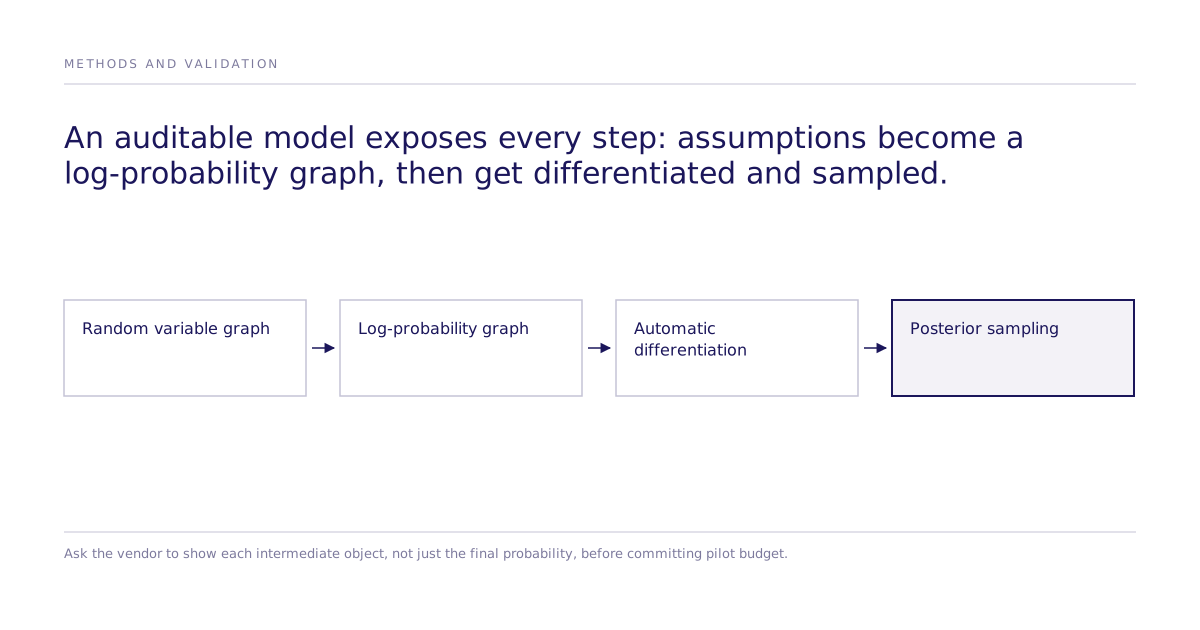
The open-source Bayesian modeling ecosystem around PyMC makes the alternative concrete. PyMC models are built as a graph of random variables: a structured statement of assumptions with no probabilities attached yet. A separate conversion step turns that assumption graph into a joint log-probability graph, which is the object a model actually gets tested and sampled against. That conversion is what makes a Bayesian model auditable: every step from assumption to estimate exists as an inspectable graph, not a black box.
From assumption graph to testable probability
The pattern has three parts, regardless of which library implements it:
- Define the random variable graph. Each unknown quantity in the model, such as a mean, a variance, or a probability of belonging to a segment, is declared as a random variable with a distribution and its relationships to other variables.
- Convert the graph into log-probabilities. A dedicated conversion step walks the random variable graph and produces a joint log-probability graph: the mathematical object that says how likely any given set of parameter values is, given the model's assumptions and the observed data.
- Differentiate and sample. Automatic differentiation turns the log-probability graph into gradients, which posterior sampling methods use to explore which parameter values are actually consistent with the data.
PyMC's 4.0 release rebuilt this pipeline around a graph-based computational backend, replacing the discontinued Theano project with a new fork purpose-built for this workflow (PyMC 4.0 Release Announcement). That backend has since been renamed and continued as PyTensor, reflecting further consolidation of the graph-computation layer rather than a change in the underlying pattern (PyMC's backend fork to PyTensor). The library names in this ecosystem have changed twice since 2022; the architecture pattern has not: declare assumptions as a graph, convert that graph into a checkable probability object, then sample from it.
What does this buy a buyer?
The practical advantage is inspectability. A model built this way can be interrogated at each stage: what assumptions were encoded, how they were converted into a probability estimate, and whether that estimate can be reproduced from the same graph and the same data. A model that skips straight to a final number, with no equivalent intermediate object, cannot answer any of those questions.
\log p(\theta \mid y) \propto \log p(y \mid \theta) + \log p(\theta)Where theta is the set of model parameters, y is the observed data, p(y | theta) is the likelihood implied by the random variable graph, and p(theta) is the prior. The conversion step is what turns the right-hand side from an abstract statement into a graph that can be evaluated, differentiated, and sampled.
How does Subconscious apply the same audit standard?
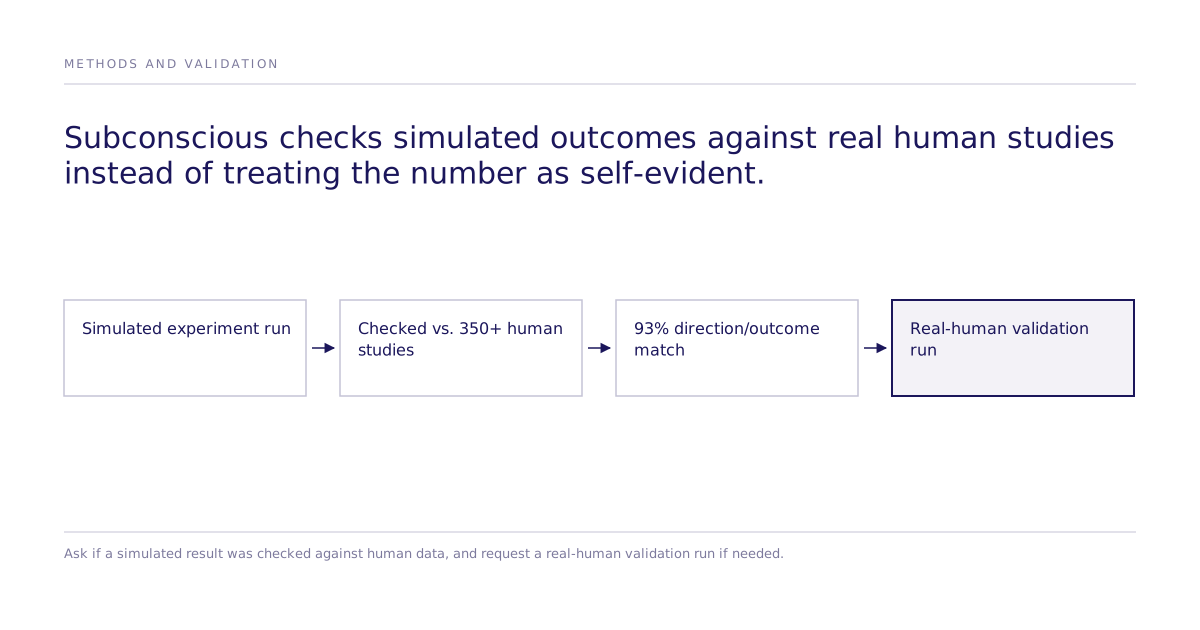
Subconscious runs on causal experimentation and discrete-choice-style modeling, not generic synthetic-user roleplay, and validates its output against real human behavioral studies rather than treating a simulated result as self-evidently correct. The validation is concrete: our best configuration reaches 87% of the measured human ceiling on one study (0.832 rank correlation against the published human result, where two independent samples of real humans reach 0.959; mean 0.73 across the 43 studies that pass design filters, drawn from a corpus of ~300 replicated human studies across 9 domains), detailed in the causal fidelity paper. The same audit instinct this article recommends for any vendor, asking how assumptions become an evaluable estimate, applies to Subconscious itself. A team can move from a simulated experiment to a real-human validation run without changing the underlying causal question, and compare results on the leaderboard that tracks replication performance across domains.
Limitations
Real-human validation confirms that a simulated study reproduces a prior human result; it does not turn a causal experiment into a usability study, a clinical trial, or an automatic guarantee of market performance. And the graph-based architecture described above is a property of the open-source Bayesian ecosystem this article uses to illustrate the pattern; it says nothing about which specific tools any given causal vendor, including Subconscious, runs internally. The useful question for a buyer is not which library a vendor uses, but whether the vendor can show, concretely, the steps between its assumptions and its estimate.
What to ask before shortlisting a vendor
Before committing pilot budget to a causal-inference or behavioral-simulation vendor, ask for the graph and the design, not just the number: what assumptions define the model, what conversion step turns those assumptions into a probability estimate, what randomized attribute design underwrites the causal identification, and what validation corpus checks that estimate against real outcomes. A vendor that can walk through that architecture in specific terms has given a buyer something to audit. A vendor that answers only with a final score has not.