What Should Transfer to a New Context? A PyMC Walkthrough for Evaluating Causal Simulation Predictions
A causal simulation predicts a segment, product, or time period it never observed directly. Before a team acts on that prediction, someone has to answer one question: which learned relationships were assumed to carry into the new context, and which were left to be re-estimated or bounded by fresh uncertainty? If that assumption is silent, the error stays invisible until the real outcome misses the simulated one.
PyMC's Bayesian workflow makes this question explicit, and its worked examples are a checklist for anyone evaluating a causal simulation output, whether they wrote the model or are reviewing someone else's.
The mechanism: what carries forward and what gets relearned
A Bayesian model infers a posterior distribution over its parameters from observed data. Predicting in a new context means building a second model and deciding, variable by variable, whether each parameter's posterior draws should be reused or resampled from a prior.
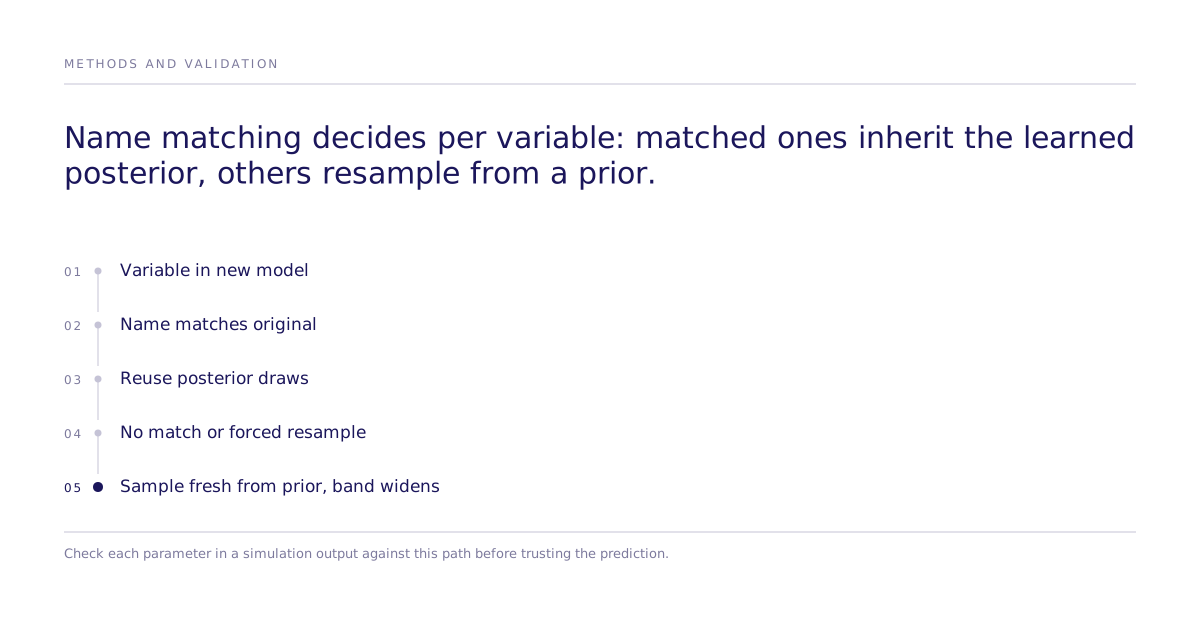
PyMC's sample_posterior_predictive function makes this decision by name matching: any variable in the new model whose name matches a variable already estimated in the original model reuses that variable's posterior draws by default. Any variable that has no match, or that the analyst explicitly asks to resample, gets sampled fresh from its prior, or from its conditional distribution given any already-reused parent variables, instead (pymc.sample_posterior_predictive documentation). The prior distribution assigned to a reused variable doesn't matter, since only the name match controls whether that variable's learned posterior is inherited or replaced.
Four ways to test what should transfer
1. Reusing a parameter across model forms
A linear model infers a slope parameter from observed predictor-outcome pairs. A second model, built for prediction only, can reuse that slope's posterior draws even though the second model's likelihood has a different functional form (a Student's T noise distribution instead of Normal). The slope is assumed to transfer; the noise structure is allowed to change.
2. Simulating groups a hierarchical model never saw
A hierarchical model estimates group-level parameters (a shared mean and a shared spread) from a fixed set of observed groups, plus a per-group offset for each observed group. To predict an unobserved group, the predictive model reuses the shared group-level parameters but draws a fresh per-group offset from the prior for each new group, since no data exists yet to estimate it directly. In the source's worked example, this pattern predicts two new groups (called the "9th and 10th schools," extending an eight-group dataset) using the group-level mean and spread learned from the original eight, while giving each new group its own offset prior.
3. Forecasting under a partial-transfer assumption
A time-series forecast can assume that some learned parameters hold into the future and others don't. Reusing every parameter, including the drift, produces one forecast band. Deliberately resampling the drift parameter from its prior, while still reusing the volatility parameter, produces a wider forecast band, because the model no longer relies on a possibly-stale trend estimate. A middle option keeps the learned drift but adds new noise around it, narrowing the band without pretending the drift is certain.
4. Recovering an unobserved variable, not just an outcome
The same reuse-or-resample logic applies to variables the original model never directly reported, such as which of several underlying groups most likely produced a given data point. Reusing the posterior draws for the group-level parameters lets the predictive model back out that assignment with its own uncertainty, higher for points that sit near the boundary between groups, lower for points that clearly belong to one group.
| Example | Reused (assumed to transfer) | Resampled or new (not assumed to transfer) | Effect of resampling |
|---|---|---|---|
| Model-form change | Slope parameter | Noise distribution shape | Not independent: slope and noise scale are jointly estimated, so the slope posterior from the Normal-noise model isn't calibrated for the T-noise model |
| New hierarchical groups | Shared group-level mean and spread | Per-group offset for each new group | New groups' offsets are drawn conditional on the reused mean and spread posteriors, so uncertainty in those shared parameters carries forward too |
| Forecast, full reuse | Drift and volatility | Nothing | Narrowest forecast band |
| Forecast, drift resampled | Volatility only | Drift | Forecast band widens substantially |
Why does this distinction matter for a causal simulation vendor?
The same generalization question underlies any causal behavioral platform that predicts a scenario, segment, or time period it did not directly test. A platform that lets a team test an action, compare scenarios, and estimate a causal effect with uncertainty for the specific study it ran is answering a narrower and more defensible question than one that implies its estimates transfer automatically to any new population or period.
Evaluating a vendor's out-of-sample claim means asking the same question this walkthrough answers for each example: which estimated relationships is the vendor assuming still hold in the new context, and where does the vendor's own uncertainty widen to reflect what it does not know? A vendor that cannot answer that question for a specific prediction is asking for trust rather than showing scope conditions.
When the decision depends on evidence beyond a simulated estimate, a team can move from a simulated study to testing with real human participants without changing the underlying causal question, a different check than generalizing a model's own draws, but often the harder validation before committing budget.
Where this method runs out
A method description that skips its own scope reads like marketing copy. Stating the scope here is what lets a reader check the claim before using it. This is a general-purpose open-source Bayesian modeling mechanism. It is not a benchmark, a validation study, or a result reported by any specific vendor's platform, and no accuracy, replication rate, or customer figure should be read out of it. It does not by itself establish that any particular causal simulation's predictions generalize correctly to a new context; that still requires evidence specific to that platform and that study.
A failure mode named in the open is one a reader can test for before trusting the result. Reusing posterior draws also assumes the analyst correctly identified which relationships are stable. Nothing in the mechanism itself checks that assumption. Getting it wrong, reusing a parameter that does not actually hold in the new context, produces a confident, well-calibrated-looking prediction that is simply wrong.
What should you ask before trusting an out-of-sample estimate?
Before acting on a simulated prediction for a segment, product, or period the underlying study did not directly cover, ask what was assumed to transfer, what was left to widen the uncertainty, and what evidence supports treating the transferred piece as stable. A team weighing how a causal platform structures that evidence or checking published study results is applying this walkthrough's discipline at the scale of a full causal behavioral platform.