When a Marketing Mix Model Recommends a Budget Shift, Test the Claim Before You Move the Money
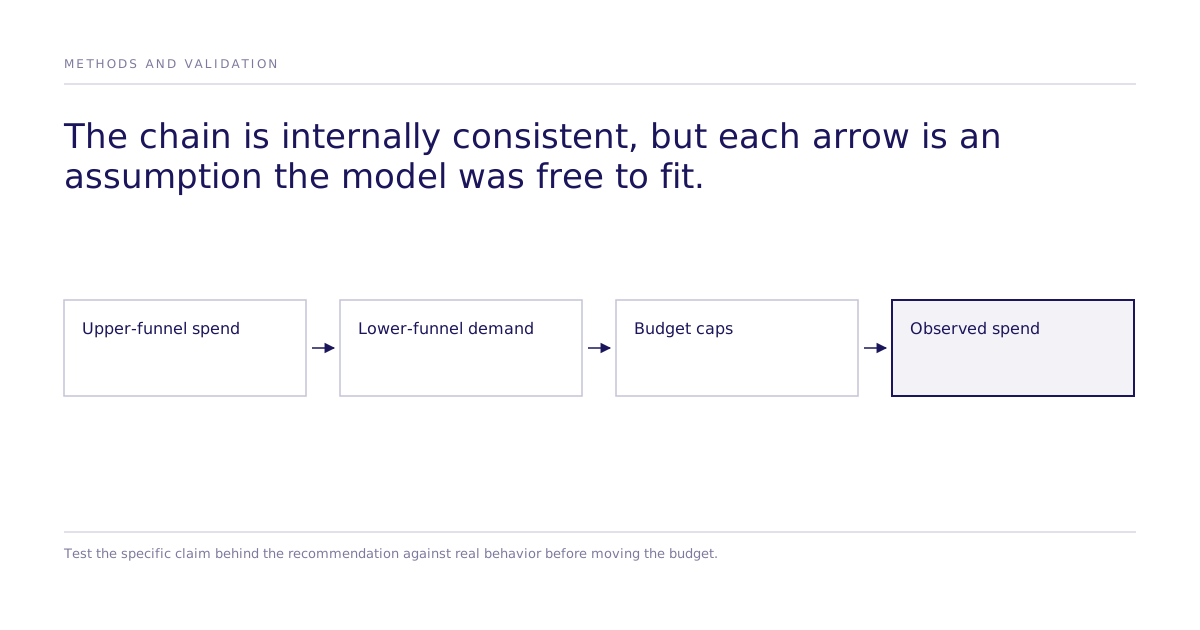
A production Bayesian marketing mix model (MMM) can trace spend through a real funnel: upper-funnel spend shapes lower-funnel demand, demand runs into budget caps, caps shape observed spend, and observed spend produces leads. That chain is a modeling architecture, not a proof. Before a marketing analytics or measurement lead reallocates a multi-million-dollar budget on the model's recommendation, the specific causal claim behind it still needs to be tested against controlled experimental evidence.
The case study behind this pattern
A marketing analytics team building a production MMM for an insurer's marketing budget ran into three problems a strong architecture alone did not solve.
1. Why don't campaigns change effectiveness smoothly?
Real campaigns shift discontinuously: new creative, a new targeting approach, a different concept, so treating channel effectiveness as constant or smoothly trending misrepresents what happened. The team's fix segmented the timeline at known campaign-change dates and gave each segment its own multiplier, constrained by a Dirichlet prior so the multipliers stay identifiable relative shares rather than an unconstrained set that degrades sampler efficiency.
Published accuracy numbers mean little without stating where they fall short. This decomposition did not improve out-of-sample predictive accuracy. It was built anyway, because the question the team needed answered, "did switching to performance creative change ROI, and by how much," is a causal question about a specific decision, not a forecasting benchmark.
2. Why isn't influencer spend one input?
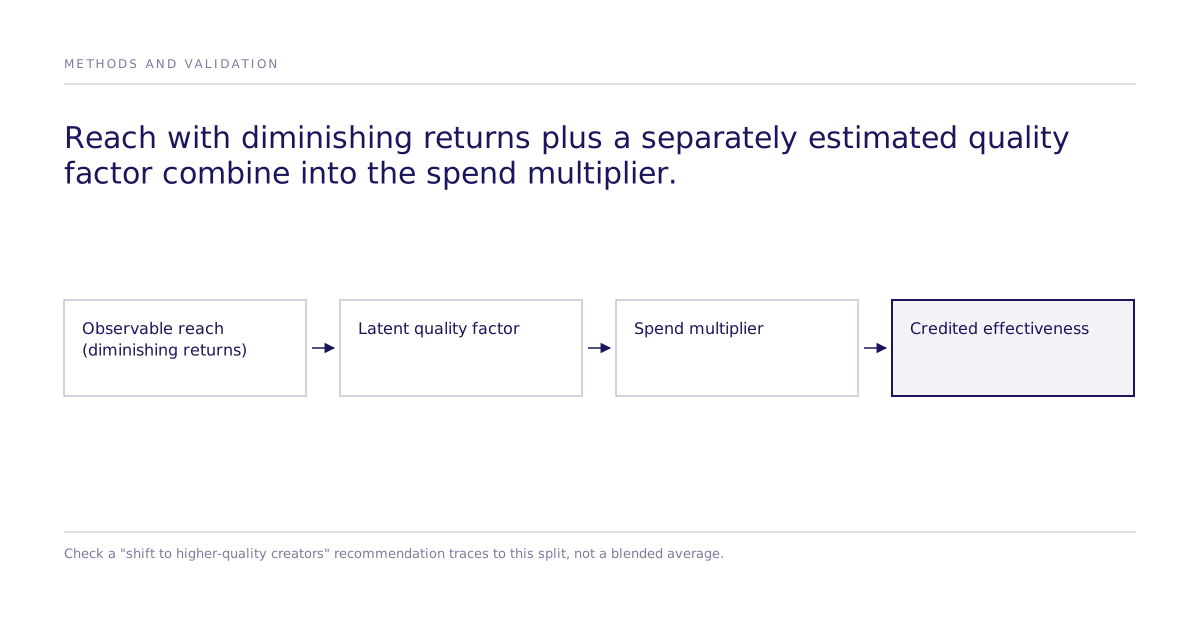
Standard MMM treats a dollar of influencer spend as fungible, but follower counts, audience quality, and conversion rates vary widely between creators. The team split influencer effectiveness into two factors: observable reach, modeled with diminishing returns so a creator with 2 million followers does not get credited with twice the impact of one with 1 million; and a latent quality factor, estimated jointly with the rest of the model, that captures the residual effectiveness a raw follower count misses. The result is a spend multiplier that shifts with whichever mix of creators was actually deployed in a given period.
3. New channels break standard cross-validation
Channels enter mid-series as new platforms launch. Standard time-series cross-validation assumes a fixed feature set across every fold, so a channel with zero spend in an early fold either gets estimated on no signal or gets excluded, changing the model specification fold to fold. The team's time-slice cross-validation excludes any channel with zero training-set spend from that fold only, so each fold's specification matches the information available at that point in the series. A validation number that skips its own limits is a sales pitch. Fold scores are not on a common model and cannot be pooled into a single accuracy figure without qualification, while still using every channel, fully, in the final model trained on all data.
What does the case study report as its outcome?
According to the source case study, the production model's recommendations were adopted into the team's budget planning, and the engagement reports a double-digit reduction in cost per lead alongside continued MMM investment. A result posted without the boundary of where it holds is marketing. Those figures describe that team's reported result on their own data, not a benchmark that transfers to another company's funnel, and they are not a Subconscious claim. Treat them as a planning example, not a guarantee.
Why the chain still needs testing, not just architecture
Every link in that funnel is a structural assumption the model was built to encode. A well-specified MMM makes those assumptions transparent and internally consistent. Naming what a model architecture cannot prove is what lets a buyer test the claim before spending against it. It does not, by itself, prove that a given assumption reflects the true causal mechanism rather than a correlation the model was free to fit.
That gap matters most at the moment a specific recommendation turns into a spending decision: raise the paid search cap, shift budget toward performance creative, concentrate influencer spend on fewer, higher-quality creators. Each of those is a claim about what would happen if the team acted on it. Google's Meridian documentation frames marketing measurement in exactly this causal-inference vocabulary: an MMM's coefficients answer "what would have happened under a different spend pattern," and that answer carries the assumptions built into the model.
Where Subconscious fits, and where it doesn't
Subconscious does not build or replace a Bayesian MMM, and does not do the censored-data handling, the campaign-segmentation modeling, or the cross-validation work described above; that is MMM construction, distinct from what Subconscious tests.
What Subconscious does: once an MMM surfaces a candidate causal driver, a team can design a discrete choice experiment that presents the underlying attribute to the affected buyer segment and estimates how it drives stated choice, as evidence to weigh before committing spend against the driver. Subconscious can then validate that experiment with real human participants, without changing the causal question being tested.
The buyer decision
An MMM's output is a decisive-looking number attached to an uncertain modeling choice. Acting on it directly assumes the model got the causal structure right. Testing the specific claim first, whether this campaign change, this influencer mix, or this budget reallocation actually changes stated choice, is the step that separates a defensible reallocation from a bet on the model.
Before moving budget on an MMM recommendation, that's the question worth answering: has the underlying causal claim been tested, or only modeled? Explore how Subconscious tests causal claims, see related case studies, or book time to walk through a specific MMM output.