When Is a Simulated Behavior Model Trustworthy Enough to Act On?
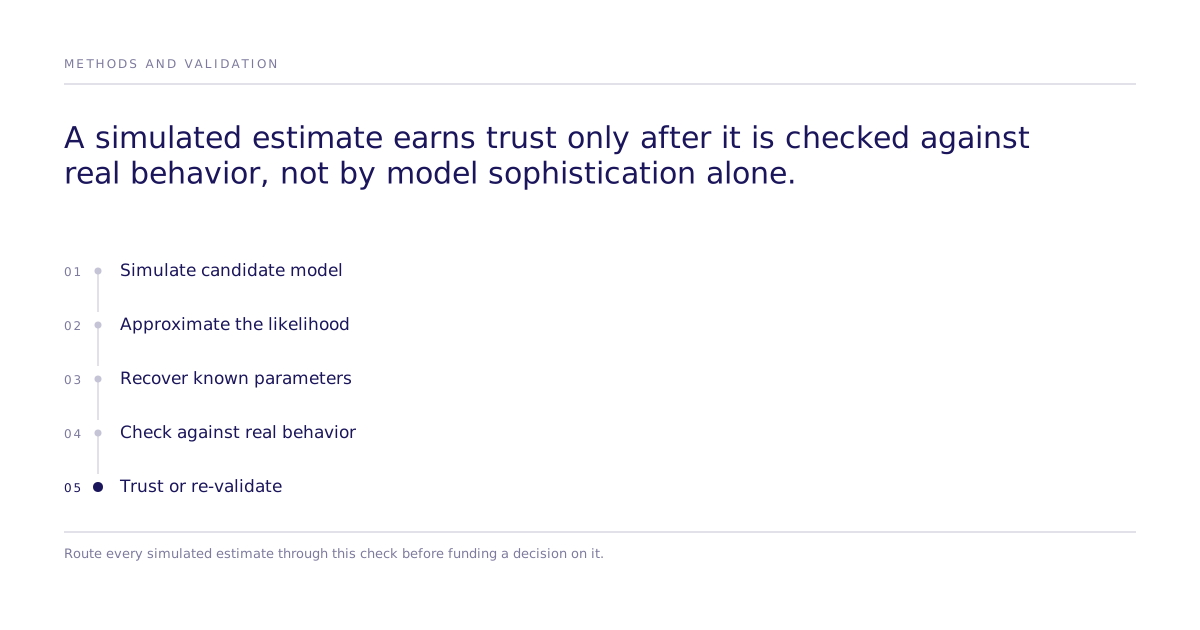
A causal effect estimated from a simulated buyer population is not automatically trustworthy. It becomes trustworthy after someone checks it against real behavior. That check, not the sophistication of the model, is what separates a decision-ready estimate from a plausible-looking artifact.
The decision this answers
A CMO or CSO looking at a launch, pricing, or messaging recommendation built on a simulated population has to decide whether to commit budget to it now or hold it for further validation. Committing before that check risks building a go-to-market decision on a model artifact instead of an actual buyer response.
Why isn't simulation alone proof?
Simulation-based models, whether they describe consumer choice or human cognition, work by approximating a process that is too complex to compute directly. The approximation can look convincing in isolation and still be wrong in ways that only show up when it is tested against data the model has not seen.
Cognitive science research on likelihood approximation networks (LANs) illustrates the standard this way. LANs use a neural network to approximate the likelihood function of a cognitive model, making inference tractable for models that were previously impractical to fit. The published methodology includes parameter recovery: researchers simulate data from known parameter values, run the LAN-based inference procedure, and confirm it recovers those known values before applying the network to real behavioral data (Fengler et al., 2021, eLife). Recovery against known values shows the estimator is self-consistent under the model's own generative assumptions; it does not test correspondence to real behavior.
The same logic applies to causal experiments on simulated markets
Subconscious's causal action testing capability runs discrete-choice-style experiments on simulated populations to estimate which product, pricing, or messaging action is likely to move a target outcome. Structurally, this is a different validation problem than the LAN work: a LAN's approximation error can be checked against a known likelihood, while a simulated respondent population substitutes for the data-generating population itself, so the only check available is real human data.
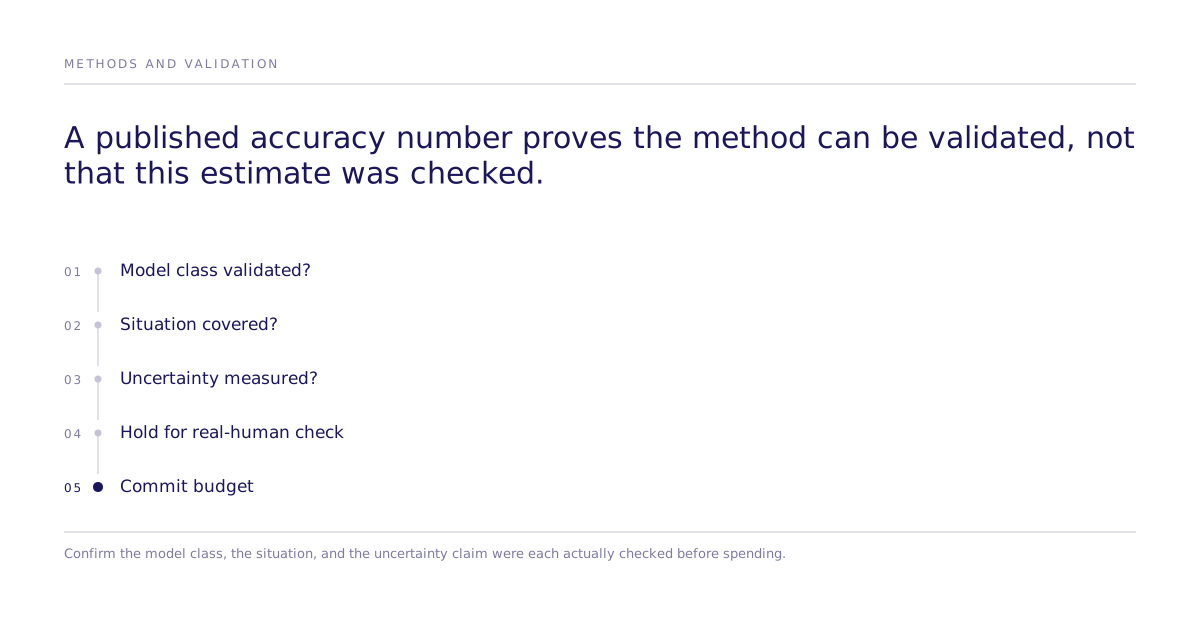
Our best configuration reaches 87% of the measured human ceiling on one study: 0.832 rank correlation against the published human result, where two independent samples of real humans reach 0.959. Across all 43 studies that pass design filters the mean is 0.73. It is a validation result on direction of agreement, not a statement about effect magnitude, price elasticity, or interval calibration, and it is not a guarantee for a new market. It is published in the causal fidelity paper. The number matters less than the fact that it is measured and published at all. A team asking whether to trust a specific simulated estimate should ask the same question a cognitive modeler asks before trusting a LAN: has this class of model been checked against real outcomes, and does that check cover the situation at hand?
What doesn't this validation prove?
The LAN parameter-recovery standard comes from clinical cognitive-modeling research, not marketing or go-to-market decision-making, so its published accuracy figures do not transfer directly to a pricing or launch decision. It is evidence that simulation-based inference can be validated rigorously, not evidence about any specific business outcome.
Uncertainty output is similarly bounded. Confidence intervals and posterior-style uncertainty estimates come out of any fitted discrete-choice model automatically; the caution is not whether an interval exists but whether it is well calibrated and whether the study design generated enough attribute variation to identify the parameter being estimated. An interval from a poorly identified or miscalibrated model is not more trustworthy for being a number.
How do you move from simulation to a real-human check?
The practical move is the same one cognitive modelers already make: run the simulation, then check it against real behavior before treating the result as settled. Subconscious can test or validate studies with real human participants, which lets a team move from a simulated estimate to a real-human check without changing the underlying causal question being asked.
Where to start
Review the replication methodology and current leaderboard before treating any simulated estimate as final, and see how the validation process works end to end before scoping a study that needs a real-human check built in.