8 Procurement Gates for Enterprise AI Audience-Simulation Pilots in 2026
Before an enterprise team lets any AI audience-simulation vendor near a pilot, it should require written answers on eight points, in this order: data residency, a Data Processing Agreement, SSO and role-based access control, an audit trail, vendor stability, evidence behind any accuracy claim, a contract structure built for enterprise use, and a pilot with a benchmark set before results exist. A promising method does not compensate for a failed security or legal review. Discovering a gap after the contract is signed forces a new procurement cycle, stalls the pilot, and costs credibility with the teams that planned around it.
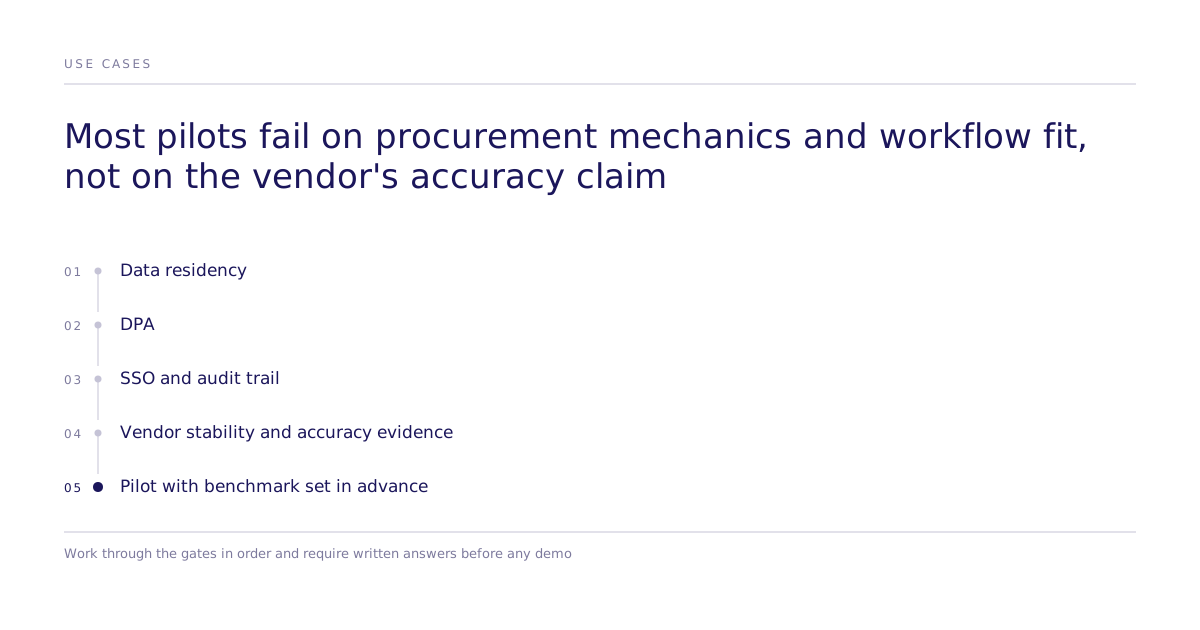
The procurement filter, in order
Most vendors are eliminated on procurement mechanics before anyone evaluates research quality. Work through these eight gates in sequence rather than jumping to a demo.
1. Data residency
Ask where the platform stores study prompts, audience definitions, results, logs, and backups, and which regions and subprocessors touch that data. EU residency is a hard requirement for most buyers under European data-protection law, and a vendor that cannot answer clearly should not advance. A GDPR compliance guide for SaaS vendors walks through the residency and transfer questions procurement teams are expected to ask.
2. A Data Processing Agreement on day one
A standard DPA should be available for review without a multi-week legal back-and-forth. It should name controller and processor roles, retention and deletion terms, subprocessors, and incident-notification duties. A SaaS compliance checklist lists the DPA terms that belong in this review before signature, per Article 28 and Article 32 of the GDPR.
3. SSO and role-based access control
Single sign-on against the buyer's identity provider and role-based access across teams are not optional at enterprise scale. Test provisioning, de-provisioning, and least-privilege roles directly in the vendor's environment rather than accepting a feature name on a slide.
What should an audit trail include?
Every study configuration, every persona or audience definition, and every result should be logged and exportable. Research operations and compliance need a reviewable chain from study setup to result, not a promise that logging exists somewhere in the product.
5. Vendor stability
Ask who owns support, security incident response, business continuity, and data export if the relationship ends. Team size and funding history matter only as inputs to that question, not as a standalone score. A small team can still pass this gate with a documented plan for key-person risk, support coverage, and an exit path.
What evidence backs an accuracy claim?
An accuracy number is only useful once the vendor states what it predicted, against what comparison, and where the method fails. Ask whether the claim describes an aggregate pattern, the direction of an effect, or individual-level behavior, and ask for the benchmark population and holdout procedure that produced it.
What contract structure fits enterprise use?
Pricing and contract terms should match enterprise procurement, not a self-serve plan relabeled for a larger buyer. Confirm the agreement covers the security and legal terms already reviewed in gates one through four, not just seats or usage volume.
8. A pilot with the benchmark set in advance
The pilot should run against a business decision the buyer already owns, with the alternatives, target population, outcome measure, and a defined failure condition written down before the vendor produces a result. This checklist puts a pilot's misses on record next to its hits. A retrospective example can illustrate the method. It cannot substitute for a pre-defined benchmark, and most failed pilots fail on workflow fit rather than on accuracy.
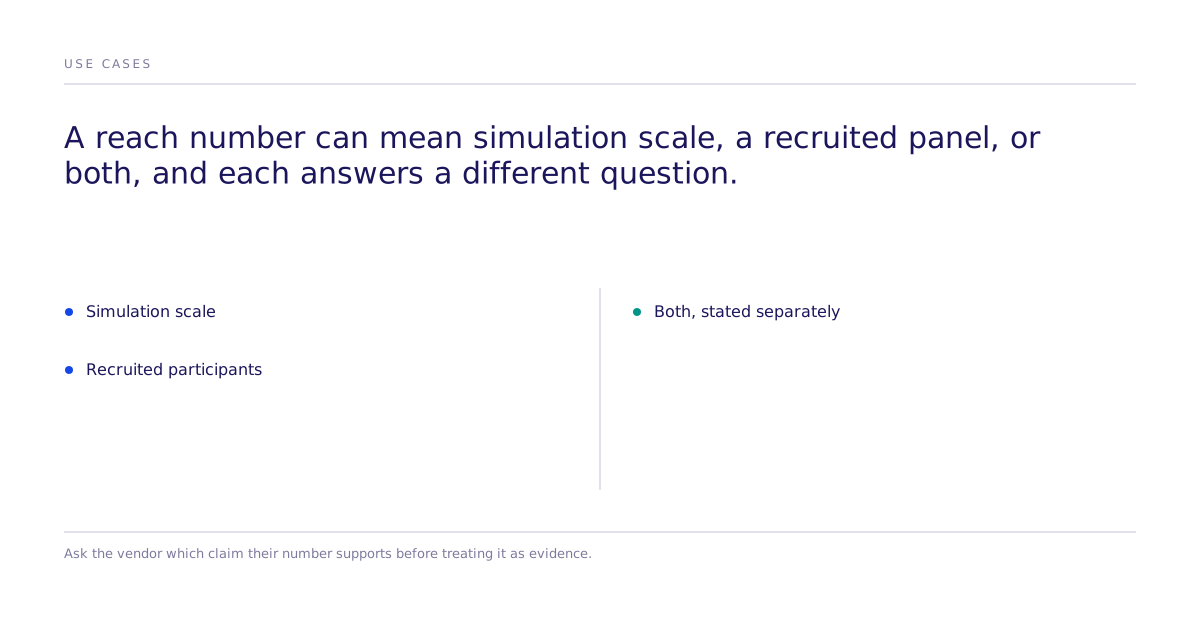
Keep audience reach and recruited participants distinct
A platform's stated reach describes the scale of the simulated population it can draw on, not a pool of people available for interview. Subconscious can run controlled studies against a person-level audience graph covering 800 million real people; that describes simulation scale, not a recruitable panel. When a decision calls for it, Subconscious can also test or validate a study with real human participants, without changing the causal question the study was built to answer. Buyers evaluating any vendor's reach claim should ask the same question: does this number describe simulation scale, recruited participants, or both.
Hold the causal question stable through validation
A pilot is easiest to defend when the team names the action, the alternative it is compared against, the buyer or market population, and the decision outcome before any result exists. If a later real-human study changes any of those four elements, it answers a different question rather than confirming the first one. Subconscious frames its fit as a causal behavioral platform: it structures the experiment around the action and its alternatives, then lets a team move from a simulated experiment to real-human validation without re-defining the question. Buyers can review the research and validation approach and how a study moves through the process before deciding whether that structure fits their pilot.
What this checklist does not prove
Naming a failure mode here is what lets a buyer go check it directly. Passing these eight gates does not confirm that a vendor's DPA, SSO, RBAC, or audit trail work correctly in the buyer's environment, and it replaces neither legal sign-off nor implementation testing. A simulated experiment is not automatic proof of market performance, and aggregate agreement in a benchmark does not establish accuracy at the individual level. Real-human validation does not turn a causal action test into a usability session, a clinical trial, or a field result; the conclusion stays bounded by the audience, alternatives, outcome, and benchmark used in that specific study.
Bring procurement and research into one evaluation
Run procurement and research evaluation together rather than in sequence: the decision, target population, alternatives, outcome measure, and benchmark belong in the same review as the data-residency, DPA, SSO, and audit-trail questions. Once both sides are answered, discuss a specific pilot with Subconscious.