When an Agent Picks Your Vendor, What Should It Be Checking?
A growth or marketing-ops lead used to sit through a vendor bake-off before a tool got near a campaign budget. That step is increasingly gone: an agent reads the task, picks a tool, runs it, and reports the result. Nobody on the team watched the selection happen.
That shift changes what "buyer" means for anyone selling GTM tooling, and what a VP of product or growth needs to demand before letting an agent commit budget, creative, or pricing on its own.
Agents pick tools the way a database picks an index
An agent choosing a vendor doesn't evaluate the way a person does. It doesn't read a homepage, watch a demo, or weigh a sales conversation. It reads a machine-readable description of what a tool does and decides, in one step, whether to call it.
The connective layer behind most of this is the Model Context Protocol, an open specification published by Anthropic that lets an agent discover a tool's capabilities and call it directly, without a person wiring up a custom integration. Model providers, coding tools, and agent frameworks have widely adopted it, so a growing share of vendor choices now route through a machine-to-machine handshake instead of a browser tab.
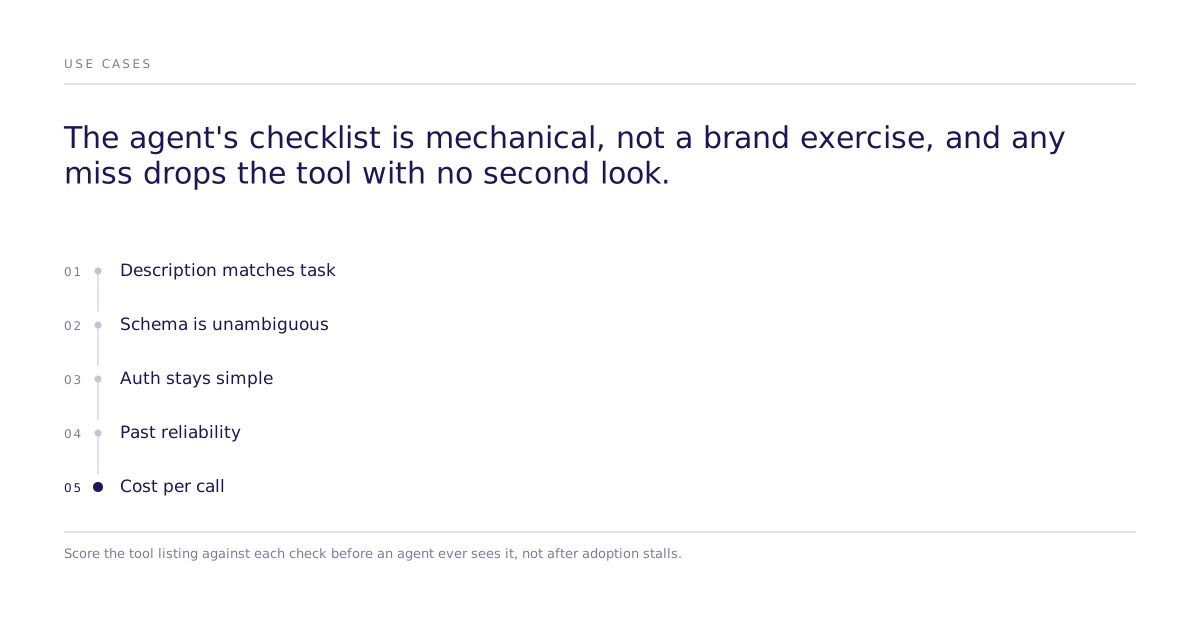
What an agent weighs before it calls a tool is narrower and more mechanical than what a person weighs:
- Does the description match the task. A vague or generic description gets skipped for one that names the exact job.
- Is the input and output schema unambiguous. An agent that has to guess a parameter's meaning picks the tool where it doesn't.
- Does authentication stay simple. A tool reachable with a plain API key wins over one needing a multi-step login flow, when the agent has a choice.
- Has the tool been reliable before. Past failures, timeouts, and errors get weighed against it the next time.
- What does a call cost. For usage-priced tools, an agent weighs cost per call the same way it weighs fit.
None of that list is a brand exercise.
Why is the vendor review window so much shorter now?
The old evaluation sequence, awareness, consideration, trial, purchase, gave a human days or weeks to catch a bad fit before it became a live campaign. An agent collapses that sequence into a single tool call. If the match isn't obvious on the first pass, there's no second look in that session.
The missing review step is the real risk, not the automation. An agent that selects a tool can also commit a budget line, creative, or a price change in the same workflow. Remove the human checkpoint without replacing it, and a bad message, a mispriced offer, or an off-target audience choice moves forward unreviewed.
How does marketing work move through an agent pipeline?
Marketing teams already run agents through a multi-step loop: generate creative variants, test them against a panel or a live split, pick a winner from the combined read, and push it out through connected ad and orchestration platforms. Every stage in that loop is itself a tool an agent has to find and call. The person setting strategy for the quarter isn't clicking through vendor comparisons; they're deciding which stages get a human check and which run unattended.
That's the decision in front of a VP of product, growth, or marketing ops: not whether to let agents touch GTM work, but where in that pipeline a claim needs evidence before it's allowed to spend money.
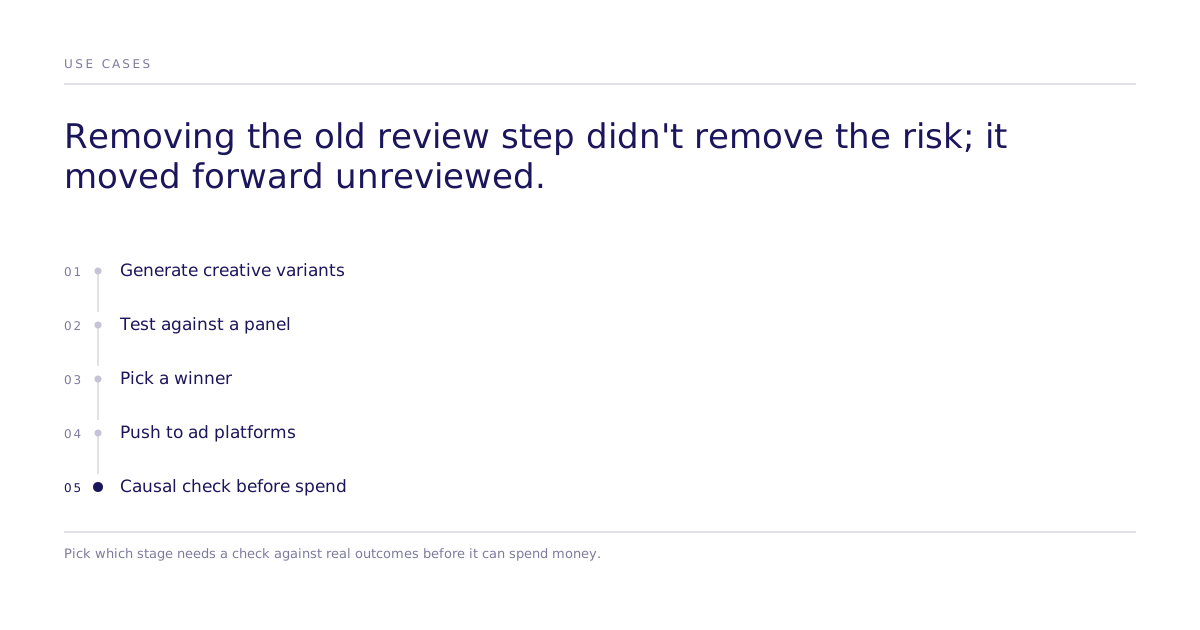
Where a causal check belongs in an agent-run loop
Subconscious is a causal behavioral platform. It runs controlled experiments against simulated audiences to estimate which product, pricing, message, or launch action is most likely to move real behavior before it ships. In an agent-run marketing loop, that's the role worth protecting: a check run against a candidate action before it goes live, rather than a claim that gets acted on because it pattern-matched well against past results.
The standard for that check should be the one any evidence source is held to: does it hold up against real outcomes, not just its own backtest. Our best configuration reaches 87% of the measured human ceiling on one study: 0.832 rank correlation against the published human result, where two independent samples of real humans reach 0.959. Across all 43 studies that pass design filters the mean is 0.73. See the causal fidelity paper for how that figure is measured. It is a validation result, not a guarantee for a new market. Subconscious can also move a finding from a simulated read to a real-human validation step without changing the underlying question being tested. Read more about the research behind the method, and see how the process runs.
Subconscious isn't positioned as a tool an agent discovers and calls on its own; it's the evidence layer a team, or the agent acting for it, checks before an agent-picked action is allowed to spend.
What a checkpoint can't skip
Naming these conditions up front is what lets a buyer check the work before spend goes out. A causal check only holds up if a few conditions stay true across the pipeline. The question being tested has to stay specific: a vague brief produces a vague read. The simulated result still has to answer the same causal question a real-human check would ask, so moving to validation doesn't quietly change what's being measured. And a synthetic result predicting behavior isn't the same claim as a clinical outcome or a guarantee of market performance; it's a causal estimate with a stated confidence range, and should be read as one.
Next step
Deciding where a checkpoint belongs in an agent-run GTM pipeline is easier before an agent has shipped a decision than after. See how a demo walkthrough maps that checkpoint against your own launch process.