Why Churned Customers Leave, and Which Fix to Test First
Customers leave for reasons usage data alone cannot name, so the fix to test first is the one a causal test confirms actually changes the outcome for that specific at-risk segment. A retention lead staring at a churn dashboard already has the number. What's missing is the reason, and which fix to try on the next at-risk cohort before it cancels too. A dropdown reason on a cancellation form offers a guess, not a story, so a team ends up choosing a discount or an onboarding tweak without knowing whether it targets the actual problem.
The gap between a churn score and a churn reason
Most retention stacks carry two kinds of data. Product usage signals, declining logins, unused features, a rising support-ticket count, a missed payment, say who is likely to leave and roughly when. They stop short of explaining why. A cancellation form tries to close that gap with a short list of preset reasons: too expensive, didn't use it enough, found something else. "Too expensive" could mean the sticker price is out of budget, the product never proved its value, or a competitor simply undercut on price.
Getting that detail from someone who has already canceled is hard by design. Once a customer is gone, they have little reason to explain themselves, and response rates on post-cancellation and lapsed-customer surveys run low (Improve Survey Response Rate: 25 Proven Ways That Work; The low survey response rate crisis: 2025 guide for CX & insights leaders). The few who do respond tend to be the most frustrated or the most agreeable, neither of whom speaks for the larger group that just quietly stopped logging in.
| Data source | What it tells you | What it leaves out |
|---|---|---|
| Usage and support data | Who is at risk, and roughly when | The reason behind the drop |
| Cancellation-form reason | A category picked from a short list | Which specific problem sits behind that category |
| Both combined | A ranked list of at-risk accounts | Which retention action actually changes the outcome |
Turn a guess into a test
Guessing at the reason behind a cancellation and guessing at the fix are two separate failure points, and most retention programs only try to close the first one. The next step treats retention like a pricing or messaging decision: name the specific action under consideration, a discount, a rebuilt onboarding step, a rewritten cancellation-flow message, and test it against the segment it's meant for before it ships to every account.
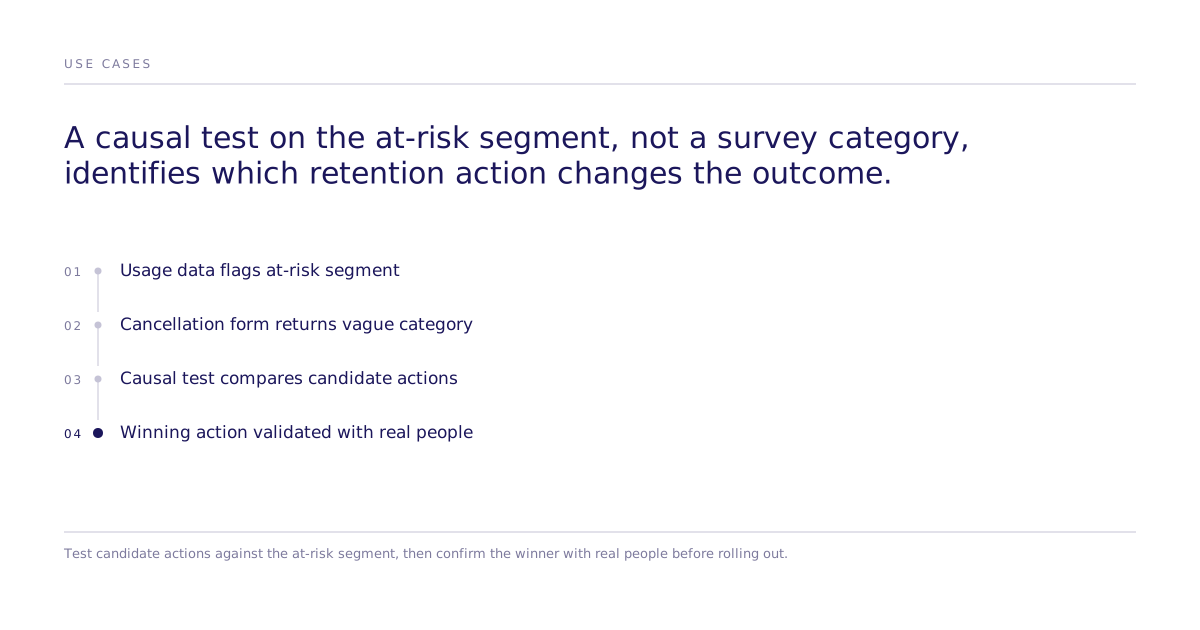
Subconscious runs that step as a controlled experiment rather than an open-ended conversation. A team defines an at-risk segment from its own usage and support data, then puts two or three candidate retention actions in front of that segment in a causal test, with a confidence interval attached instead of a single plausible-sounding guess. The output names the action that moves the outcome, not a sentiment read on how the group feels about canceling.
Will one offer fit every segment?
The reason behind a cancellation rarely stays constant across a customer base. An enterprise account is more likely to leave over a missing integration; a self-serve account, over price; a casual account, because it never became a habit. A single retention offer tested once against the whole customer base hides that split and usually gets tuned to whichever segment is loudest, not whichever segment is largest or most valuable.
The fix is to test segment by segment instead of company-wide. Start with the highest-risk segment's own candidate action, repeat the same test for the next segment, and expect the winning action to differ each time. A discount that saves a price-sensitive self-serve account will not do much for an enterprise account walking away over a missing feature.
Why confirm the winner before it becomes the default?
A retention action that tests well in a simulated study still carries risk once it reaches every renewal on a segment. Subconscious can move a study from a simulated test to validation with real people without changing the underlying causal question, so a team can compare the simulated read against a real one before committing budget broadly. How that comparison has played out on other decisions, in prior studies, helps calibrate how much weight to put on a simulated result alone.
What does this not replace?
This isn't an open-ended, roleplayed conversation standing in for a canceled customer, and it doesn't hand back an automatic, segment-by-segment substitution or cannibalization breakdown; that output needs a study designed for it specifically, with uncertainty bounds attached only where the design supports them. This is a decision-specific causal test aimed at one retention action and one segment, not a churn-prediction engine or a packaged interview product. The score that flagged the segment still comes from your own usage and support data; the causal test only judges which candidate action changes the outcome once that segment is defined.
Where to start
Pick one segment your team already tracks and one candidate action, a discount, an onboarding fix, or new cancellation-flow copy, and test that action instead of guessing at it. Book a walkthrough or read how a study gets built before the next churn cohort repeats the same unanswered question.