AI Mind Clone Platforms in 2026: An Evaluation Framework
AI mind clone platforms cover named-expert replicas, customer personas, synthetic respondents, audience twins, and consumer characters. Choose among them by what grounds the representation, whether state persists, and which tests the platform supports.
Subconscious can compare generated responses or choices to defined actions in a configured audience. A study output does not establish that a persistent representation of a named person is available; ask for the actual data, configuration, and supported task.
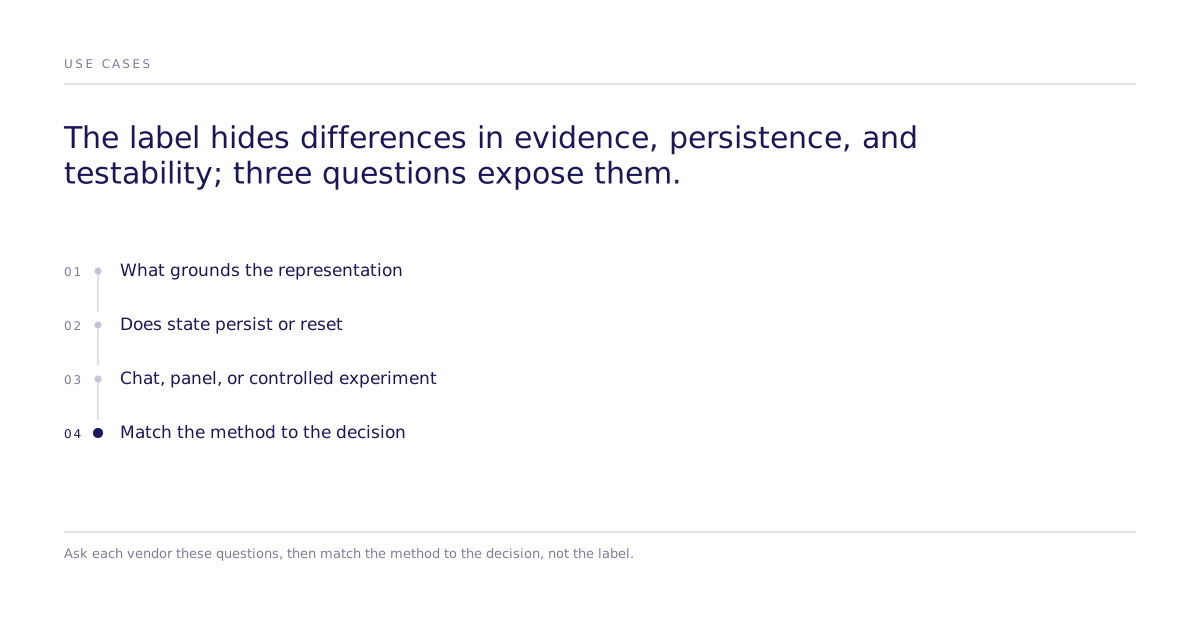
Three questions to ask
What grounds the representation?
A demographic prompt is not enough. Ask which data defines the audience, how assumptions are documented, and whether the representation is calibrated against relevant human evidence. Require a named benchmark, metric, comparison group, and evaluation scope before using any vendor accuracy claim in procurement.
Does state persist?
Some tools preserve conversation history and update a representation over time. Others generate a fresh response for each prompt. Persistence may matter for coaching or entertainment, but it can also introduce drift and make controlled comparison harder.
What can the team test?
Direct conversation supports exploratory interviews. Panels can compare representations. An intervention question requires assigned alternatives, a defined outcome, and an estimation method. Ask whether validation evaluates that same outcome and audience; Subconscious’s public research evaluates rank agreement on estimated choice parameters, which does not establish fidelity for a new mind-clone use case.
Common platform types
Named-expert tools such as Delphi focus on querying a representation of a person. Character.ai focuses on entertainment and roleplay. Synthetic Users focuses on product research. Electric Twin describes synthetic audiences, while Aaru emphasizes population simulation. Check current documentation for grounding, refresh frequency, and supported experiments rather than inferring capability from the product label.
A self-serve chat interface is not equivalent to statistical population simulation, and neither is automatically a causal experiment.
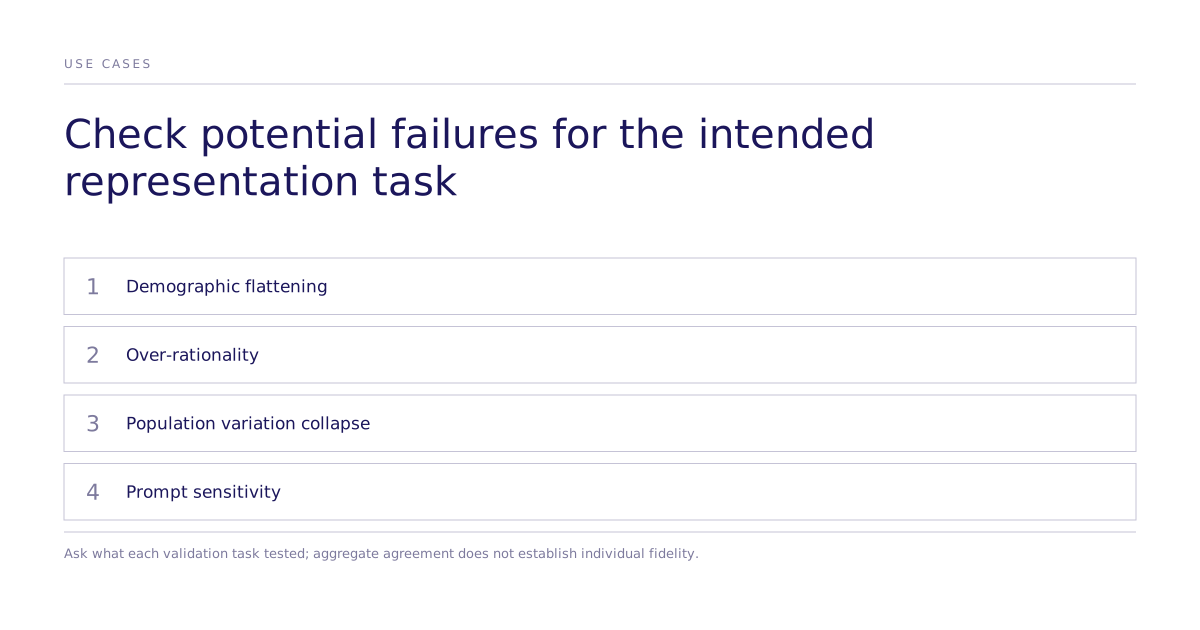
Evaluate proof before features
A market hypothesis for the next 12 to 18 months: continuous refresh, validation transparency, and native integration will become more important. It is not a product guarantee.
Ask the vendor to define the simulated unit, human baseline, validation task, and known limits. Check population variation, prompt sensitivity, and fidelity for the intended task separately; aggregate agreement does not establish individual correspondence.
Choose the method from the decision and evidence needed. For Subconscious, scope the alternatives, modeled endpoint, and relevant human check. Review applied case examples for context rather than treating every example as validation of a mind-clone use case.