AI Persona Panels: What They Are and When to Trust Them
An AI persona panel is a set of grounded synthetic personas built from demographic and psychographic detail, queried through a language model, and used to test a question before a team commits budget to fielded research. The persona is not a live capability that replaces real people. It is a controlled first pass that tells a team which questions are worth escalating.
The decision this page answers: when should a research or marketing lead trust a synthetic-panel read on its own, and when does the same question need a real-human validation step before it drives a launch, pricing, or messaging call?
Why isn't a synthetic panel just a stateless prompt?
Asking a language model to "imagine you are a 42-year-old marketing director" produces a stateless, surface-level answer with no way to check whether it represents the segment a team cares about. A grounded persona differs in three ways:
Grounding depth. The persona carries a consistent professional history, category-specific knowledge, and behavioral pattern, not a one-line demographic tag.
Internal consistency. Values, priorities, and decision style stay coherent, part of a stored backstory rather than reinvented on each query.
Panel structure. Many personas queried together produce segment cross-tabs and aggregate distributions instead of one isolated answer.
Questions suited to synthetic triage
Useful for an early read before a team commits to a consequential market decision:
| Team | What synthetic triage tests |
|---|---|
| Marketing | Headlines, concepts, and campaign variants across markets before a launch spend commits. |
| Product | Feature-reaction tests and workflow-disruption pre-mortems ahead of a build decision. |
| Sales | Buyer objections by role on a buying committee to sharpen a pitch before the call. |
| Research | Which questions are worth a fielded study, rather than rationing every question by budget. |
| Brand | Attribute-level perception between fielded tracker waves, so a shift gets caught early instead of at the next scheduled wave. |
Questions that must leave the synthetic layer
- Sensory testing is out of reach: a language model has no channel for taste, smell, touch, or fit.
- Fully novel categories strain the grounding. A category with no public precedent gives the model nothing to condition on, and reliability drops.
- Precise purchase-rate prediction is unreliable. A synthetic panel is a reasonable guide to which of two segments responds more, and a poor guide to an absolute conversion number.
- Regulatory and legal substantiation stays out of scope. Synthetic data does not satisfy marketing-claim substantiation or formal research deliverables in most jurisdictions.
- Recent events past a model's training window return a guess, not the audience's real reaction.
- Minority-opinion tails compress toward the average, harder to surface synthetically than through well-recruited human research.
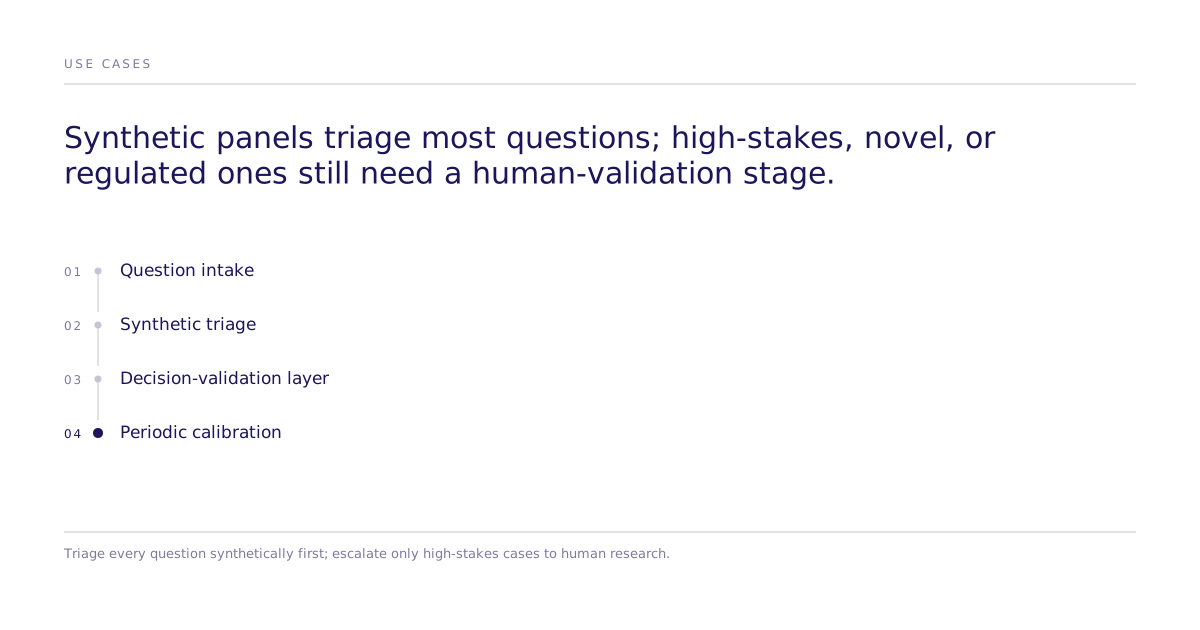
A four-stage path from question to evidence
Teams that get the most out of synthetic testing use it as a triage layer, not a replacement:
- Question intake. Every research question enters the stack here, before a channel is chosen.
- Synthetic triage. Run the question through a persona panel first. Most questions get answered at this resolution.
- Decision-validation layer. The small set of high-stakes, novel, or regulated questions per quarter go to real-human research, briefed sharper because the synthetic pass already did the triage.
- Periodic calibration. Run a real-human study alongside a synthetic panel on the same question once or twice a year, and adjust the synthetic setup if the two have drifted apart.
Skipping the decision-validation layer on a high-stakes call is the failure mode this stack exists to prevent: a pricing, message, or launch decision that looks confirmed synthetically but does not hold once real buyers respond. A 2024 Political Analysis study on simulating human samples with language models found the same pattern from the research side: language-model samples can track certain human response distributions but should not be treated as a substitute for the underlying population without checking that fit.
How do you keep the causal question intact during validation?
Subconscious runs controlled, discrete-choice-style experiments that estimate which tested action moves which outcome, rather than open-ended persona chat. It draws on a person-level audience graph covering 800 million real people, a modeled reach figure distinct from a recruitable panel of consenting participants. When a question clears the triage layer and needs the decision-validation step, Subconscious moves the same causal question to fielded participants instead of switching to a different method.
What checks should a team make before it acts?
Confidence intervals, segment-heterogeneity breakdowns, and full decision memos are not standard on every study; treat them as something to confirm for the specific study a team is planning. Pricing optimization, substitution and cannibalization matrices, and full catalog simulation sit on the roadmap rather than as a live, ready-to-use capability today.
Start with one live decision
Pick one real, current question a team is already wrestling with. Build a small panel calibrated to the audience the question is about. Compare the panel's answer to what the team would have predicted: a meaningful gap is a signal worth digging into, and a match is a useful confirmation of the team's existing read. From there, route only the questions that clear the triage bar (high stakes, novel behavior, or regulatory exposure) into a real-human validation study, and keep the rest at the synthetic layer.
Teams weighing this decision in more detail can see how the stack plays out in the Subconscious case studies, review the research program, or book time to scope a study.