Analytics, Tracking, or a Controlled Experiment: Picking the Right Target-Group Research Instrument in 2026
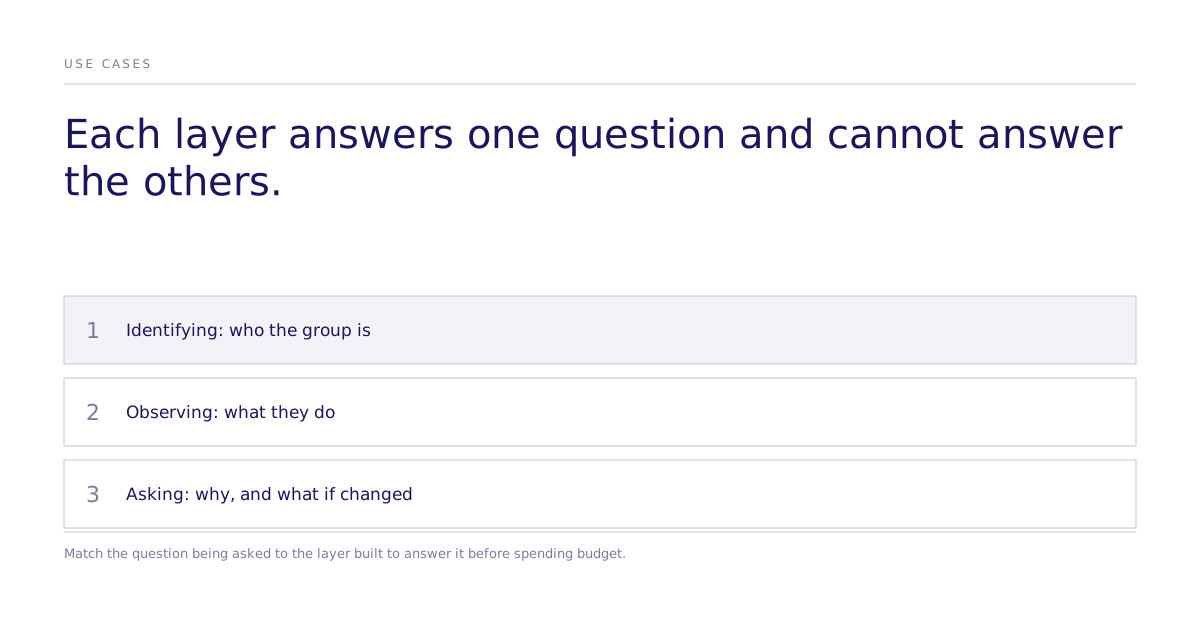
There is no single best tool for target-group research. There are three different questions, and each needs a different instrument. Analytics tools tell you who your audience is. Tracking tools tell you what they do. Only a controlled experiment tells you why, or what they would do if you changed the price, the message, or the concept in front of them.
Picking the wrong instrument is expensive in a specific way: teams spend research budget and fieldwork weeks answering a question the method was never built to answer, then discover the result cannot support the decision it was meant to inform.
Three layers, three different questions
Target-group research splits into three functional layers. Confusing them is the most common way research budget gets wasted.
| Layer | Question it answers | What it can't answer |
|---|---|---|
| Identifying | Who is the target group? | Why they prefer one option over another |
| Observing | What is the target group doing? | Why non-converting visitors leave, or what non-visitors want |
| Asking | Why does the target group behave this way? | Population-scale statistical proof for a regulator or auditor |
Identifying-layer tools work from search behavior, competitor traffic, and audience-overlap data to draw the demographic and psychographic boundaries of a market. Observing-layer tools track how real visitors interact with an existing site or product, which is useful for understanding current customers but silent on people who never showed up. Neither layer can tell you how a target group would react to a concept, a price, or a message it has never seen. That is the asking layer's job.
The asking layer has a speed problem and a validity problem
Recruiting a human panel for every question is slow: fielding a study can take three to four weeks and cost real money before a single answer comes back. That cost pushes teams toward two bad habits: skipping research on decisions that deserve it, or running one broad study and stretching its answer to cover questions it was never designed for.
The newer failure mode runs the other direction. Simulated research tools can return a directional read in minutes, but a fluent, plausible-sounding response from a generated respondent is not the same thing as evidence that a real market would behave that way under a specific alternative. Qualtrics's overview of synthetic data in market research is a useful primer on where synthetic methods help and where they still need a human check.
What Does a Controlled Experiment Add That a Directional Read Doesn't?
Subconscious runs a discrete-choice experiment: it compares defined alternatives, such as competing messages, prices, or concepts, across a defined population, and returns a measured causal effect with a confidence interval, not a paragraph of generated opinion. A directional read tells a team a concept felt more appealing. A causal effect tells a team how much more likely a defined population was to choose it over the alternative, and how much uncertainty is attached to that estimate. Marketbridge's case for a hybrid research approach makes a similar argument for pairing fast simulated methods with the rigor a real decision requires.
For teams that want to see how Subconscious structures and validates these experiments, the replication leaderboard documents the method and tracks how estimates hold up against real outcomes.
Where Isn't a Controlled Experiment the Right Instrument?
A controlled experiment does not replace an analytics platform or on-site behavioral tracking. It cannot tell a team who is visiting a website right now or where they came from; that is still the identifying and observing layers' job.
Naming this limit is what lets a buyer check whether the method fits a regulatory or audit need before they rely on it: it also does not produce population-scale market sizing or the kind of statistical proof a regulator or auditor requires. If a claim must hold up to outside scrutiny with a precise figure, say, 34 percent of a population sharing a given view, the number has to come from a study built and fielded for that purpose, typically with recruited human participants.
The leaderboard puts misses next to hits in public, and this is one of the miss conditions worth stating outright: it is weakest on behavior with no real-world precedent. A method built on historical patterns and existing data will lag a genuinely novel product category, an unprecedented event, or a group underrepresented in the data it draws on.
Screening before you field: a workflow, not a single tool
The instruments are complementary, not competing, and the sequence matters more than any single choice:
- Use identifying and observing tools to define the target group and see how current visitors already behave.
- Use a controlled experiment to screen hypotheses before committing fieldwork budget: which concept, message, or price is worth testing further.
- Refine the research instrument itself. A simulated pass on draft questions surfaces confusing phrasing or missing options before they reach a real panel.
- For high-stakes calls, such as a multi-million-euro media buy, a final price, or a regulatory submission, move to recruited human participants. Subconscious can validate a study with real participants without changing the underlying causal question. Because the earlier steps already narrowed the field, that human study is smaller, more targeted, and more defensible than one built from a cold start.
Audience reach and recruited participation are two different things worth keeping separate. Subconscious can run controlled studies against a person-level audience graph covering 800 million real people; that scale describes who a study can reach, not a promise that 800 million people are personally recruited and interviewed.
How Do You Choose the Instrument for the Decision in Front of You?
The practical rule: match the instrument to the question, not to whichever tool is fastest to open. If the question is who the audience is, use identifying tools. If it's what they're already doing, use observing tools. If it's why they'd choose one option over another, or what would change that choice, that's a controlled experiment. Save recruited human participants for the calls where the cost of being wrong, or the need for outside-defensible proof, is highest.
To see how this fits into a live research process, /how-we-work walks through the setup, and a demo is the next step for teams ready to test a specific decision.