Cost-Plus or Value: How to Stress-Test a Price Before You Lock It In
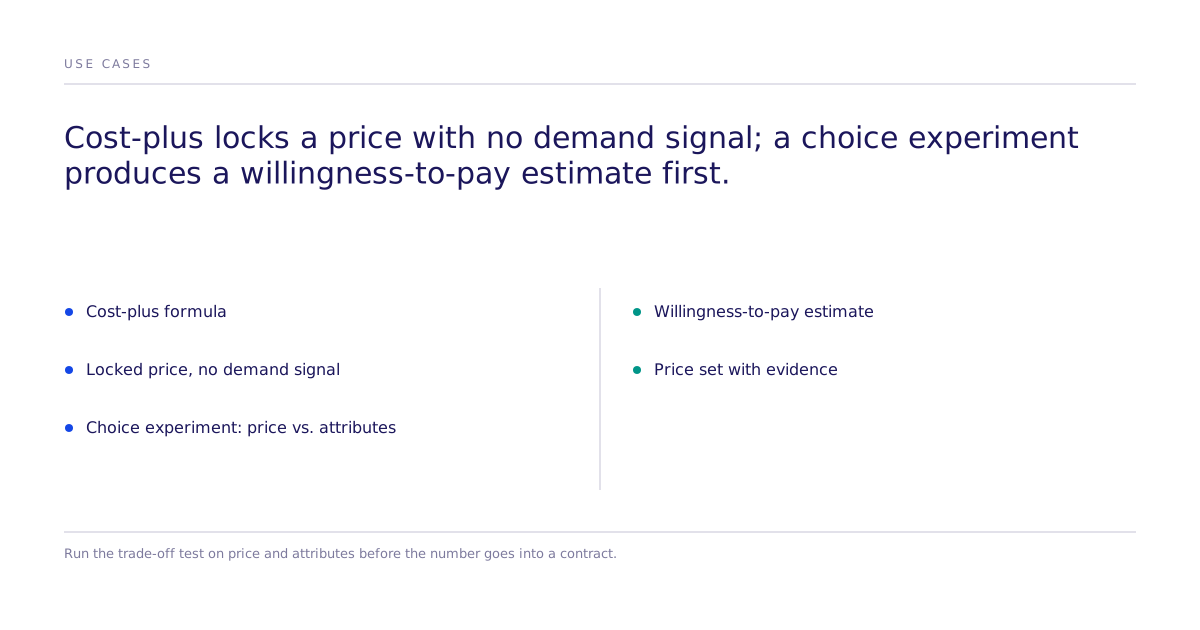
Founders setting price for the first time usually reach for the same shortcut: add up costs, tack on a margin, call it a rate card. That answers what this costs to deliver, and skips what a customer will pay rather than walk away.
Underpricing on a cost-plus basis gives away revenue on every contract signed at that number, and the loss compounds for as long as the contract runs. Overpricing without evidence risks losing winnable deals to a competitor the buyer never compares you against. Either mistake is expensive because price is hard to walk back once existing customers are anchored to it.
Why does cost-plus hide the number that matters?
Cost-plus pricing treats the customer as a passive recipient of a formula. It never asks what the customer is actually trading off: price against turnaround, price against a feature, price against the risk of switching providers.
The standard method for recovering that trade-off is a discrete choice experiment (DCE): present respondents with choices that vary price alongside other attributes, and estimate willingness-to-pay from what they pick, rather than inferring it from cost math or anecdote, as documented in the peer-reviewed literature on discrete cost and random-coefficient willingness-to-pay estimation (Health Economics Review).
What does a price stress-test look like in practice?
A pricing decision becomes testable once it can be stated as a choice: which combination of price and feature set does the customer actually prefer, and by how much does demand shift as price moves.
| Question you're answering | What cost-plus tells you | What a discrete choice experiment tells you |
|---|---|---|
| Is the price too low? | Nothing, cost-plus has no reference to demand | Willingness-to-pay estimated from real trade-offs against other attributes |
| What happens if I raise price? | Unknown until it's tried on real customers | Modeled shift in choice share before committing |
| Which feature justifies a premium? | Not addressed | Isolated from the same choice data, alongside price |
Subconscious runs this kind of test as a randomized experiment: respondents see controlled variations in price and other attributes that matter, and the resulting choices are the evidence, not a guess dressed up as a formula.
What is this test, and what is it not?
A discrete choice experiment requires a defined respondent sample and a designed choice task. It is a structured survey experiment, not a live back-and-forth with a simulated persona, and runs on a study cycle rather than producing an instant answer. Treat the output as evidence for the pricing decision in front of you, not a guarantee about how any one customer will behave.
Subconscious can also validate the same study with real human participants once the simulated result narrows the decision, without changing the underlying causal question. That step matters when the pricing decision is large enough to warrant a second, independent confirmation before it goes into a contract.
Before the rate card is final
If the pricing decision has enough on the line, run the trade-off before the number goes into a contract. Review case studies on how this method has been applied, or book time to talk through the attributes worth testing for a given price point. For teams building the test internally, how Subconscious works covers the mechanics of setting one up.