How B2B SaaS Teams Test Product and Pricing Decisions Before Recruitment Finishes
B2B SaaS teams under-research their buying committees, then ship positioning, pricing, and roadmap decisions built on assumptions. Causal experiments on a simulated market close that gap without waiting on a recruitment cycle the buying committee will never sit through.
Why B2B SaaS Teams Under-Research Their Buyers
The reasons are structural, not cultural: three constraints keep teams from getting customer evidence on a useful timeline.
Why Is Enterprise Buyer Recruitment Hard?
Most B2B SaaS products sell into a narrow, specific audience: a head of marketing at a mid-market company, a VP of engineering at a Series B startup, a CFO at a company with 200 to 500 employees. These roles are busy, do not sit on research panels, and ignore cold outreach. Incentives that work for consumer research, such as €50 gift cards, are irrelevant to someone earning €150k or more.
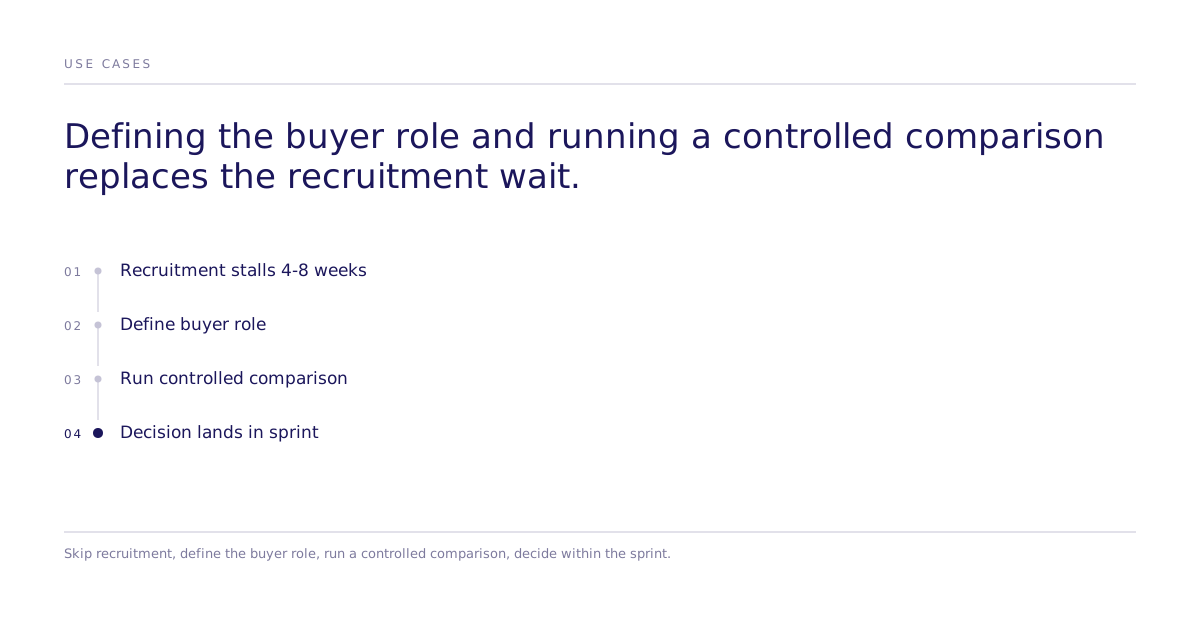
A typical B2B research study needs 12 to 20 interviews. Finding that many qualified participants runs 4 to 8 weeks, and recruitment fees alone add up to €5,000 to €15,000 (Drive Research's 2026 market research cost guide).
Subconscious can define a target population against a person-level audience graph covering 800 million real people. That reach supports precise population definition; it does not mean 800 million people are available as recruited study participants.
Why Do Small Customer Bases Limit Access?
A SaaS product with 200 paying customers has a shallow pool to draw from. Interviewing 15 of them means talking to 7.5% of the entire customer base, and it burns goodwill for 6 to 12 months before most of those customers will agree to another interview.
Why Doesn't Research Fit Sprint Cycles?
Product teams work in two-week sprints, but traditional research needs 6 to 8 weeks to finish. Findings tend to land after the team has already shipped the feature, moved to the next priority, or changed direction.
The Decisions That Stay Unanswered
Despite the difficulty, B2B SaaS teams carry research questions that directly affect revenue, retention, and growth:
- Positioning and messaging. Does the value proposition land the same way with a VP of sales as with a head of marketing? Which objections differ between enterprise and mid-market buyers?
- Feature prioritization. Which features matter most to which segment, and where do user requests and buyer value diverge?
- Competitive positioning. How do target buyers weigh the company against alternatives, and what triggers a switch?
- Pricing and packaging. How do segments react to a pricing structure change, and where is the actual value gap?
- Expansion and churn. What causes an account to expand usage, and what precedes churn?
Most teams answer these with internal opinion rather than buyer evidence, because traditional recruitment costs too much relative to a two-week sprint.
Where Causal Experiments Fit B2B Product Research
Subconscious is a causal behavioral platform: it runs controlled experiments on a simulation of the market, validated against real human behavior, to estimate which action changes a buyer's decision. For B2B SaaS, that means comparing product, pricing, messaging, and go-to-market actions across defined buyer and user roles before committing roadmap capacity or sales effort to one of them.
Define buyer roles with real depth
B2B decisions depend on role, not just demographic. A useful buyer definition for this kind of test includes:
| Dimension | Example |
|---|---|
| Role and seniority | Engineering VP, roughly 150 employees at the company |
| Context | Owns infrastructure and developer productivity for a 20-person team |
| Goals and metrics | Cut deployment frequency from weekly to daily, reduce incident response time |
| Constraints | Limited budget, must justify ROI to the CFO, inherited legacy stack |
| Decision process | Runs on a 60-day trial; needs sign-off from 3 team leads, then the CEO approves |
| Beliefs | Skeptical of vendor claims, prefers open source, weighs community reputation |
This level of detail is what lets a comparison across roles reflect an actual B2B buying committee rather than a single generic response.
Run controlled comparisons for specific decisions
- Positioning. Present the value proposition to 5 buyer roles and compare what each understood, what was compelling, and whether it produced a next step.
- Feature prioritization. Compare reactions to 3 candidate features and follow up on the reasoning behind the ranking.
- Competitive reaction. Test how a competitor's announcement shifts perceived buying criteria.
- Pricing. Compare 2 pricing structures and estimate which one a role would advocate for internally, including anticipated objections.
Iterate inside the sprint, not around it
The advantage isn't raw speed. It's fitting a controlled comparison inside the same two-week sprint where the decision is being made, instead of waiting 6 to 8 weeks for interview findings to arrive after the decision has shipped. A team can test a positioning variant before a standup or compare pricing reactions across segments before a pricing meeting.
Where Real Buyer Contact Still Matters
A causal action test does not replace every form of customer research for B2B SaaS. It works best paired with real buyer contact.
Use a simulated comparison for:
- Testing whether a hypothesis is worth a full research investment.
- Comparing how the same message lands across 5 defined buyer roles without recruiting 5 separate cohorts.
- Testing reactions to a hypothetical competitive or market change.
- Exploring the question space before designing a quantitative survey.
Use real buyer contact for:
- Building the relationship and trust that a controlled experiment cannot substitute for.
- Emotional discovery: how a buyer feels about a problem, not only how they reason about it.
- Validating a high-risk decision, such as a major price change or market pivot, before it ships.
- Surfacing the unexpected finding a real conversation produces and a controlled comparison cannot.
Subconscious can also test or validate studies with real human participants, which lets a team move from a simulated comparison to real-human validation without changing the underlying causal question. That step matters most for the highest-stakes decisions above.
How to Start
- Start with the ideal customer profile. Define 4 to 5 roles that represent the main buyer segments.
- Ground each role in real evidence: sales call recordings, support conversations, and CRM notes.
- Test a live question. Pick something the product team is actively debating and run a comparison against it.
- Compare the result against recent human interview data where it exists to calibrate confidence in the method.
- Put the comparison inside the sprint cycle so it becomes a standard input, not a special request.
A single controlled comparison does not replace a buying-committee relationship, direct sales and support evidence, or observed product use. It gives a B2B SaaS team a faster first pass at which action is worth taking.
Teams can review a decision already tested or scope a comparison for a live product, pricing, or positioning choice.