Marketing Mix Models, Attribution, or Experiments: Which One Should Decide Your Next Budget Move?
A CMO deciding where to move next quarter's media budget usually has three kinds of evidence on the table: a marketing mix model, an attribution report, and maybe a handful of A/B tests. They rarely agree, and only one of the three actually tells you what happens if you change something.
Three ways teams measure marketing effectiveness
| Method | What it measures | What it can tell you | What it can't tell you |
|---|---|---|---|
| Marketing mix modeling (MMM) | Historical spend and outcomes across channels | Broad, macro-level patterns across a long time window | Whether a specific channel *caused* the outcome, or just moved with it |
| Multi-touch attribution (MTA) | Trackable touchpoints on the path to conversion | Which touchpoints appeared before a conversion | Whether removing or adding that touchpoint would change the outcome |
| Controlled experiments (A/B tests) | Outcomes under a randomized, controlled change | Whether a specific action caused a specific result | Anything outside the scope of the test itself |
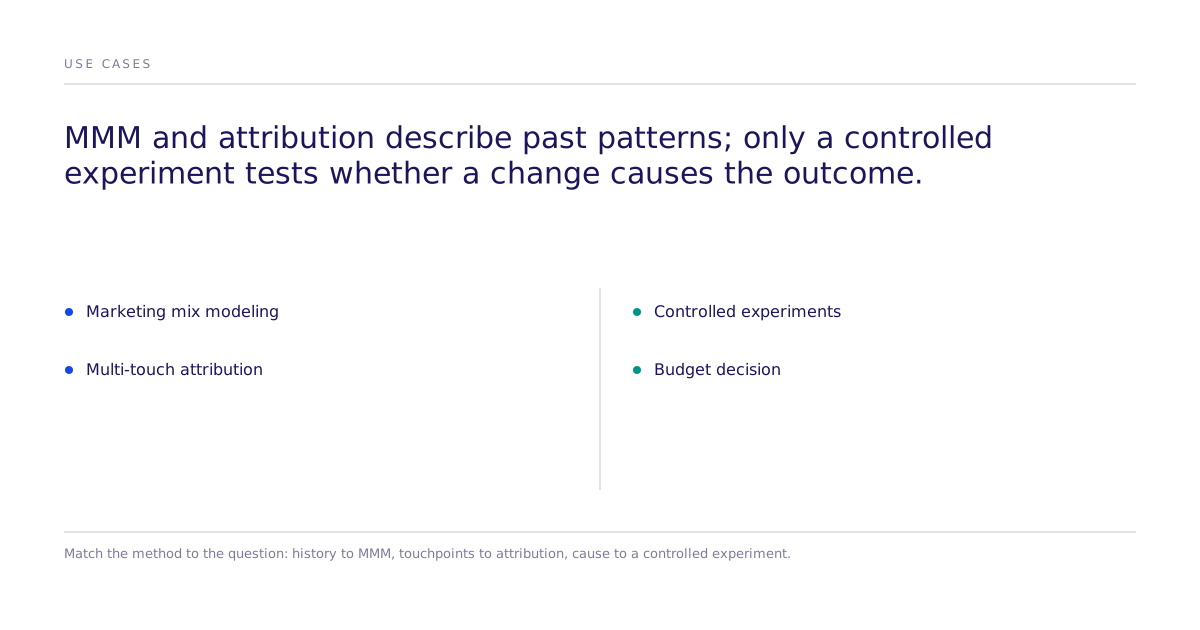
Attribution and mix modeling both describe the past. Controlled experiments are treated as the reference standard for marketing measurement because randomization is what separates correlation from cause, a distinction that isn't specific to any one vendor or method (Forbes: Measuring The ROI Of Marketing).
What does it cost to pick the wrong measurement method?
Reallocating spend based on a channel that only correlates with results, rather than one that causes them, wastes the budget moved into it and can starve the channel actually driving performance.
Teams commonly earmark around 10% of total media budget for measurement and analytics work, a starting point that shifts with business size and market characteristics.
What can controlled experiments do that MMM and attribution can't?
MMM and attribution both work from data that already exists. Neither one can run a change and observe the result before you commit budget to it.
A controlled experiment does exactly that, and Subconscious runs that layer on top of MMM and attribution rather than in place of them: randomized comparisons against a simulated population that estimate whether a specific action (a message, a channel shift, a budget reallocation) changes the outcome. Subconscious can test or validate the same studies with real human participants, which lets a team move from a simulated read to a real-human check without changing the underlying causal question.
What does this approach not replace?
Controlled experiments on a simulated population are not a substitute for MMM's macro, exogenous market modeling, and they don't replace attribution's touchpoint tracking. Packaged pricing and budget-optimization outputs, confidence intervals as a standard deliverable, and ready-made decision memos remain capabilities the product is still confirming, not yet available.
Choosing a method for the decision in front of you
If the question is "what happened across our channels last year," MMM is built for that. If the question is "which touchpoints preceded conversion," attribution answers it. If the question is "will this specific change move the outcome," that's the question a controlled experiment is built to answer. Recent case studies show how that plays out across categories; read how the process works before running one against your own budget decision.