Message Testing for Sensitive Corporate Communications
A reorganization memo, an earnings guidance revision, an M&A announcement, or a policy change almost never gets tested before it goes out: testing feels riskier than publishing it untested. Showing an internal layoff memo to outside readers before it is announced creates legal and HR exposure, and running a guidance revision past institutional investors before the call is not something most investor relations teams can do. So the message ships untested, and the organization finds out whether it worked by watching the reaction.
That is the wrong tradeoff. A team can compare draft variants of a sensitive communication against a defined target-audience segment and measure the causal effect of framing choices on stated reaction, without showing the draft to the real people the release is about. This is the same discrete choice experiment logic long used to test message variants in communication research (Frontiers in Communication, 2025).
Why do sensitive communications resist ordinary testing?
Three properties make reorg memos, guidance revisions, and M&A announcements harder to test than routine marketing copy.
Multiple audiences read the same document for different reasons. A reorganization memo has to be honest about the business rationale while staying sensitive to employee anxiety. A guidance revision has to satisfy institutional investors who want financial detail while remaining legible to retail shareholders who want a plain-language explanation.
Framing changes the reaction more than the facts do. Call a price increase an investment in product quality and readers respond one way; call the identical increase a response to rising costs and they respond another, even though nothing about the underlying numbers changed.
Once published, the communication is permanent. Earnings-call transcripts sit in SEC filings indefinitely. An internal memo that leaks can circulate long after the news it described has changed.
Testing message framing before a sensitive release
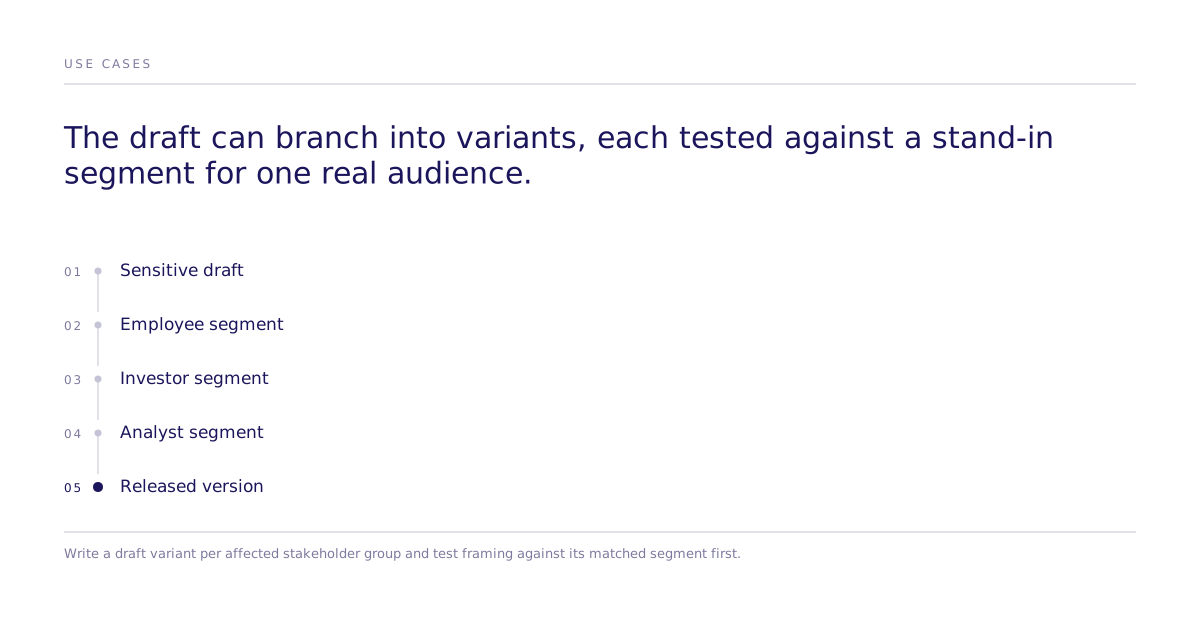
The useful question is not whether a draft is well written. It is which of several draft variants moves a defined audience segment's stated reaction in the direction the team needs, and by how much. For a major communication, that usually means identifying the three to five stakeholder groups affected and testing draft variants against each one.
For an internal audience, that means testing draft variants of a reorganization or policy memo against a segment defined by the organization's own employee population, measuring whether one version scores better on the reactions that matter: does it acknowledge the change's impact, is the business rationale legible, does it answer the question the reader will ask next.
For a board or investor-facing communication, that means testing draft variants of an earnings statement or strategic update against a segment defined by institutional-investor criteria, measuring where each version is more or less credible on the specific financial claims it makes, before the call happens.
For a release aimed at press and industry coverage, that means testing draft variants of a release or FAQ against a segment defined by industry-analyst criteria, measuring which framing produces the interpretation the team intends.
In each case, the deliverable is a causal comparison between draft variants for a defined audience segment, with confidence intervals where the study design supports them, not a verdict on what a group of individuals "thinks" of the message.
Practical applications
M&A communications
Get the first 24 hours of an announcement wrong and the integration can spend the rest of the deal recovering from it. A team can treat each outward-facing document as its own draft variant against its own audience segment before the announcement: the press release against press and analyst readers, the internal memo against the workforce, the customer-facing FAQ against the customer base. Run separately, they show where the narratives conflict across audiences before that becomes a public problem.
Earnings guidance revisions
The difference between a guidance revision the market accepts as prudent and one that draws a shareholder claim is often a matter of framing and timing, not the underlying number. Testing draft variants of the revision against an investor-defined segment before the call gives the investor relations team a causal read on which framing is least likely to trigger an adverse reaction.
Internal policy changes
Compensation adjustments and restructuring announcements are usually checked through manager feedback and legal review, neither of which simulates how an individual employee reads the memo. Testing draft variants against an employee-defined segment surfaces the failures those internal loops miss: ambiguity about what the change means for one person, corporate language substituting for plain language, and a tone that skips the emotional weight of the change.
How this compares to the review a sensitive release already gets
| Review step | What it checks | What it does not check |
|---|---|---|
| Legal and compliance review | Regulatory exposure, disclosure obligations, liability language | Whether the audience reads the message as intended |
| Manager or executive review | Internal consistency, alignment with strategy, tone as read by people close to the decision | How someone outside the drafting group, without that context, is likely to react |
| Causal framing test | The measured difference in stated reaction between draft variants, for a defined audience segment | Legal risk, HR risk, and anything that requires a lawyer's or compliance officer's judgment |
The table above puts the causal framing test's gaps next to legal and manager review's own gaps, so a reader can check where each one stops. The causal framing test does not replace the first two rows. It runs in addition to them, on the question neither one is built to answer.
What are the limitations of a framing test?
A result published without its limits is marketing, and this section states the limits of a framing test. A framing test does not replace legal, HR, or compliance review of a sensitive disclosure. It cannot simulate insider information leaking ahead of a release, regulatory reaction, or the full emotional response of the employees, investors, or analysts who will read the real thing, and it is not a recruited panel of real executives or institutional investors. The result is a directional signal about which framing performs better for a defined segment, not a guarantee of how the market or workforce will respond.
Where the decision depends on it, a team can move from a simulated framing study to a study with real human participants without changing the underlying causal question. That step matters when the stakes of a release justify it, not for every sensitive communication.
Teams building this into their communications process can start by reading how Subconscious structures a causal experiment, or look at the research behind the method. For a specific release under deadline, the fastest path is to talk to the team about the audience segment and comparison. General background on the company is on the about page.