Stress-Testing a First Monthly Investor Update Before It Ships
A monthly investor update shapes how investors remember a founder more than any pitch deck or board meeting. It is the document an investor skims on a Sunday night before thinking about the company on Monday. Over a year, the pattern of those updates decides whether a founder gets a warm intro at the next raise, a fast yes on a bridge, or a reply that never comes (Visible.vc, "Investor Updates").
Most founders write their first update without a single outside read. That is the gap a controlled comparison closes before the draft leaves the outbox.
The decision the founder is actually making
The question is not "did I write an update." It is which draft, tone, and metric emphasis should go out this month. Few things a founder writes carry as much weight per word as these five hundred, and most first-time founders write roughly five to ten before they find their voice. Investors rarely reply to the email itself, so the feedback loop is invisible. A founder who never gets outside signal drifts toward minimum-viable effort: a mediocre update is forgotten, but one that buries a problem instead of naming it costs trust that is slow and expensive to rebuild.
What Does Choosing Poorly Cost?
The cost does not show up in the moment. It shows up months later, when a lead investor who was never asked a clarifying question quietly loses conviction, or when a follow-on target reads several months of vague, inconsistent updates and takes a pass without saying why.
Where Does a Controlled Comparison Fit?
Subconscious can run a controlled comparison of two or more draft versions against a modeled investor audience on its person-level audience graph, and read which version changes the investor's stated reaction. That comparison can test:
| Question the founder needs answered | What the comparison isolates |
|---|---|
| Which of ten candidate metrics should lead the update? | Which numbers a modeled investor reader wants first versus only if the trend is good |
| Does the current draft read as confident or evasive? | The emotional reaction to tone, holding the underlying facts fixed |
| Is this version more forwardable than last month's? | Whether specific paragraphs make an investor more or less willing to pass the update along |
| What follow-up question does this draft invite? | The gap between what the founder wrote and what a skeptical reader will ask next |
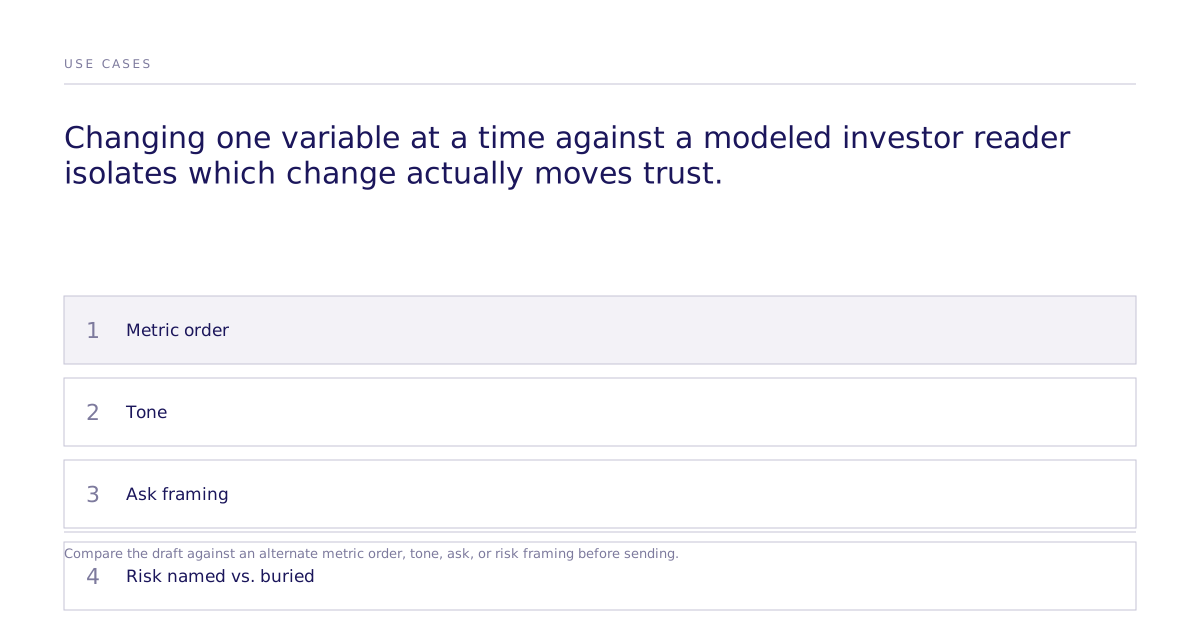
A useful comparison changes only the variable under test, the metric order, the tone, the ask, and holds everything else constant. That is what separates a causal read on the draft from a guess about which version feels better.
What Is the Practical Advantage Over Writing Alone?
A founder has too much context and emotional proximity to the numbers to read their own draft the way an outside investor will. A controlled comparison supplies that outside read without waiting months for investor feedback to accumulate. It surfaces the same failure pattern that recurs across first-time founder updates: a weak or missing ask, a risk section that stays buried, a metric that is flat or down and quietly drops from the draft, and a narrative with no arc, just a list of facts.
Proof and where the method comes from
The controlled comparison described here, testing one changed variable against a modeled audience and reading the effect, is the same method described on Research and How We Work. Naming exactly where proof stops is what lets a buyer check the claim. There is no case result or customer number specific to investor updates to cite; the description above applies the method to this use case, not a proven result for it.
Limitations and what this does not replace
A method that never states what it cannot do is just marketing copy. This tests message and tone reception only. It does not replace the founder's judgment, the board relationship, or an actual investor's real capital decision. A modeled investor's reaction to a draft is a read on how the writing lands, not a prediction of whether that investor will write a check.
Next step
Start with the update already sitting in a draft. Compare it against an alternate framing, a different metric order, a rewritten ask, or a named risk instead of an omitted one, and see which version a modeled investor reads as clearer before either goes out. See a demo or read more about Subconscious to understand how the comparison is built.