Testing Onboarding Flow Decisions Before Build
Test an onboarding flow before build by treating each version as a competing action, not a finished screen.
A historical industry benchmark reported that 40% to 60% of new signups did not complete onboarding (Userpilot). A number without its limits is marketing copy. That range is a planning example, not a current Subconscious benchmark. The product decision comes before the dashboard can show where a live flow lost people.
Decide Which Behavior to Ask For First
An onboarding test should answer a build decision: which sequence should the team ship? The alternatives might be an email-only signup against a form that also asks for role and company, or guided setup against immediate product exploration.
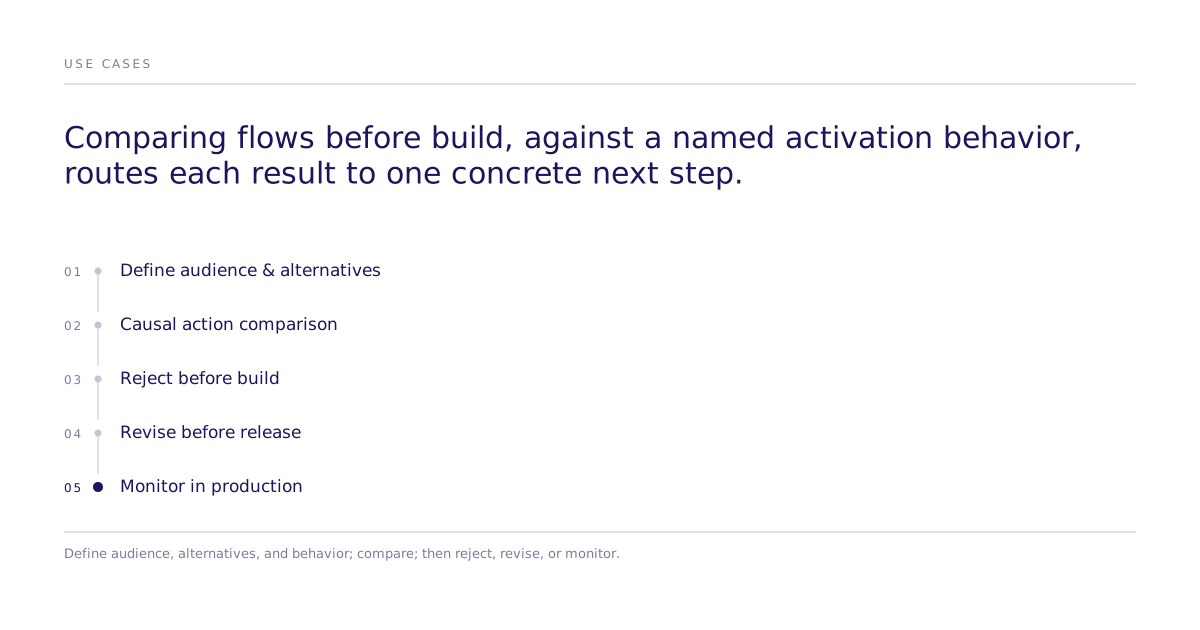
The comparison needs three explicit parts:
- A target signup audience. Define whose activation behavior matters for this decision.
- Two or three credible alternatives. Compare only versions the team could actually build and support.
- A behavioral outcome. Name the completion or activation action each version is intended to move.
Subconscious supports this decision through causal action testing and discrete-choice-style experiments, comparing alternatives against the same behavioral question before engineering commits to a single design.
Which Method Should You Use for Which Question?
Pre-build comparison, observed usability, and product analytics answer different questions. Keeping those roles separate prevents an early directional result from being treated as proof of live performance.
| Method | Decision it supports | Boundary |
|---|---|---|
| Causal action comparison | Which proposed flow is more likely to move the defined completion or activation behavior | Does not observe a person operating the live product |
| Usability observation | Where people hesitate, misunderstand, or fail to recover while using an interface | Does not establish how the full market will behave |
| Live product analytics | Where shipped behavior converts or drops off in production | Arrives after the team has built and released a flow |
A team can use the action comparison to choose what deserves engineering investment, usability work to diagnose interaction friction, and live analytics to monitor the released experience.
Stress the Paths That Threaten Activation
The happy path is rarely the whole decision. Compare each alternative against the moments that can change behavior:
- Confusion. If a step is misunderstood, can the person recover?
- Deferral. If setup is optional, does skipping still lead to a useful first experience?
- Expectation mismatch. Does the flow correct a mistaken expectation before it becomes abandonment?
They are competing behavioral hypotheses, not interface observations, and should be stated before the study. This method's failure mode is published here for the buyer to check. Direct observation remains necessary when the question is exactly where someone looks, clicks, hesitates, or gets stuck.
Can You Validate Results With Real Human Participants?
Subconscious can test or validate studies with real human participants, carrying the same causal question from a simulated comparison into real-human validation of the preferred flow.
Subconscious can also run controlled studies against a person-level audience graph covering 800 million real people. Naming what a number can't do is what lets a buyer check it. The graph supports audience definition, not a pool of recruited research participants.
The misses sit on the same page as the hits. Neither form of pre-build evidence guarantees activation after launch. It does not replace direct usability observation, real-user session data, or live product analytics. It narrows the build decision and makes the remaining uncertainty explicit.
Convert the Result Into a Release Plan
Give every finding one operational destination:
- Reject before build when an alternative presents a clear abandonment risk.
- Revise before release when the comparison identifies a plausible weakness that can be addressed in the first implementation.
- Monitor in production when the result remains ambiguous and needs live behavioral evidence.
Start the brief with the audience, the two or three alternatives, and the activation behavior that should move. Subconscious research explains the causal approach, case studies show applied work, and a walkthrough can help turn the decision into a study.