Validating Agentic Research Output: A Five-Layer Eval Framework
Every automated research pipeline runs into the same question: how do you know the output is real before you act on it? The cost of running a study has dropped so far that unvalidated output can now outpace anyone's ability to check it by eye. Trusting a result means picking a validation layer that matches how much is riding on the decision, not applying the same check to every study.
What "accurate" needs to mean before you use it
"The panel is 87 percent accurate" means nothing until you say against what. Three different things get measured under that label:
- Stated-preference fidelity: does the output match what a matched group of real people would say to the same question? This is the most common benchmark and the easiest one to run.
- Behavioral prediction: does the output correctly predict what people actually do (click, buy, churn)? Harder to measure, and where automated methods are structurally weakest.
- Decision-quality outcome: did using the research lead to a better business decision than the alternative? This is what actually matters, and it is rarely measured because it needs a year of follow-through on decisions that were already made.
Most published accuracy numbers measure the first one. The second and third are where the real validation work sits.
Five layers, from routine-and-frequent to rare-and-decisive
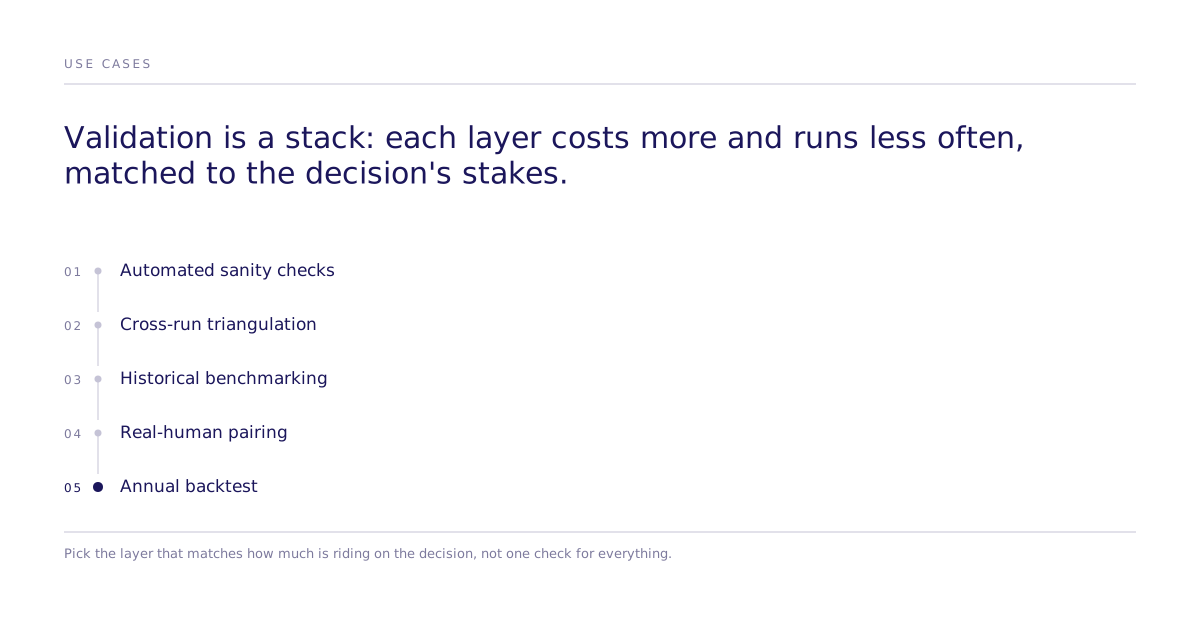
Treat validation as a stack, not a single gate. Each layer catches a different failure mode, at a different cost.
Layer 1: automated sanity checks, on every response
Run in the loop, at close to zero added cost: internal consistency across personas in the same segment, whether the response actually answers the question asked, and whether the language and reasoning fit the persona it claims to represent. Failures here usually mean the brief was malformed, not that the underlying method is broken.
Layer 2: cross-run triangulation, per study
Within one run, look at where personas agree and disagree. Responses inside a tight segment should cluster; if a study designed to surface disagreement between segments instead produces convergence everywhere, the run is flattening real variation. The two or three most extreme responses are usually either the most useful signal or the most broken output; read them by hand rather than averaging them away.
How do you benchmark against historical human data?
Keep a small set of questions (5 to 10, spanning the categories you actually study) where you already know the real-human answer, its sample size, and its date. Re-run the same questions on a cadence and track the delta over time. Small drift is normal; sudden drift usually means the model behind the method changed underneath you without an announcement.
When should you pair a decision with a real-human check?
When a study is about to inform an actual decision (a launch, a price, a campaign), pair it with a smaller real-human check on the same causal question. This is the highest-value layer because it is where the money actually moves: the team that pairs its top few decisions a quarter with real-human validation learns more about its own method's reliability than any number of generic benchmarks produce. Subconscious fits this layer directly: it can test or validate studies with real human participants, running the same causal experiment against a matched human sample without changing the underlying question.
How often should you backtest against reality?
On a yearly cadence, revisit the major calls a team made and grade each study against what actually happened. Decision quality is what this layer measures, and it's the layer teams skip most, since it means holding a researcher to a forecast made twelve months back. Everything above it correlates with the answer; this layer is closer to causal.
Failure modes that slip past the first three layers
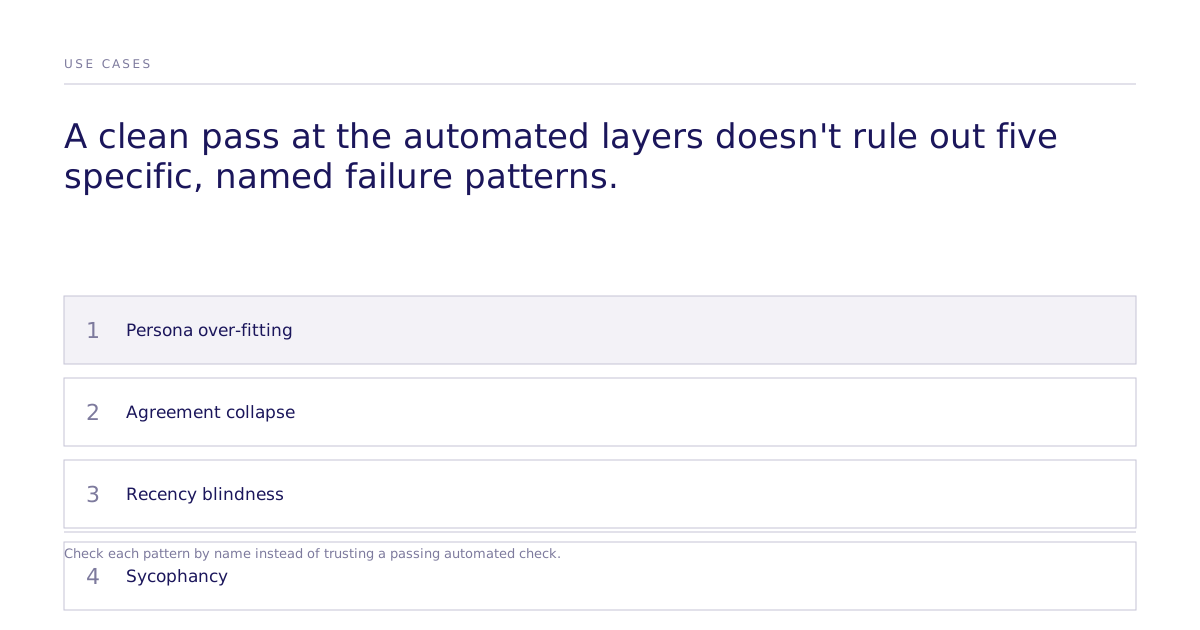
A few patterns show up repeatedly in production, independent of platform:
- Persona over-fitting. The output describes the persona instead of answering as the persona, using consultant-slide phrasing instead of a plain answer. The fix is a tighter brief, not a bigger model.
- Agreement collapse. Every segment converges on the same answer. Usually a symptom of an underlying model update; Layer 2's between-segment check catches it.
- Recency blindness. Output lags a market shift the model hasn't seen. Symptom: it doesn't know about something that shipped in the last quarter.
- Sycophancy. Output agrees with whatever framing the question implies. Catch it by running the same study with the framing negated and comparing.
- Feedback-loop drift. A method trained partly on its own earlier outputs drifts away from real-human ground truth across generations. Only Layer 3, benchmarked against fresh human data, catches this one.
A Stanford study supports this risk: generative agents completed the American Voices Project interview, then predicted those same 1,052 participants' answers on the General Social Survey and personality batteries. The agents reproduced individual response patterns with meaningfully more fidelity than demographic-only personas, though predictions still diverged from the people they modeled (Stanford HAI). That gap between "closer than a demographic baseline" and "confirmed by the person" is what Layer 4 exists to close.
What to ask a platform before you trust its number
Before treating any platform's accuracy claim as usable, ask three questions: What does "accuracy" mean in the benchmark, precisely? How does the platform handle model updates that shift response patterns, and does it tell you when that happens? Can you re-run the benchmark yourself, on demand, against the current model version? A number without a stated method and a checkable date is marketing, not evidence.
Subconscious does not publish one blanket accuracy percentage in place of this, and it does not replace a team's own outcome-backtesting discipline or the executive accountability for the decision itself; Layer 5 stays a human responsibility regardless of which method fed Layer 1 through 4.
Why the volume changes the stakes
When research ran at human pace, a bad study took weeks to produce, the cost was visible, and someone usually noticed if the output felt off. At automated volume, with hundreds of runs a week per team, that friction disappears, and unvalidated output compounds without anyone noticing. Teams that get this right run Layers 1 through 3 by default, pair Layer 4 with every decision that matters, and backtest once a year. Teams that skip straight to "the model ran a study, here's the recommendation" find out later that the recommendation was confidently wrong.
The question is not whether to validate. It is at what depth, matched to what is riding on the call. For the decisions where that call is expensive to get wrong, see how Subconscious pairs a causal study with a real-human check.