What to Test in Simulation Before You Burn Your First Ten Customer Calls
A pre-seed founder with no research budget has to decide, before the first customer call, which questions belong in that call and which ones can be resolved first. Get the split wrong and the cost shows up two ways: burn the first ten conversations on things a live human never needed to answer, or treat simulated enthusiasm for a pitch as proof that a real buyer will pay for it.
Why founders skip research instead of triaging it
Traditional qualitative research is built for a company that can wait. Independent industry estimates put a proper qualitative study at roughly €10,000-€30,000 and 6-8 weeks of turnaround (Merren, "How Much Does Qualitative Research Cost in 2026"). A pre-seed team doesn't have either. By the time a study like that would land, the product has usually shipped three iterations and pivoted twice.
So most founders skip the formal process and run on instinct, founder-network conversations, and whatever user calls they can schedule. That works to a point: instinct is overfit to the founder's own experience, network conversations skew toward people already inclined to agree, and user calls are slow to book with people who don't know the founder yet.
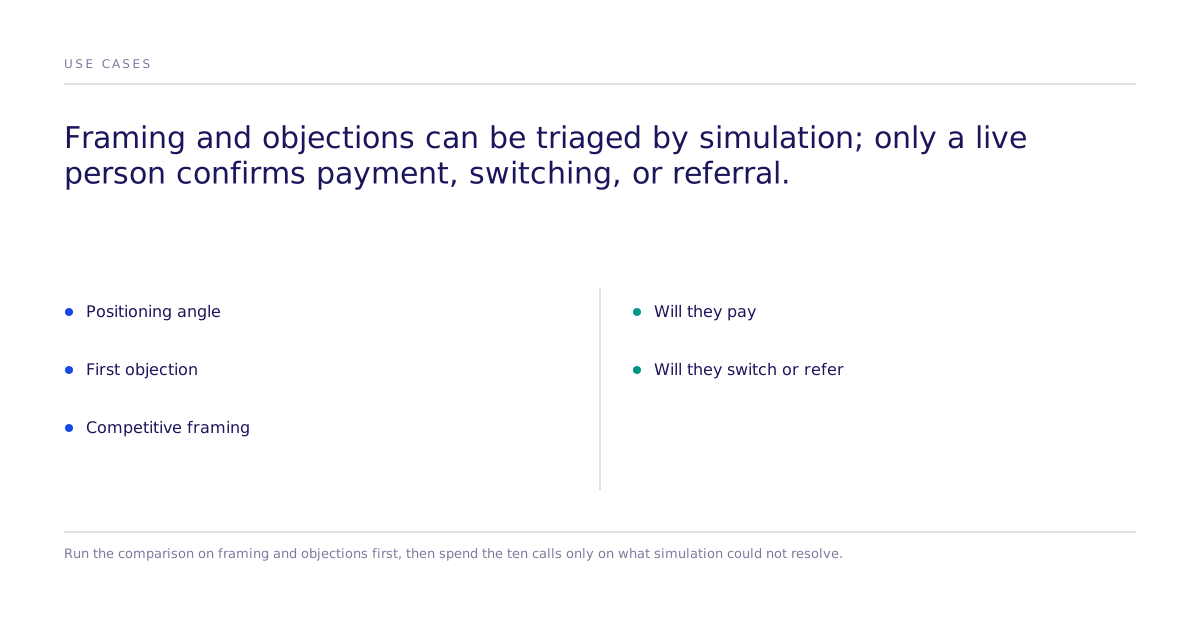
The failure mode isn't skipping research. It's not triaging it. Some questions (does this positioning angle land better than that one, what's the first objection a skeptical buyer raises) don't need a live human to surface. Others (will this person pay, will they switch, will they refer it) can only be answered by one.
What can a controlled comparison settle before the first call?
A causal behavioral platform like Subconscious runs controlled experiments that compare one action against another, such as one positioning angle or one ICP definition against another, and estimates which is more likely to move a stated outcome. That's a narrower job than full customer discovery, but it's the triage this decision needs: a way to rule out the weakest hypotheses before spending a real conversation on them.
Before talking to a single customer, a founder can use this kind of controlled comparison to:
- Run a value proposition against a defined customer profile and see which framing gets less resistance.
- Map the objections a skeptical buyer would likely raise first.
- Compare several positioning angles against each other rather than guessing which one to lead with.
- Run a competitive comparison conversation to see where a pitch holds up and where it doesn't.
After a few real conversations have happened, the same comparison can be re-run grounded in what surfaced: scaling the same questions asked of three real customers out to fifty simulated ones, testing whether an objection generalizes, or checking an adjacent customer type nobody has had time to reach yet.
A fit worth being honest about
Subconscious's stated ideal customer is a team with a consequential, repeated decision and enough market context to define a testable population, not a pre-revenue founder with one untested hypothesis and no budget. That's a real mismatch: this approach sharpens the questions a founder brings into real interviews, it does not substitute for a team built or priced for a single founder's stage.
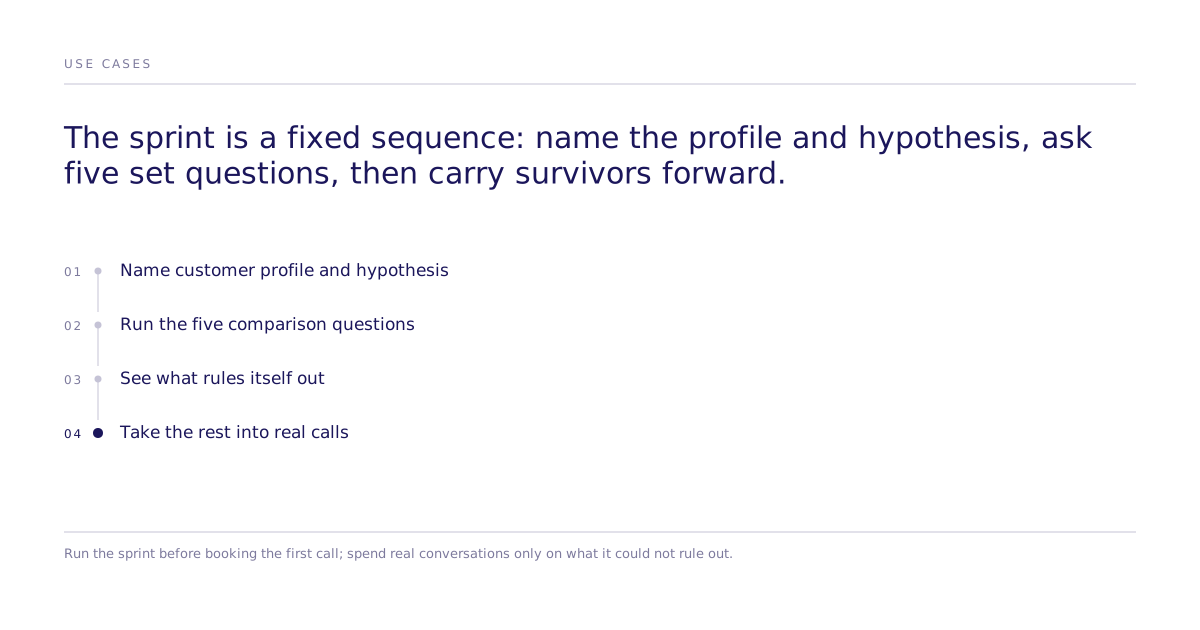
The sprint looks like this: name the customer profile and the hypothesis, ask the comparison five questions (the biggest frustration with current solutions, the first reaction to the pitch, the first skeptical objection, how it compares to the main competitor, and what would have to be true to try it in the next 30 days), then take whatever ruled itself out into the first real customer conversations instead of testing it there.
What can't a controlled comparison tell a founder?
A controlled comparison of hypothetical responses cannot tell a founder whether a real person will change behavior, pay money, or refer the product to someone else. Enthusiasm for a simulated pitch is not conversion evidence; treating it as such is the second way founders waste runway on this problem. The method compresses the hypothesis-testing cycle before real validation; it doesn't replace it.
When a team does need to move past hypothesis testing, Subconscious supports testing or validating a study with real human participants without changing the underlying causal question: the same comparison, run against people instead of a model. For an early triage pass, that step usually isn't necessary yet.
Where does this fit for a founder before product-market fit?
Before product-market fit, the most useful thing this kind of comparison can do is sharpen an ICP definition rather than confirm demand. Testing several distinct customer types against the same problem statement and watching which one responds most specifically and emotionally produces that signal faster than recruiting five customer types and interviewing all of them in person before knowing which one matters.
That signal still has to be confirmed: it tells a founder which type of customer to prioritize for the ten real conversations that decide the go-to-market call, not what to decide.
Next step
A founder deciding what belongs in the next ten customer conversations can see how Subconscious frames this in how we work, or look at case studies and the research library for examples of the same triage applied to a bigger decision. A demo walks through what this looks like end to end.