Will Your Claim Survive an Expert Audience? Test It Before They See It
A clinician, a security engineer, or a compliance officer reads a vendor claim differently than a consumer does. They know the failure modes, and what a number is hiding. If a launch claim cannot survive that kind of scrutiny, the moment to find out is before it reaches the real expert, not after.
Why do expert audiences break the usual research playbook?
Consumer research assumes an audience that reacts to messaging on instinct. A cardiologist evaluating a diagnostic claim, a network architect evaluating a security pitch, or a regulator evaluating a compliance framework brings domain knowledge that consumer research was never built to anticipate. Recruiting that audience at scale is also expensive and slow: specialists are hard to reach and reluctant to take vendor surveys.
Physicians in particular remain openly skeptical of AI-driven claims even as adoption grows, which is the exact failure mode a technical or regulated launch has to plan for before it reaches them (Healthcare Dive, 2026).
What decision does this affect?
The question is not whether the product works. It is whether a specific claim, framed a specific way, holds up when a skeptical domain expert reads it. That decision sits with whoever owns the launch messaging for a technical or regulated product: marketing leadership, regulatory affairs, or both. Get the framing wrong and the cost is not a lukewarm response. It is a wasted advisory-board cycle, a delayed analyst briefing, or a messaging rewrite after the real regulator or reviewer has already formed an opinion.
What causes a claim to fail with experts
Claims fail with expert audiences for a narrow, diagnosable set of reasons:
- Ambiguous precision. An accuracy claim that does not specify what it measures invites the obvious follow-up: accuracy of what, measured how, against what baseline? Experts ask that question immediately; consumers rarely do.
- Wrong variable. A claim built around speed or convenience falls flat with an audience that cares about a different variable entirely, such as diagnostic accuracy or regulatory defensibility.
- Generic framing. A claim written for a general buyer, not tuned to a named specialty, seniority, or regulatory context, reads as vendor noise rather than an argument built for that reader.
How do you test a claim before an expert sees it?
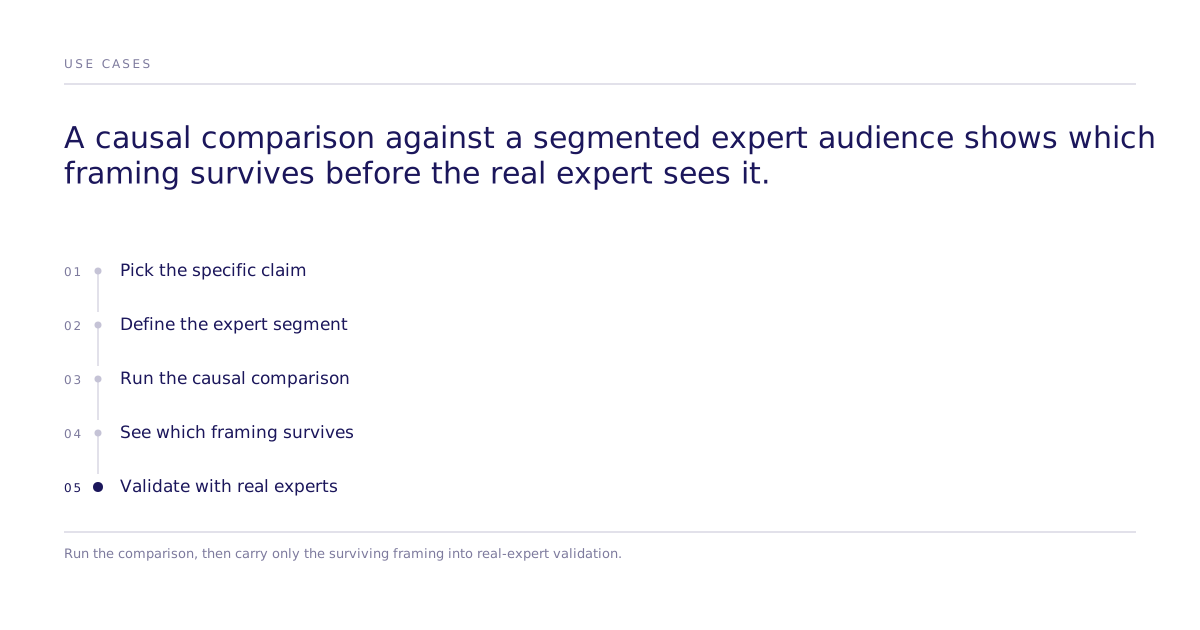
Subconscious runs a controlled, causal experiment comparing candidate claim framings against a segmented audience matching the real professional buyer type, such as clinicians in a given specialty, security engineers, or compliance officers. The output is a causal effect with confidence intervals showing which framing holds up and why, not a summary of impressions.
| Framing failure | Why it fails with experts | What a comparison test surfaces |
|---|---|---|
| Unqualified accuracy claim | Experts ask what the number measures and against what baseline | Which qualified version of the claim (specificity, sensitivity, or another measure stated separately) survives scrutiny |
| Speed- or convenience-led claim | The audience cares about a different variable, such as accuracy or defensibility | Whether leading with the variable the audience actually weighs changes the response |
| Generic, unspecialized framing | Reads as vendor noise instead of an argument built for that reader | Whether specificity of audience and claim changes credibility |
This is a comparison of framings, run before the team commits budget or submits work for real expert review. Learn more about how Subconscious runs these experiments.
Moving from a simulated comparison to real-expert validation
A causal comparison of claim framings is not a substitute for the real expert's judgment. When the decision depends on it, a team can move from the simulated comparison to validation with real human participants without changing the underlying causal question. See how this fits into a broader research workflow.
What this does not do
- It does not grant regulatory clearance. A regulator's approval still requires the regulator.
- It does not substitute for peer review. A methodology comparison is not a peer-reviewed result.
- It does not produce a citable population statistic. The output is a causal comparison between claim framings, not proof that any expert body has endorsed the work.
- It does not guarantee faster delivery or lower cost than any other approach; no such comparison has been run.
Before the advisory board sees it
The teams that get the most out of this kind of test are the ones who have already watched a technical or regulatory claim collapse on contact with a skeptical expert. Pick the specific claim that most needs pressure-testing, define the expert audience precisely by specialty, seniority, and region, and run the comparison before the advisory board, the analyst, or the regulator sees the work. For medtech, pharma, and other regulated launches, see how this applies to pharmaceutical decisions, or talk to the team about a specific claim.