AI Marketing Personas Can Critique Your Plan. They Can't Test It.
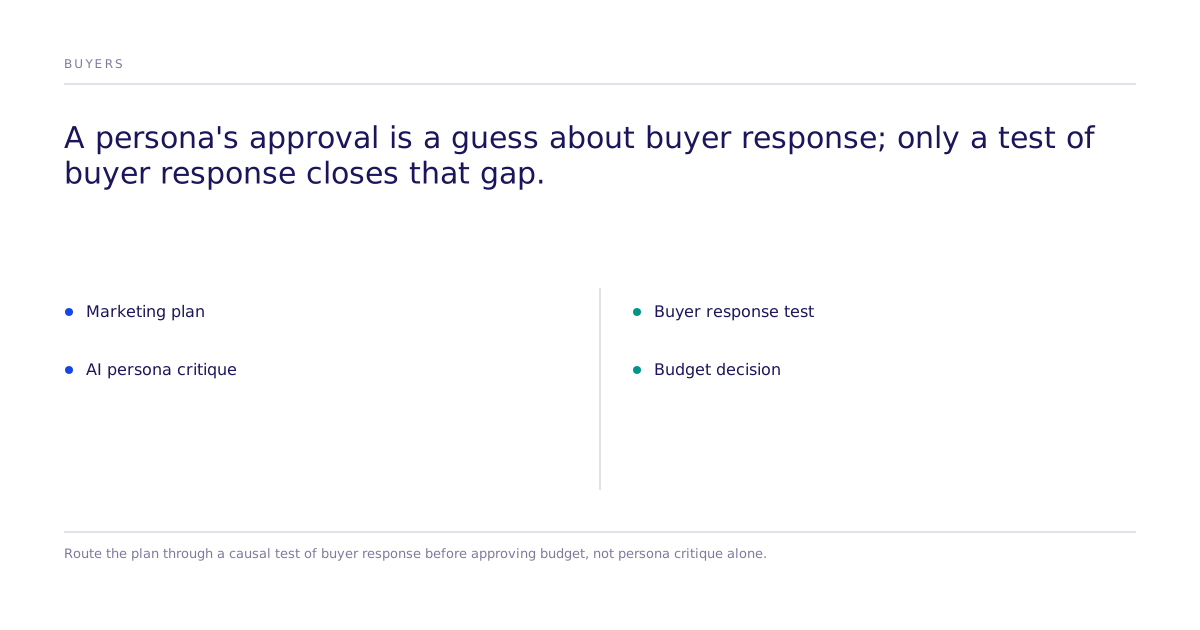
An AI marketing persona offers an opinion on a plan, while only a causal test of buyer response reveals whether that plan actually changes what the buyer does. A senior-sounding AI marketing persona takes little effort to set up and is always available. It will tell you your positioning is vague, your channel plan looks risky, or your launch sequence is too ambitious. All of that can be accurate and still leave the real question open: will the buyer respond the way the plan assumes?
An opinion, however well-informed, is a guess about what happens next. That gap, between a persona reviewing your plan and a method that shows which version of the plan a buyer would choose, determines whether the budget is well spent.
Where the gap shows up
An early-stage founder team can build and sell a product with no one on staff who has scaled marketing past a small budget or built a brand from scratch, and no way to check whether a positioning line survives contact with a better-funded competitor. A growth-stage company might have five to ten marketers who run campaigns well but have never navigated a move into an enterprise segment or a shift in category strategy. At a larger company, a CMO managing a team of 50 can sit behind a three-week backlog before a product marketer gets a strategic read on a repositioning question.
An AI persona tuned to sound like a seasoned marketer can fill that gap with useful triage: is the positioning specific enough, does the channel plan hold up against a rival that outspends you, is a message likely to land. That's a real service. It is not evidence that the plan works.
Is an AI persona's opinion a stated preference?
Any answer the persona gives, including "yes, launch this campaign," is what researchers call a stated preference: a description of what someone would do, without doing it. Stated preferences reliably diverge from revealed preferences, the choices people make when the decision is real (Dectech on stated versus revealed preference research). A plan approved because a persona liked it carries the same risk as one approved because an internal team liked it: nobody checked what the buyer would do.
A team can commit a $200K brand campaign to a message nobody tested against the actual buyer, and learn only after the budget is spent that the message didn't land. A fluent, confident review process, human or AI, does not protect against that outcome. Only a test of the buyer's response does.
What does a causal test add?
Subconscious runs a controlled experiment on the decision itself: which positioning line, which channel and message pairing, which launch sequence. The comparison runs against a person-level audience graph covering 800 million real people, using causal experimentation and discrete-choice-style modeling rather than a single fluent opinion. When the stakes justify it, the same comparison can move from that modeled audience to real human participants without changing what's being measured. Pairing a large modeled comparison with a real-human check follows the same logic researchers have used for decades to keep a stated answer honest against what people do (Marketing Letters on combining revealed and stated preference data).
| Plan-review question | What a persona gives you | What a causal test gives you |
|---|---|---|
| Is the positioning specific enough? | A critique measured against general marketing judgment | Which of two positioning lines changes what the buyer says they'd choose |
| Should we spend on this channel? | An opinion on the channel's cost or popularity | Which channel or message produces the stronger response from the target buyer |
| Should we launch in three markets at once? | A flag that this looks risky | Which entry order performs better under the same conditions |
Decisions worth testing before the money moves
- Positioning. Compare a category claim against an outcome claim, or a broad audience frame against a narrower one. Test which version changes what the buyer says they would do, not which one reads better internally.
- Campaign channel and message. Before a large brand budget goes out, especially into a channel where rivals already outspend you 10x, test whether a different message or a different channel produces a stronger buyer response than the default plan.
- Launch sequence. A plan to enter three markets at once is a prioritization call dressed up as a launch plan. Test staged entry against simultaneous entry under matching conditions before committing the team to either.
What a tested result does not replace
This section states what the causal test does not do, so the buyer can check that limit before the budget moves. Testing a decision is not the same as running the business behind it. It doesn't build the agency relationships, media contacts, or peer network a marketing leader accumulates over a career. It doesn't execute: someone still has to write the campaign, brief the agency, and run the calendar. It doesn't carry the pattern recognition of a person who has lived through a comparable call inside a comparable company, and it doesn't sit in the room to navigate the politics between sales, product, and the executive team. A tested result gives the human decision-maker better evidence. It doesn't take the decision, or the accountability for it, off their desk.
Where to start
Pick one decision that's about to consume real budget or a real launch window: a positioning line, a campaign channel, a market sequence. Name the alternatives worth choosing between, then bring that decision to a Subconscious working session instead of another plan review. To see how a comparable test read for another team first, the published case studies show the format.