When to Simulate First: Seven Decisions That Need a Triage Pass Before Real-Human Research
A marketing, product, or growth leader rarely gets to test every option with real people. Budget and time force a cut before the research starts. Which options get tested, and who decides, is the question worth asking before that cut.
Fielding full human research on every candidate (every name, price structure, audience segment) burns weeks and budget on options a faster pass would have eliminated. Skipping validation and shipping on a hunch risks a mispriced package, an alienating pricing change, or a message aimed at the wrong buyer. Neither failure mode is a methodology footnote; it is a resourcing decision made with incomplete information.
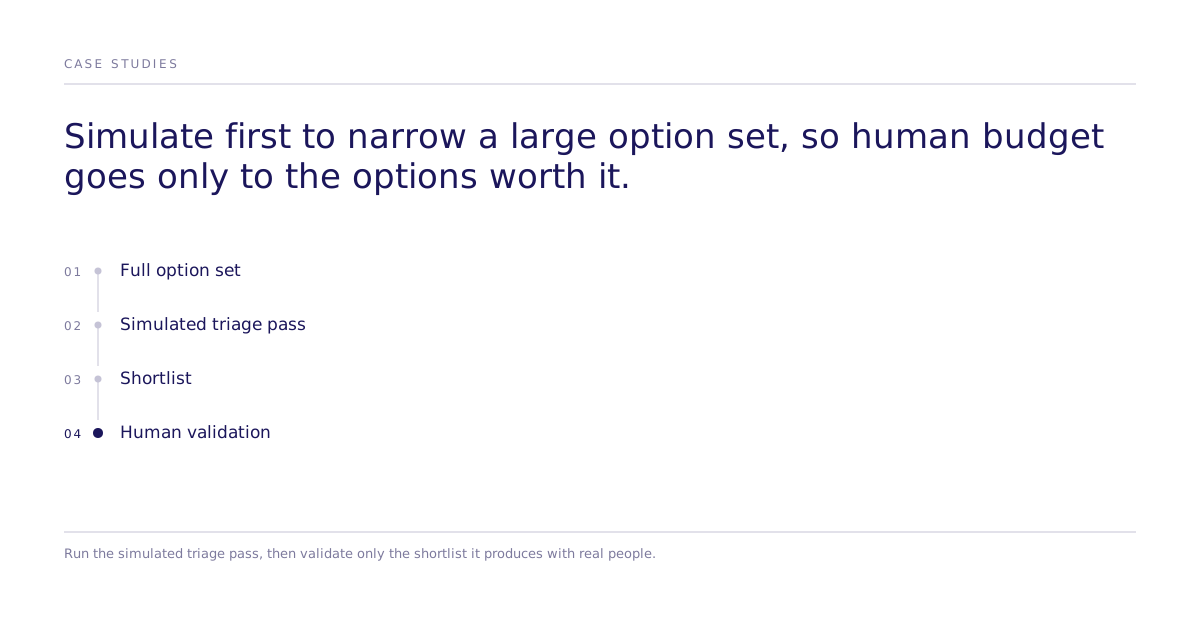
A middle path: run a controlled synthetic experiment first to cull a large option set to a short list, then commit real-human validation budget only to that short list. The pattern shows up across decisions a growth or product team makes in a normal week. The seven below describe the class of decision each represents, not any single vendor's results.
Seven decisions that benefit from a triage pass
Naming and positioning for a launch. A team with more candidate names and angles than it can afford to test chooses which few reach a full study. A fast simulated pass, followed by a focused human study on the top performers, concentrates research spend on the options worth it.
Mapping objections across a buying committee. Recruiting a full B2B buying committee (CTO, CISO, budget owner, procurement) for a traditional panel is slow and expensive by role. Simulating role-specific reactions to a discovery, demo, and pricing conversation surfaces likely objections fast enough to prepare sales-engineering responses before the next real deal, then check those objections against actual win/loss conversations.
Choosing among several pricing structures. Moving pricing models is a one-way door for existing customers. Testing multiple structures across segments in simulation narrows the field before committing a real pilot cohort to the strongest candidate.
Localizing a message across markets. Testing every message variant in every target market at a meaningful sample size is one of the most expensive research workflows, because cost multiplies by market. A simulated pass across markets and variants flags which messages carry and which trip on culture-specific friction before the paid campaign spends against them.
Pressure-testing a feature the team is already sure about. Confidence built from inbound feedback is a biased sample: whoever bothers to file a complaint is not a stand-in for the quiet segments who stop using a product without saying why. Walking simulated segments through a feature spec before launch surfaces workflow-disruption or trust concerns that inbound channels miss.
Tracking brand perception between the years a full wave affords. A traditional brand tracker often runs annually because of its cost. A lighter simulated read run more often can catch a perception shift or a competitor-driven swing early enough to act, with the traditional wave serving as the periodic ground-truth check.
Narrowing an ideal customer profile with no research budget. A seed-stage team choosing among candidate ICPs without budget for customer research can walk simulated respondents from each candidate profile through the same sales narrative and compare intent, objections, and willingness to pay before committing scarce outbound effort.
What do these seven decisions have in common?
None of these seven replaces the final validation step. Each operates at the triage layer: a fast, broad pass that culls a long list, surfaces likely objections, or points a directional thesis before anyone commits the larger budget. The decision is not "simulation or humans" but which options get pushed to the top of the queue for human validation.
| Approach | What gets tested | Where the risk sits |
|---|---|---|
| Full human research on every option | Every name, price, message, or segment | Slow and expensive; some tested options were always going to lose |
| No validation, ship on simulation alone | Nothing checked against real behavior | Fast, but a wrong call ships uncaught |
| Simulate to triage, then validate the shortlist | A large option set narrowed to a few, then checked with real people | Concentrates real-human budget on the options worth that spend |
Where does Subconscious fit in this process?
Subconscious runs controlled discrete-choice experiments to estimate causal effects across pricing structures, messages, positioning angles, and audience segments. A fit claim without its boundaries is a sales pitch, so this article points to the study that draws them. Independent research on when digital personas reliably approximate human survey findings finds that the fit varies by domain and question type, which a vendor's own case narrative cannot establish alone. A separate uncertainty-quantification study asks how many human respondents a language model's simulated response is worth for a given estimate, a way to reason about where simulation substitutes for humans and where it does not.
Subconscious can test or validate studies with real human participants. The advantage: a team can move from a simulated experiment to real-human validation on the same causal question, without redesigning the study or waiting on a separate vendor relationship to catch up.
What does a triage pass not prove?
Simulated screening narrows options. It does not replace validation for a final, high-stakes decision, and no single accuracy number travels across use cases.
Naming where a study's participants actually come from is what lets a buyer check the claim. Three things stay distinct in this pattern, and blending them is where a team gets misled: the audience a platform can reach, the participants in a simulated experiment, and the participants recruited for real-human validation. A large reachable audience is not a validated finding, and a simulated panel is not a recruited human sample.
Next step
A team weighing this sequence for its own decision, whether a launch name, a pricing change, or an ICP bet, can see how the causal effects methodology works, review other case examples, or read how a study moves from simulation to human validation. For a specific option set, booking a working session is the fastest way to find out.