Subconscious.ai FAQ: What a Causal Behavioral Experiment Can and Can't Tell You
Subconscious.ai runs controlled causal experiments on simulated populations so a team can estimate which product, pricing, or messaging action is likely to change customer behavior before it ships. This page answers the questions a buyer usually asks before trusting that kind of result for a real decision: how the method works, where it breaks down, how consent and bias questions apply to simulated respondents, and when to bring in real human participants.
What does Subconscious.ai actually test?
Causal experiments compare alternatives under controlled conditions to estimate which one changes an outcome, rather than describing what already happened or predicting a single likely answer. Subconscious.ai applies the same logic to simulated populations: it defines a decision, an audience, and a set of alternatives, then reports which alternative is more likely to move the outcome the team cares about.
How does a team use it?
A typical workflow moves through five steps:
- State the question about behavior the team needs answered.
- Choose the outcome the decision should move, such as adoption, conversion, or reduced risk.
- Design the experiment: which attributes and levels to compare.
- Run the experiment against a simulated population and get the causal comparison between alternatives.
- Look at how population or segment characteristics change the result.
This is closer to running a study than filing a research request.
Where does the method have real limits?
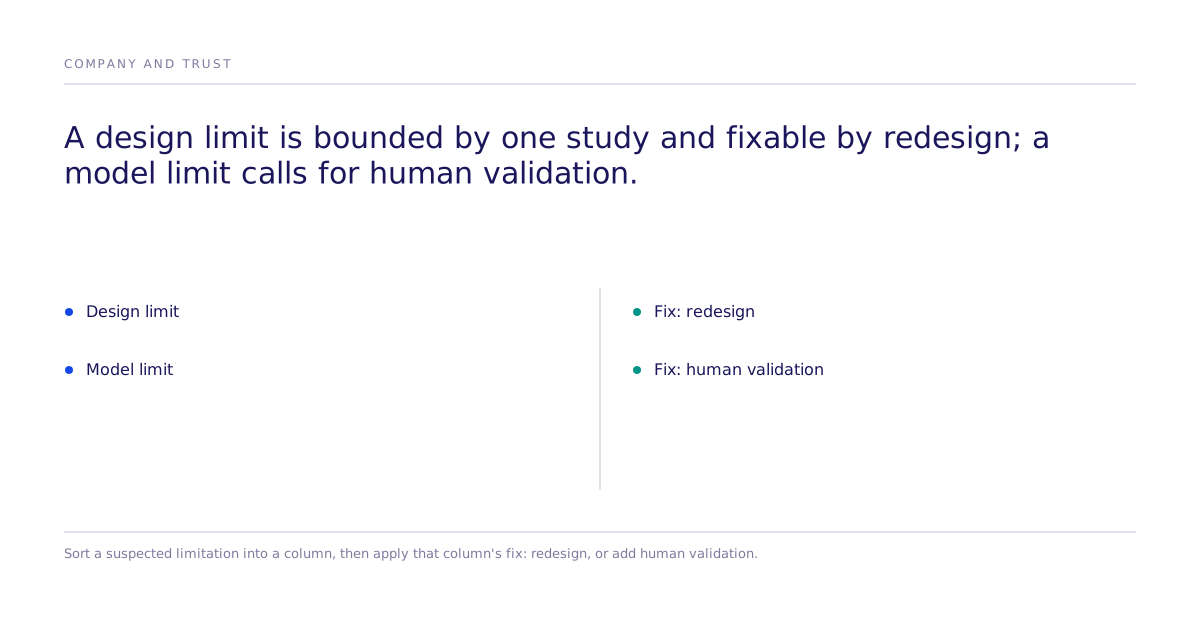
Limits specific to how an experiment is built. A single experiment can only examine a bounded number of attributes and levels before it strains both compute cost and the amount of a respondent's attention that survey-style methods can reasonably ask for. That is a design constraint on any one study, not a hard ceiling on what causal experimentation can eventually cover. Standard analysis uses named regression and choice-modeling methods; a team that wants a different analysis can work from the exported experiment data directly.
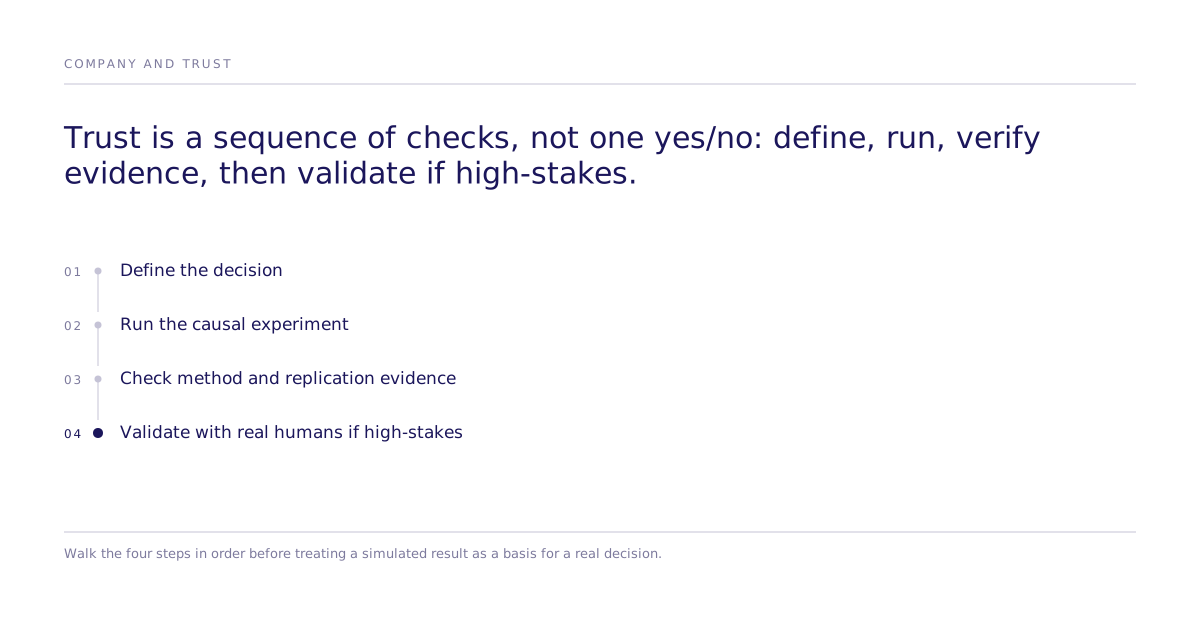
Limits that apply to any simulation built on a trained model. A simulated population is only as reliable as the data the underlying model was trained on. If that training data carries bias, the bias can surface in the simulated responses. Subconscious.ai's the causal fidelity paper reports that our best configuration reaches 87% of the measured human ceiling on one study: 0.832 rank correlation against the published human result, where two independent samples of real humans reach 0.959. Across all 43 studies that pass design filters the mean is 0.73. That comparison is corpus-level evidence, not a guarantee for a question type the corpus hasn't covered. Complex emotional or social decision-making in particular may still call for a recruited real-human study rather than simulated respondents alone.
Does using simulated respondents raise the same ethical questions as human research?
Simulated respondents have no personal feelings or privacy to protect, so a team running an experiment on them does not need informed consent or participant-privacy safeguards for the respondents themselves, and the experiment can explore sensitive topics without risking psychological or emotional harm to a real person. Because no recruitment, training, or compensation of human participants is required, resources that would have gone toward panel logistics can go toward the analysis itself, and studies that would be logistically difficult or impossible to run with human subjects become possible to explore first.
When a decision hinges on complex human emotion, social dynamics, or lived experience, real human subjects remain the more accurate source. And the data used to build or calibrate a simulated population still has to be handled ethically: it must be designed and sourced in a way that does not encode or amplify bias, and any consent or privacy obligations attached to that underlying data still apply to the team that collected it.
When should a team add real-human validation?
Add it when the decision is high-stakes and the simulated result would be acted on directly, not merely used to narrow options. Subconscious.ai can test or validate studies with real human participants, and a team can move from a simulated experiment to real-human validation without changing the causal question it's asking. That matters most for pricing, launch, and other decisions where the cost of acting on a wrong result outweighs the time saved by skipping the check. For most exploratory or hypothesis-narrowing work, the simulated result stands on its own.
Where to look next
- Research and replication evidence for the current corpus and its scope.
- How Subconscious.ai works for the experiment workflow in more detail.
- Case studies for how teams have applied a specific result to a specific decision.
- About Subconscious.ai for the company behind the method.
Limitations
This page does not cover pricing, security certifications, or team composition, and does not replace reading the study design behind any specific result before acting on it.