AI Persona Tool or Causal Decision Platform: Which One Does Your Buying Decision Need?
A team gets pitched an "AI persona" tool and has to decide fast whether it fits the job in front of them. "AI persona" describes two very different products doing two very different jobs, and confusing them costs real budget.
One end of that spectrum is a narrow, open-source documentation-review tool such as Impersonaid, which runs a docs page past simulated personas to surface confusing passages. That is a useful, focused job, and it is not the same job as testing a pricing, positioning, or launch decision.
Why this decision matters
One job is a documentation and content clarity checker: run a page of text past a simulated reader, see where it confuses them, fix the copy. The other job is a causal decision platform: run a controlled experiment on a simulated market to estimate which product, pricing, or messaging action actually changes buyer behavior.
Using the first to justify the second is the expensive mistake. A single-pass LLM opinion on whether a paragraph reads clearly is not a controlled comparison, carries no causal estimate, and reports no uncertainty. Committing a pricing, positioning, or launch decision to that kind of output means shipping on a plausible-sounding guess, the same say-do gap problem every simulated-opinion tool inherits. The reverse mistake also happens: buying a full market-simulation platform to catch confusing sentences in a docs page is over-scoped spend for a job a lightweight, linting-style checker already does well.
What causes the outcome?
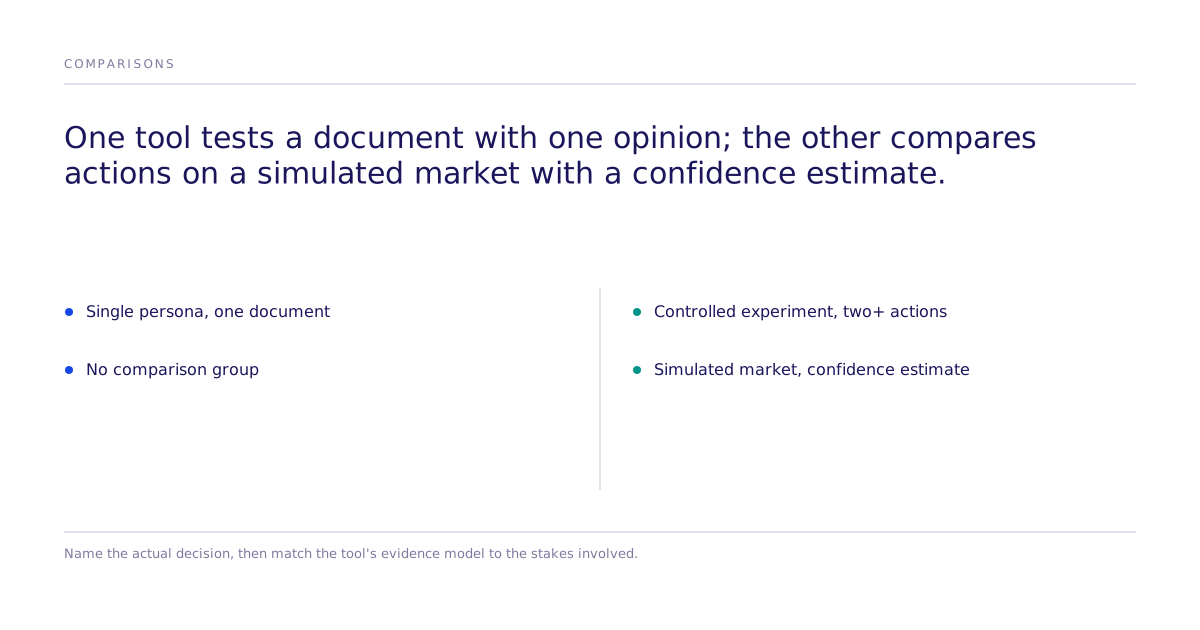
The difference is architectural, not cosmetic. A documentation-clarity checker takes one piece of text, applies one simulated persona, and returns a reaction: confused, clear, missing a step. It is a single-shot evaluation with no comparison group and no measurement of what a real audience would do differently.
A causal decision platform is built around comparison. It defines two or more actions (a price, a message, a product concept), exposes a simulated population to each one under controlled conditions, and estimates which action is more likely to move a specific behavioral outcome. That structure is what makes an estimate causal rather than descriptive: something is held constant, something is varied, and the difference in outcome is attributed to the variation.
What evidence supports this?
Subconscious runs randomized experiments on a simulation of a buyer's market, validated against real human behavior, and can extend into real-human validation studies without changing the underlying causal question.
Neither job is inherently wrong.
Options and comparison
| Tool type | Core method | Typical buyer | What it tells you |
|---|---|---|---|
| Documentation-clarity checker | Single simulated persona reviews one piece of text | Docs, DevRel, engineering teams | Where a reader gets confused or where a step is missing |
| General AI chatbot or LLM prompting | Ask a model what an audience might think or say | Anyone testing an idea informally | A plausible-sounding opinion, with no comparison group or uncertainty reporting |
| Causal decision platform (Subconscious) | Controlled experiment comparing two or more actions on a simulated market, validated against real human behavior | Product, pricing, marketing, and go-to-market decision-makers | Which action is more likely to change buyer behavior, and how confident that estimate is |
Recommended decision process
- Name the actual decision. If it is "will readers understand this doc," that is a content-clarity question. If it is "will this price, message, or launch choice change what buyers do," that is a causal decision question.
- Check whether the job requires a comparison. A clarity check evaluates one artifact. A decision that commits budget or roadmap capacity needs at least two alternatives compared under controlled conditions.
- Match the tool's evidence model to the stakes. A single-pass opinion is fine for catching a confusing sentence. It is not sufficient grounding for a pricing, positioning, or launch commitment.
- Ask what happens after the answer comes back. A clarity checker's output is a fix list for the same document. A causal platform's output should change which action a team takes next.
Where does Subconscious fit?
Subconscious is built for the second job. It is not a documentation-testing or content-linting tool and does not claim to be one.
A team can reasonably run both kinds of tools in the same stack without conflict. A documentation-clarity checker can sit in a CI pipeline, testing docs before they publish. A causal decision platform sits earlier in the stack, testing the market-facing actions (pricing, positioning, launch messaging) before they ship.
Limitations and failure conditions
A platform's published scope is what a buyer checks against their own job before they buy. Subconscious is not built for documentation UX testing, content-clarity linting, or CI-integrated docs QA. It does not ship a packaged product-catalog simulator, an automatic price or promotion optimizer, or standard substitution and cannibalization output as universal deliverables. Confidence-interval and segment-heterogeneity outputs are specific to how a given study is designed, not a guarantee attached to every result.
If the actual job is checking whether documentation reads clearly to a technical audience, a narrow, engineering-facing clarity tool remains the better-scoped choice.
Buyer questions
Is a single AI-generated opinion the same as a causal estimate? No. An opinion describes what one simulated persona thinks about one piece of content. A causal estimate compares at least two actions under controlled conditions and attributes the difference in outcome to what changed.
Can the same team use both a documentation-clarity tool and a causal decision platform? Yes. They sit at different points in the workflow: one checks whether published content is clear, the other checks whether a market-facing decision is likely to change buyer behavior before it ships.
What should change my mind about which one to use? The question being asked. "Is this text confusing" needs a clarity checker. "Will this action change what buyers do" needs a controlled experiment with a validated causal estimate.
Explore how Subconscious designs these experiments, see the research behind the causal method, or book a walkthrough of a decision-specific study. Learn more about the company.