Fast Persona Tools vs. Enterprise Simulation: The Comparison That Actually Matters
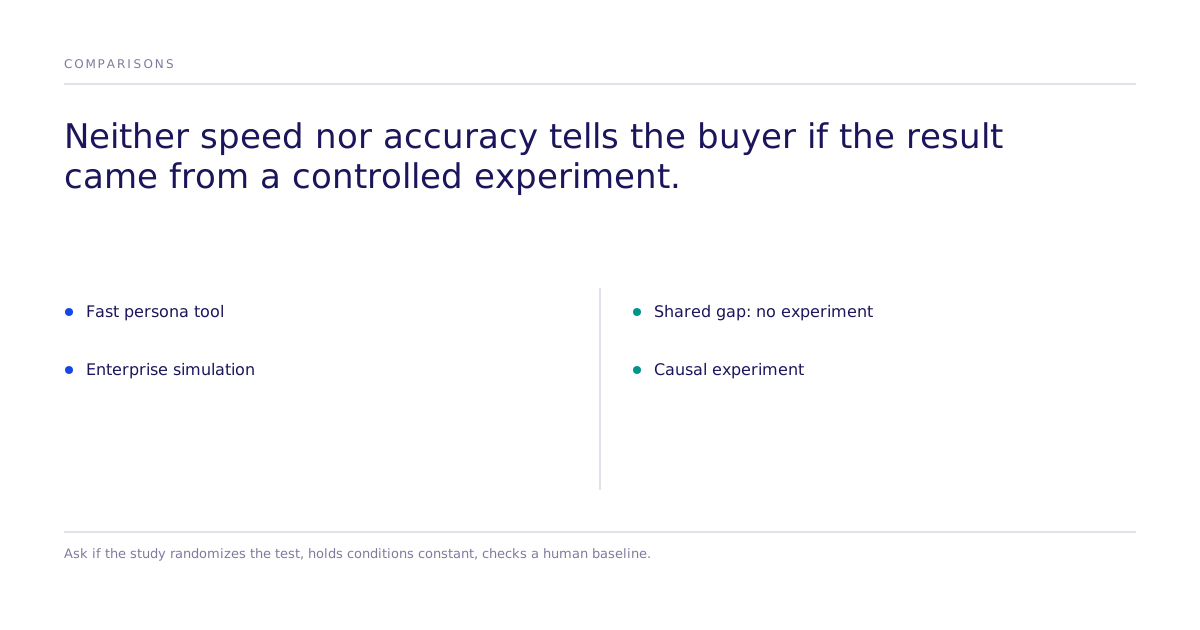
When a team compares a fast, self-serve persona tool against a slower, enterprise simulation platform trained on real interviews, the question that decides the outcome isn't speed or the higher accuracy number. It's whether either tool's output came from a controlled experiment that isolates cause from correlation. A directional read that can't be replicated is not evidence a pricing or launch decision should rest on.
Two default architectures, one shared gap
Synthetic research tools today mostly split into two families.
| Fast, self-serve persona platforms | Interview-trained enterprise simulation | |
|---|---|---|
| Persona model | Generated from a written description | Built from real qualitative interview transcripts |
| Training data required | No | Yes, real interviews per audience |
| Time to first result | Minutes, self-serve signup | Weeks: interviewing, then calibration |
| Typical buyer | Any team, no procurement cycle | Large enterprises and research agencies |
| Research scope | Any category, on demand | Bounded by the interviews already collected |
| How accuracy is validated | Precision of the persona definition | Controlled comparison against the original respondent transcripts |
Neither column answers the question that should come first: was the study designed as a controlled experiment that can isolate which action changed the outcome, or is it a plausible read that happens to be fast or expensive?
What does the interview-trained approach get right, and where does it stop?
Simile trains synthetic respondents on real qualitative interviews and validates them by comparing synthetic answers against the original human transcripts (Simile). That gives it real fidelity to the specific population it has already interviewed.
Naming this ceiling is what lets a buyer check fit before signing a contract. The trade-off is structural, not a matter of execution. Without new interview data, an interview-trained system has no way to extend into an audience it hasn't studied yet (Simile). A team researching a new market, a new segment, or an early-stage concept has nothing to calibrate against until it runs the qualitative work first. The synthetic layer amplifies research that has already happened. It doesn't replace the research that hasn't.
Fast, self-serve persona tools solve the opposite problem: no training data required, any audience addressable immediately. Speed on its own is a marketing number until the failure mode sits next to it. But that speed doesn't answer the underlying question. Generating a plausible persona and generating a causal answer are different claims, and the industry's own research literature is explicit about where description-based simulation tends to fail: aggregate pattern matching is easier to get right than person-level fidelity, and naive elicitation can produce distributions that look confident and aren't.
The question a speed-vs-rigor comparison skips
Neither architecture, on its own, tells a buyer whether the result would survive a real intervention. A model can recover a plausible answer without ever testing whether changing the price, the message, or the offer actually changes the choice.
This is the decision that should come before setup time or a self-reported accuracy score: does the study randomize the alternatives under test, hold conditions constant except for the thing being changed, and report the result against a human baseline where one exists?
Where does a causal platform sit above this split?
Subconscious runs controlled, randomized experiments on a simulated population rather than generating personas from a description or training exclusively on a fixed set of past interviews. It can run those studies against a person-level audience graph covering 800 million real people, which keeps the addressable-audience problem of interview-trained systems from applying. It can also test or validate the same study with real human participants, without redesigning the causal question. Audience reach and recruited human validation are two distinct claims: reach describes who the simulation can model, not a panel of people available to recruit.
That combination is why the buyer question isn't "self-serve or enterprise." It's whether the study was built to isolate an action's effect in the first place. See how a study is structured.
What this costs a team that skips the question
Stating this cost is what lets a buyer weigh it before the budget is committed. Committing launch or pricing budget to a directional read from an uncalibrated persona tool, or paying an enterprise contract for interview-trained simulation, without confirming the study was designed to isolate cause from correlation, means shipping a decision on a number that nobody can reproduce. The cost shows up later: in a launch that underperforms a synthetic read, or in a pricing change that moves the wrong segment, with no experiment on record to explain why.
Before you sign a contract with any vendor
Ask three questions regardless of which architecture a vendor sells:
- Was the alternative under test randomized against a control, or is the output a single plausible answer?
- Does the vendor report the result against a real human baseline, and can they show where the method fails, not just where it works?
- If the decision is expensive enough to justify it, can the same study move from a simulated population to recruited human participants without changing what's being tested?
A vendor that can't answer the third question with a concrete workflow is selling a persona demo, not a decision tool. Compare methodologies on the causal-effect leaderboard and see examples of tested decisions before the budget is already spent.