Pre-Launch Causal Testing vs. Retail-Panel Measurement
A causal experiment estimates how a proposed price, claim, or assortment change may move buyer behavior before launch. Point-of-sale and retail-panel data show what happened after the change reached the market.
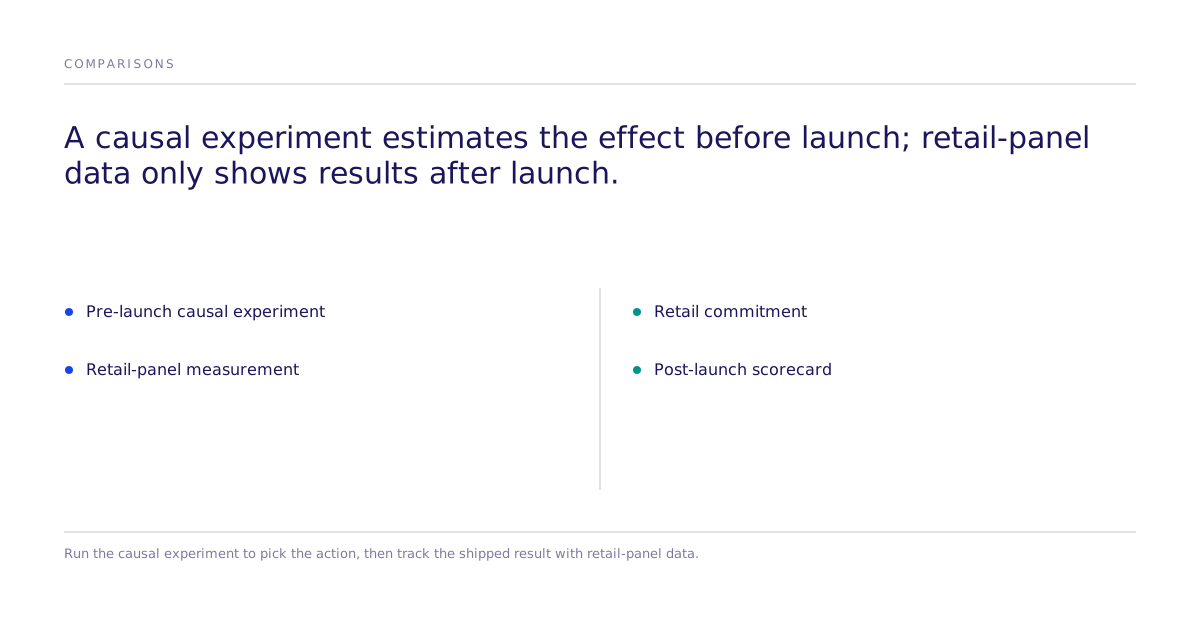
Choose the method by the decision in front of you
Retail measurement is the right instrument to monitor sales and market performance after launch. One current first-party product page describes its offering as a market-insights data platform for manufacturers (product overview).
A controlled causal experiment compares specific actions before launch and estimates which action changes behavior. That distinction matters when the team must commit shelf space, retail support, and marketing spend before observed sales exist.
| Decision point | Point-of-sale and retail-panel measurement | Pre-launch causal experiment |
|---|---|---|
| Core question | What happened after the change shipped? | What may happen if we make this specific change? |
| Best use | Monitor sales and market performance | Compare proposed prices, claims, or assortments |
| Evidence | Observed in-market transactions and panel data | Controlled behavioral choices in a defined study |
| Place in the workflow | Post-launch scorecard | Pre-launch decision evidence |
| Boundary | Does not estimate the causal effect of an unlaunched action | Does not track ongoing in-market sales or distribution |
Why does the expensive commitment come before the scorecard?
A pricing, claims, or assortment decision can trigger slotting fees, marketing spend, and retail commitments. If the choice is based on internal judgment alone, the first strong signal may arrive only after those costs are sunk and the decision window has closed.
A pre-launch experiment is not a replacement forecast for every market condition. It answers a narrower, consequential question: among the actions the team can actually take, which one has the strongest measured effect on buyer choice, and how uncertain is that estimate?
How do you test the action the buyer will encounter?
Subconscious runs controlled experiments on simulated populations to compare defined actions such as a price point, a product claim, or an assortment change. Where the study supports it, results include confidence intervals so decision-makers can see the estimate and its uncertainty.
Studies can be run against a person-level audience graph covering 800 million real people. That figure describes audience reach, not the number of people recruited into a study. When a team needs another layer of evidence, it can validate the finding with real human participants without changing the causal question.
This sequence gives a CPG team decision evidence before it commits retail capital: the experiment narrows which action is worth taking, and post-launch measurement tracks how that action performs in the market.
Keep the market scorecard
Pre-launch causal evidence does not provide point-of-sale tracking, continuous retail-panel measurement, syndicated buyer-survey infrastructure, or supply-chain and distribution analytics.
Market conditions can also differ from a controlled study: distribution, competitor actions, inventory, media, and execution may affect the observed result. The strongest evidence sequence uses each method for its own job:
- Define the price, claim, or assortment decision before launch.
- Run a controlled experiment on the specific alternatives.
- Use real-human validation when the decision requires it.
- Track the shipped outcome with point-of-sale and retail-panel data.
If the open question is which action deserves the retail commitment, discuss the decision and study design. If the open question is how the market performed after launch, keep the retail measurement platform at the center of the answer.