How to Test a Pricing Decision Before You Commit to It
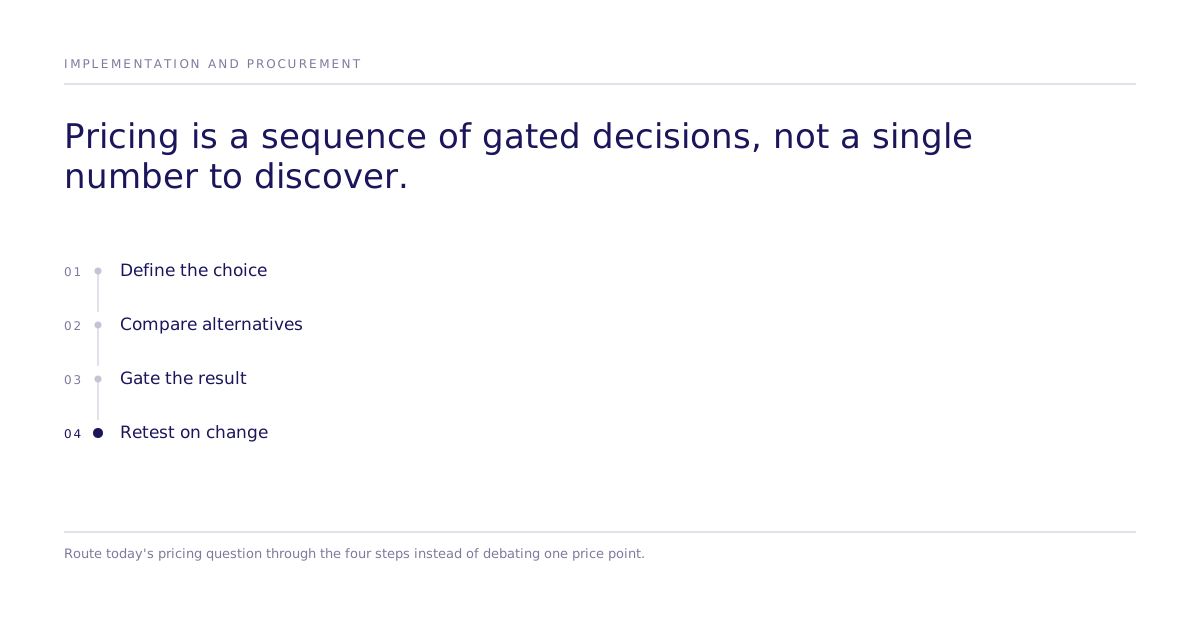
Set product pricing by testing a defined choice, not by searching for one perfect number. Compare concrete price points, packaging structures, or free-tier framing for one buyer segment. Measure which action changes stated purchase intent or preference. Then decide what deserves real-market validation.
Setting or resetting a first real price is expensive to reverse. Underpricing can cap revenue per account and signal low value to enterprise buyers. Overpricing can stop conversion before the sales and marketing motion pays off. Existing customers also notice price changes, so a poor entry price can compound instead of correcting itself.
McKinsey found that a 1% improvement in price can produce a roughly 6-11% improvement in operating profit, depending on the study cohort (McKinsey & Company, "The power of pricing").
An older planning heuristic makes the same point more bluntly: moving price by 10% does more for the business than moving customer acquisition by the same 10%.
What should you define before testing a pricing choice?
Name the buyer segment, the alternatives, the outcome, and the commercial constraints before comparing anything.
Bring these inputs:
- The product type, core features, and delivery model.
- The customer profile, company size, and relevant budget range.
- Current pricing, if any, and how it was set.
- The realistic alternatives a buyer would compare.
- COGS, CAC, operating expenses, and other unit-economics boundaries.
- The business objective, such as penetration, growth, profitability, or premium positioning.
The experiment tests buyer response to controlled alternatives; the commercial model determines whether a preferred alternative is viable.
Turn five questions into controlled comparisons
The most useful pricing questions become explicit actions and outcomes:
| Buyer decision | Alternatives to compare | Outcome to define |
|---|---|---|
| Which pricing model should launch? | Flat-rate, per-seat, usage-based, or freemium | Stated purchase intent or preference for the defined segment |
| Where should the entry price sit? | Selected price points positioned below, near, or above realistic alternatives | Directional change in purchase intent |
| Should there be a free tier? | The same paid offer with and without free-tier framing | Preference for the offer and intent to choose a paid option |
| How should tiers be packaged? | Controlled feature allocations across named tiers | Preference between the tested packages |
| Where does price resistance begin? | Defined price points with the rest of the offer held constant | The point at which stated purchase intent changes direction |
Keep the product, buyer definition, and outcome constant where possible. Otherwise a team cannot tell whether price, packaging, or a second change caused the difference.
What can Subconscious test?
Subconscious is the causal AI company. It runs randomized experiments on a simulation of the market and can validate studies against real human behavior. For pricing, the supported fit is decision-specific scenario testing.
A number without its limits is marketing. Uncertainty should be reported only when the study design supports it. The comparison does not calculate a complete commercial answer on its own.
The practical advantage is continuity. A team can move from a simulated experiment to real-human validation without changing the causal question. The intervention, alternatives, buyer population, and outcome remain aligned.
What can the evidence settle?
The misses sit on record next to the hits. The result can support a choice among the alternatives actually tested. It cannot establish a universally correct price.
Naming the failure mode here lets a buyer check the study against it. Do not infer a demand curve, portfolio switching effects, or a profit-maximizing price unless the study was explicitly designed to estimate that output. Do not treat stated preference as guaranteed market performance. Unit economics, contractual constraints, sales execution, and actual post-launch behavior still belong in the decision.
Use the evidence as a gate:
- Advance an alternative when the directional result is clear and the economics are viable.
- Revise the alternatives when the comparison does not separate them.
- Validate with real participants when the consequence of being wrong demands stronger confirmation.
- Monitor actual conversion, retention, and buyer response after launch.
Retest when the decision changes
Do not rerun the same study on stale assumptions. Retest when:
- A new tier or add-on changes the offer.
- A competitor changes the realistic choice set.
- Costs change the viable price range.
- The product enters a new buyer segment.
- Conversion changes without a clear cause.
Update the alternatives, buyer definition, and commercial inputs while preserving the outcome that matters.
Bring one pricing decision, not an entire price book
Start with the price, tier, or packaging choice that has the highest cost of being wrong. Review how a study moves from decision to evidence, see completed decision studies, or read the research behind the method. When the segment, alternatives, and outcome are clear, set up the pricing study.