Test Pricing Assumptions Before the Real Study
Before a pricing or product research lead commits budget to a conjoint or willingness-to-pay study, the real decision is narrower: which pricing assumptions deserve that fielding spend, and which ones a cheap directional round can kill first. Sending untested attributes, levels, or value language into a fielded study risks burning a validation slot on a hypothesis a faster check would have ruled out.
Why does this pricing decision matter now?
Research teams increasingly use AI for analysis, reporting, data preparation, and self-service insight, which puts pressure on the earlier stages of a pricing study, where assumptions get set before fielding budget is spent. That pressure does not remove the need for a fielded conjoint or willingness-to-pay study; it changes what happens before that study starts, moving the harder problem earlier: which attributes, price levels, and value-language options are worth fielding at all. Demand for the underlying research work is not disappearing either; the Bureau of Labor Statistics puts market research analyst and marketing specialist jobs on a growth path between 2024 and 2034.
What changes in scoping a pricing study
The old default was to field broadly and let the analysis sort out which attributes mattered. That still works, but costs more when several tested attributes or levels were never checked against a cheap directional read first.
A pricing lead who scopes the study well does two things: owns the question before any exploratory tool touches it, and owns the caveat after it produces output. That means naming the decision the study answers, what would change it, the confidence level required, and where a directional read could mislead if treated as final.
A four-layer evidence system for pricing assumptions
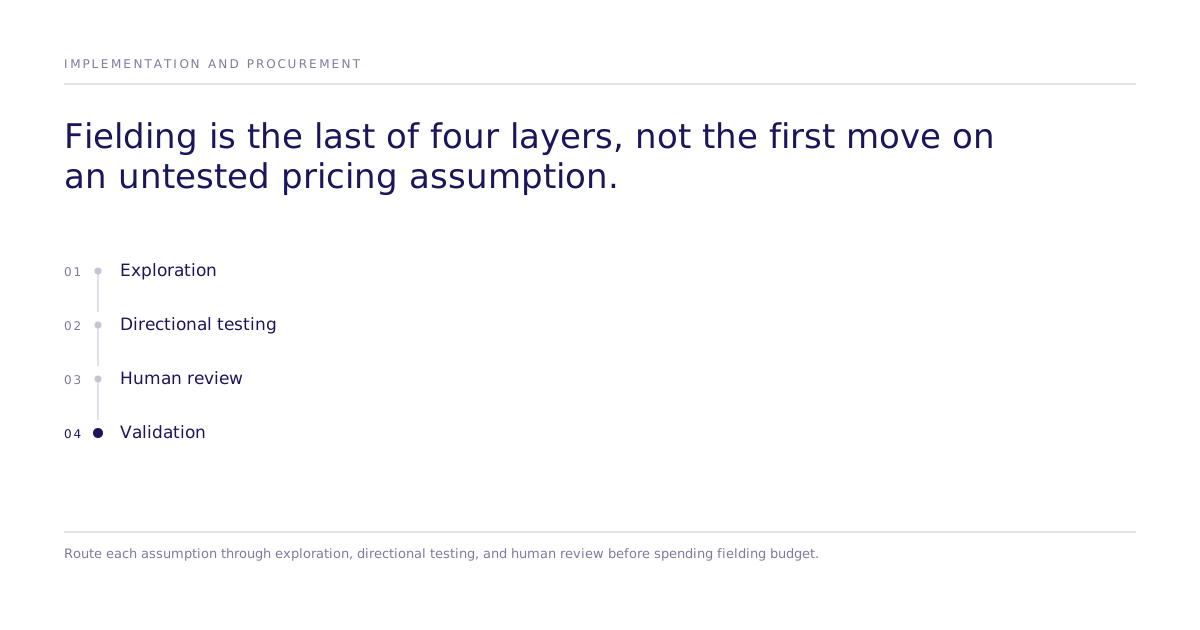
A pricing study should not jump straight from a hypothesis to a fielded conjoint. A clearer sequence keeps the expensive step for what needs it:
| Layer | What it does | When to use it |
|---|---|---|
| Exploration | Generate hypotheses, objections, and alternative pricing framings | Before any attribute list is finalized |
| Directional testing | Compare packaging, framing, or positioning options quickly on a controlled, simulated audience | Before committing to a fielded conjoint or WTP study |
| Human review | A person confirms the audience is defined correctly, the prompts stayed neutral, sources are grounded, and business context holds up | After every directional round |
| Validation | Run the real fielded conjoint, willingness-to-pay study, or other quant validation | When the pricing decision is expensive or public |
The value of the directional layer is not the output itself. It is a disciplined path to a safer, better-scoped fielded study, with clearer attributes, cleaner levels, and sharper hypotheses.
Where does Subconscious fit in that sequence?
Subconscious is a causal experiment layer for comparing pricing-adjacent actions, such as packaging, framing, and positioning, before the expensive fielded study runs. It is a controlled experiment on simulated buyers, not a substitute for a fielded conjoint or willingness-to-pay study, and its output is labeled directional until validated.
The workflow starts with the decision, not the tool. Write down what changes depending on the answer, then define the audience precisely: segment, context, current behavior, alternatives considered, and what the buyer is trying to accomplish. Run a focused stimulus, such as a pricing story, a packaging option, or a framing choice, and ask for reactions, objections, and comparisons. Compare segments and look for contradictions before treating an early answer as settled.
When the pricing decision is consequential enough to warrant it, Subconscious can test or validate studies with real human participants, moving from the simulated comparison to real-human testing without changing the underlying causal question. That step validates the narrower, better-scoped study the directional round produced, not a substitute for it.
What is the failure mode to avoid?
The mistake is treating a directional, simulated read as the answer the fielded study was supposed to produce, usually driven by a rush for speed, a confident-sounding output, and a deadline with no room to double-check it. A directional comparison and a validated willingness-to-pay result answer different questions; confusing them is the failure this workflow exists to prevent.
The fix is to make the limits part of the deliverable: state the directional round's intended use, where it does not apply, and what still needs validation before the business acts on it.
Limitations
Subconscious does not produce a final price for the buyer, settle willingness to pay, or replace a fielded conjoint or WTP study. It narrows which assumptions deserve that spend. A case study is the place to look for evidence a specific method held up in a specific market; this scoping question has none attached, so treat the approach above as a process recommendation, not a proof point.
What to do this week
- Pick a real pricing decision with budget attached.
- Write the pricing decision in one sentence: what changes depending on the answer.
- Define the audience and how much the decision can tolerate being wrong.
- Run a directional comparison on the packaging, framing, or positioning question, not the full attribute list.
- Have a person flag which output is usable, which is shaky, and what shouldn't be acted on.
- Decide which parts of the study still need real-human validation, and book time to scope that step.
Read more about how the underlying method works in Subconscious's research.