Which Consumer Insight Workflows Should Move to AI First?
A head of consumer insights does not need to decide whether AI touches the research function. It already has. The real decision is narrower: which workflows move to AI-assisted or synthetic-panel exploration this quarter, and which stay locked to real-respondent validation. Get the sequencing wrong and the cost is not one bad study. It is a research function that stakeholders stop trusting for a full budget cycle.
The decision this quarter
Five workflow types sit at the center of this call: concept screening, message iteration, segment hypothesis generation, journey questions, and report drafting. None of them is automatically safe just because a tool can produce fluent output for it.
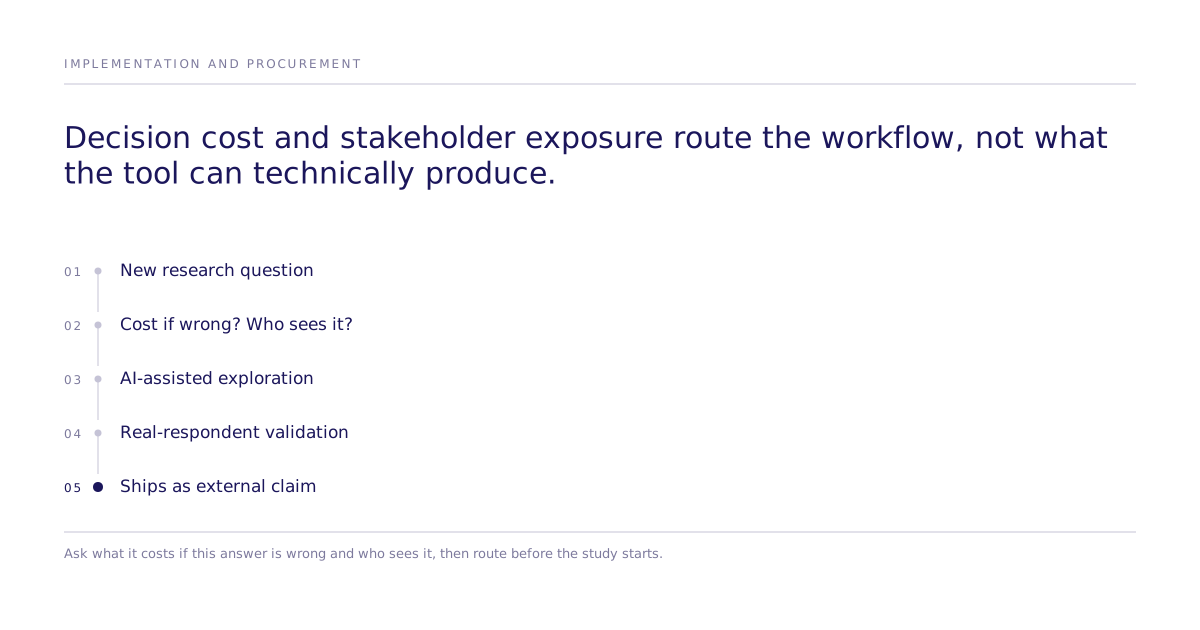
The variable that matters is not tool capability. It is decision cost and stakeholder exposure. A concept screen that narrows ten ideas to three before a creative sprint is a low-stakes, high-volume call: wrong here costs a redirected week of exploratory cycles. A pricing decision, a public claim, or an executive strategy call is a high-stakes, low-volume call: wrong here erodes stakeholder trust in the research function, not just in one study.
Why is the wrong sequence expensive?
Skipping validation on a high-stakes call and shipping a plausible-but-wrong synthetic read does more damage than the study itself. It teaches stakeholders that "AI-assisted" and "unverified" mean the same thing, and that lesson generalizes to every research output that follows, including the ones that were properly validated.
The opposite mistake carries a cost too. Routing a low-risk, exploratory question through a full fielded-validation process wastes a week that a lighter governance step would have caught in an afternoon. Both failure modes trace back to the same root cause: treating every workflow as if it carried the same stakes.
A sequencing framework, not a tool checklist
| Workflow | Typical stakes | First-pass fit |
|---|---|---|
| Concept screening | Low-to-moderate; narrows options before build cost is committed | AI-assisted / synthetic-panel exploration |
| Message iteration | Moderate; shapes creative direction before spend | AI-assisted / synthetic-panel exploration |
| Segment hypothesis generation | Low; generates directions to test, not conclusions | AI-assisted / synthetic-panel exploration |
| Journey questions | Moderate; informs experience design before rollout | AI-assisted / synthetic-panel exploration |
| Report drafting | Low; first-pass structure, not final claims | AI-assisted, human-reviewed |
| Pricing decisions | High; public and revenue-facing | Real-respondent validation required |
| Public claims | High; external, reputational | Real-respondent validation required |
| Executive strategy calls | High; capital-allocation consequences | Real-respondent validation required |
This table is a starting sequence, not a permanent map. A concept screen for a regulated product category can carry executive-level stakes. The governing question stays fixed regardless of category: what does it cost the business if this specific answer is wrong, and who sees it?
Where does causal discrete-choice testing fit?
Subconscious runs controlled discrete-choice experiments against synthetic populations and returns effects with confidence intervals rather than a single fluent-sounding answer. That distinction lets a research lead label a result honestly as directional, not as fact.
That property maps onto the exploration and directional-testing layers of this framework: concept screening, message iteration, and segment hypothesis generation. These are the workflows where a comparative directional read against defined alternatives is the useful output, not a final claim. The research methodology and how a Subconscious study runs end to end both describe how the confidence-interval format supports this kind of governed, sequenced use.
What limit has to stay explicit?
This is a sequencing and governance framework, not a claim that synthetic panels replace fielded validation for expensive or public decisions. Pricing, public claims, and executive-level calls still require real-respondent or behavioral validation before anything ships externally. Subconscious can test or validate studies with real human participants, which means a team can move from a directional synthetic read to real-human validation without changing the underlying causal question. The audience definition and the tested alternatives stay fixed while the evidence source changes.
Treat that boundary as a hard governance gate, not a suggestion. A finding that started as directional AI-assisted exploration does not become validated evidence through repetition or stakeholder pressure to ship faster. It becomes validated evidence when a defined population responds to the same tested alternatives under real conditions.
Building the habit
The workable version of this is not a one-time policy memo. It is a recurring practice: before each new research request, name the decision it feeds, place it against the sequencing framework above, and route it accordingly. Employment for market research analysts is projected to keep growing from 2024 to 2034, according to the U.S. Bureau of Labor Statistics, a sign the function itself is not disappearing. The workflows within it are what get resequenced.
Teams that build this habit end up with something more durable than a list of approved tools: a working system that can explain, for any output it produces, whether it is a directional hypothesis or validated evidence, and what has to happen before that difference stops mattering.