Why a Single Forecast Number Hides the Risk You're Actually Taking
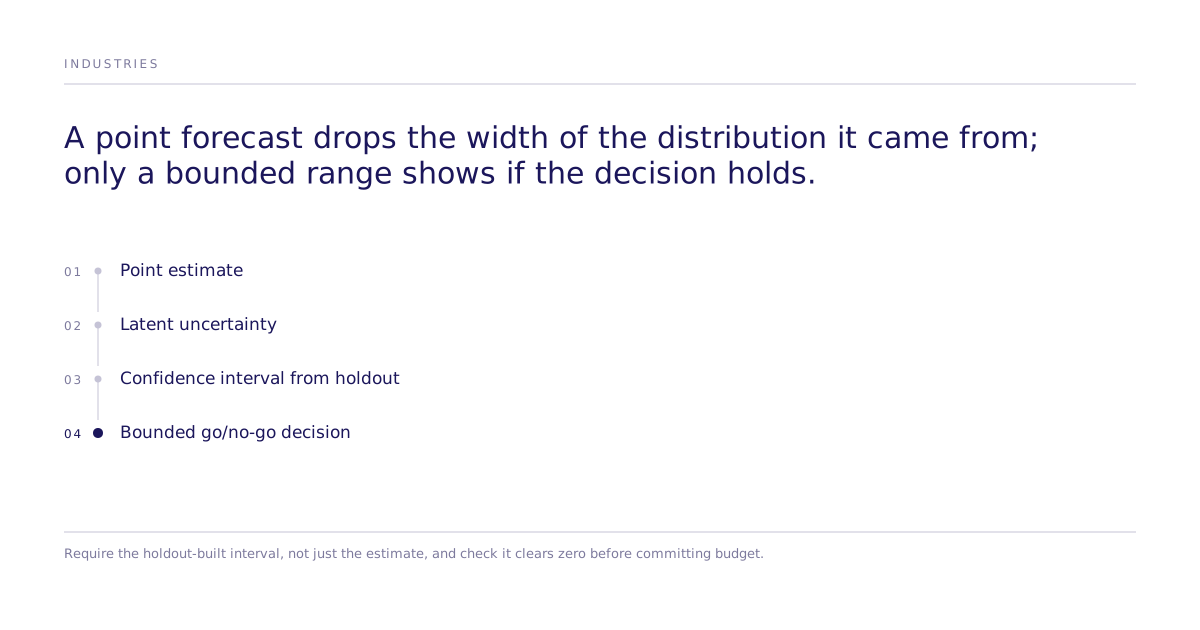
A single forecast number hides risk because it reports a point estimate without the range of error around it, so the same number can mask a wide swing between a safe bet and a reversal. A quant or growth-analytics leader asks for "the number" before a pricing or messaging change ships: a lift estimate, a projected response rate, a forecast. What rarely arrives with it is how much that number could be wrong. That gap is the actual decision: greenlight the action off a single point forecast, or require a bounded range before committing budget.
Why a point estimate hides risk it doesn't report
Markets and buyer response both carry time-varying volatility, the swing between calm and chaotic periods, not a fixed level of noise. Financial researchers model this directly: a stochastic volatility model in PyMC treats volatility as a latent variable that evolves over time, using daily returns of an index like the S&P 500 as the estimation target. The output isn't a single number; it's a distribution that widens or narrows with how turbulent the underlying period was.
A point forecast for a pricing or messaging decision throws that structure away. During a volatile stretch (a category disruption, a pricing war, a news cycle) the true range around that number can be wide enough to reverse the decision, and nothing in a single-number report says so.
What does "bounded" look like in a market decision?
The fix isn't a better point estimate. It's reporting the range alongside it: a confidence interval, error bars, a holdout comparison against a control condition. Subconscious runs randomized experiments and reports causal effects with confidence intervals and error bars rather than a single predicted number. A pricing or messaging option that clears its interval above zero is a different decision than one whose interval straddles zero, even if both report the same central estimate.
How to apply this before the next decision
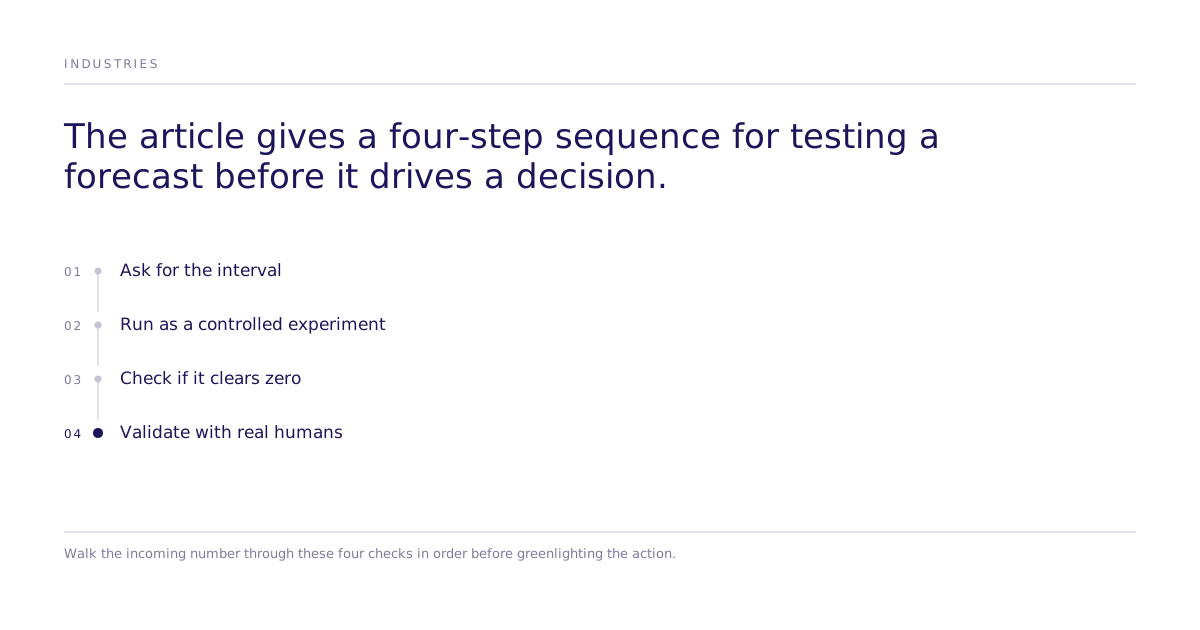
- Ask for the interval, not just the estimate. If a report gives one number with no range, treat it as incomplete rather than confident.
- Run the comparison as a controlled experiment. A causal effect needs a holdout to measure against, not an isolated forecast.
- Check whether the interval clears zero. An estimate with a wide interval that straddles zero is not evidence to act on, regardless of how large the point number looks.
- Move from simulated study to real-human validation when the decision depends on it. The same causal question can be tested first in a controlled simulated experiment, then checked against a recruited-human sample without changing what's being asked, whenever a wrong answer would carry real consequences.
Where does this not apply?
This is a decision discipline, not a financial-markets product. Subconscious does not forecast financial market volatility or asset returns, and is not a trading or time-series forecasting tool. The stochastic volatility example above illustrates why point estimates hide risk; it isn't a capability this product offers for market prediction. The confidence intervals Subconscious reports come from sampling and estimation error in a randomized experiment, not from time-varying market volatility; the two are different sources of uncertainty.
Next step
Before the next pricing, messaging, or GTM action ships on a single forecast number, run the comparison as a controlled experiment and check the interval it returns. See how the research methodology and leaderboard results report effects, or book a walkthrough built around your own decision.