How Partial Pooling Supports Decisions from Sparse Survey Data
A sparse survey can support a segment decision when the model shares information across related groups and the result carries its uncertainty. It cannot support the decision when a thin cell is presented as a precise standalone fact.
A decision case built on thin cells
A public-opinion team needs an estimate for a demographic or geographic segment. The overall survey is useful, but the segment has only a few observations. A direct cross-tab would let those observations dominate the answer. Collecting more data could help, but the team first needs to know whether the existing sample contains enough structure to support a model-based estimate.
That leaves two costly errors:
- Treat noise in a thin cell as a stable segment preference, then commit messaging or resources to it.
- Discard useful evidence and commission more sample before testing whether a hierarchical model can support the decision.
How does partial pooling change the evidence?
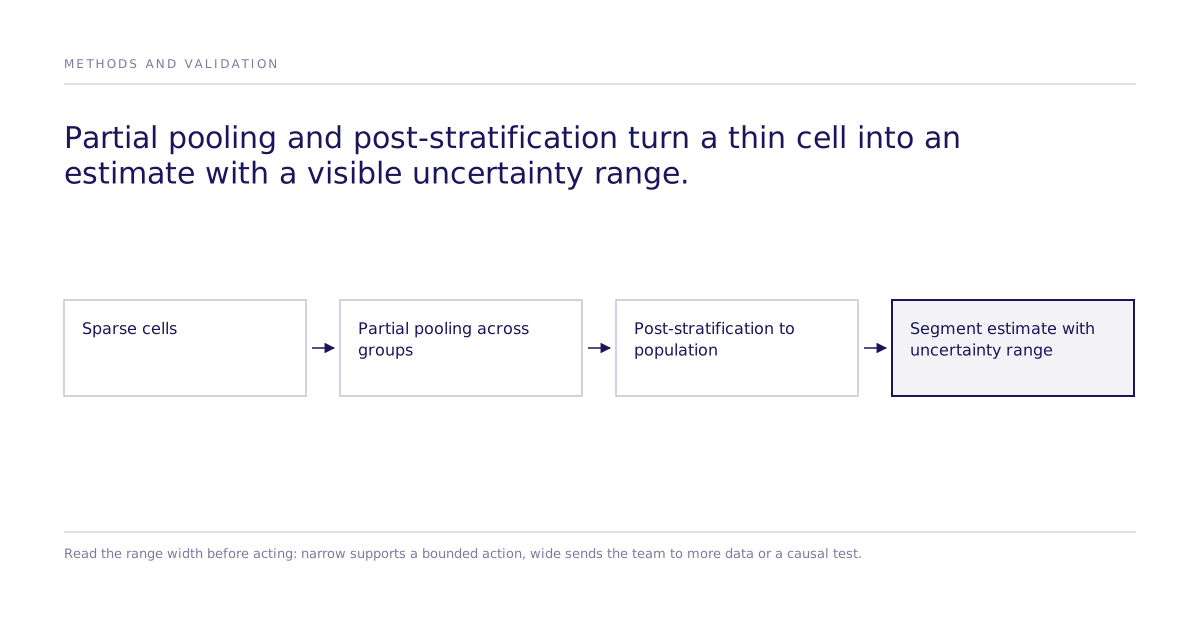
Multilevel regression and post-stratification (MRP) has two parts. First, a multilevel model estimates responses across demographic and geographic groups, allowing related cells to inform one another through partial pooling. Second, post-stratification weights those cell estimates to the composition of the target population (Using Multilevel Regression and Poststratification to Estimate Dynamic Public Opinion).
A data-rich cell is influenced more by its own observations. A thin cell is influenced more by the shared pattern in the hierarchy. The model does not erase the sparse segment. It makes the amount of direct and borrowed evidence explicit.
The method answers a different question from a direct cross-tab or a causal experiment:
| Buyer question | Appropriate method | Decision value | Main boundary |
|---|---|---|---|
| What did respondents in this cell say? | Direct cross-tab | Describes the observed sample | A thin cell can be unstable |
| What is the segment estimate for the target population? | MRP | Combines partial pooling with population weighting | The result depends on the hierarchy, predictors, and post-stratification data |
| Which action changes behavior? | Controlled causal experiment | Compares interventions against a decision-specific outcome | The result applies only within the supported population and study design |
What can the estimate authorize?
The estimate should change the decision only to the extent that its uncertainty permits. A concentrated range may support a bounded action. A wide range may support a provisional test, more data collection, or no action. Reporting only a point estimate hides that distinction.
Structured priors can help when an MRP model contains many interactions and sparse cells, but they do not remove the need to test whether the model is well specified (Improving multilevel regression and poststratification with structured priors).
A number without its limits is marketing. Three limits remain:
- The misses belong on the record next to the hits. The hierarchy can be wrong. Partial pooling helps only when the grouped segments share meaningful structure.
- Population weights are not a cure for missing variables. Post-stratification adjusts for included population dimensions. It cannot repair selection bias tied to factors the model does not represent.
- An estimate is not an intervention effect. MRP can estimate segment opinion or preference. It does not establish which message, product, or policy action caused a behavioral change.
The validation gate before action
For a product, pricing, or messaging choice, the next question is causal: which action changes the outcome for the segment? Subconscious uses controlled experiments on simulated populations to compare actions, with uncertainty reported where the study design supports it. The MRP estimate can help define the segment and prior evidence. It does not replace the experiment.
When the cost of a mistaken segment decision warrants another gate, Subconscious can test or validate studies with real human participants without changing the causal question. Human validation checks the decision against real behavior. It does not turn a model-based estimate into automatic proof of market performance.
Before acting, require a direct answer to four questions: What information was borrowed across groups? Which population counts shaped the estimate? How wide is the uncertainty? What evidence would cause the team to change its decision?