From Uncertainty to Insight: What Bayesian Reasoning Means for a Business Decision
A marketing or analytics leader deciding how much stock to buy, how to price a product, or when to worry about churn usually has a forecast in hand. What that forecast rarely carries is an honest statement of how wrong it might be. A single point estimate, such as "sales will be 1,200 units next month," hides the range of outcomes that are also plausible given the data. Commit budget against that number alone, and the business gets blindsided when real demand lands outside the range nobody wrote down.
Bayesian reasoning exists to fix that gap. It does not replace machine learning; it changes what a decision-maker is allowed to see before acting.
Why a point estimate is not enough
Traditional machine learning models are tuned to produce one answer. They are fit on historical data, optimized for accuracy on a validation set, and used to generate a prediction. That workflow works well when data is abundant and the cost of being wrong is small. It works poorly when either condition breaks down: when a business has too few observations to trust a black-box function, or when the decision at stake (a stocking commitment, a price change, a churn intervention) is expensive to reverse.
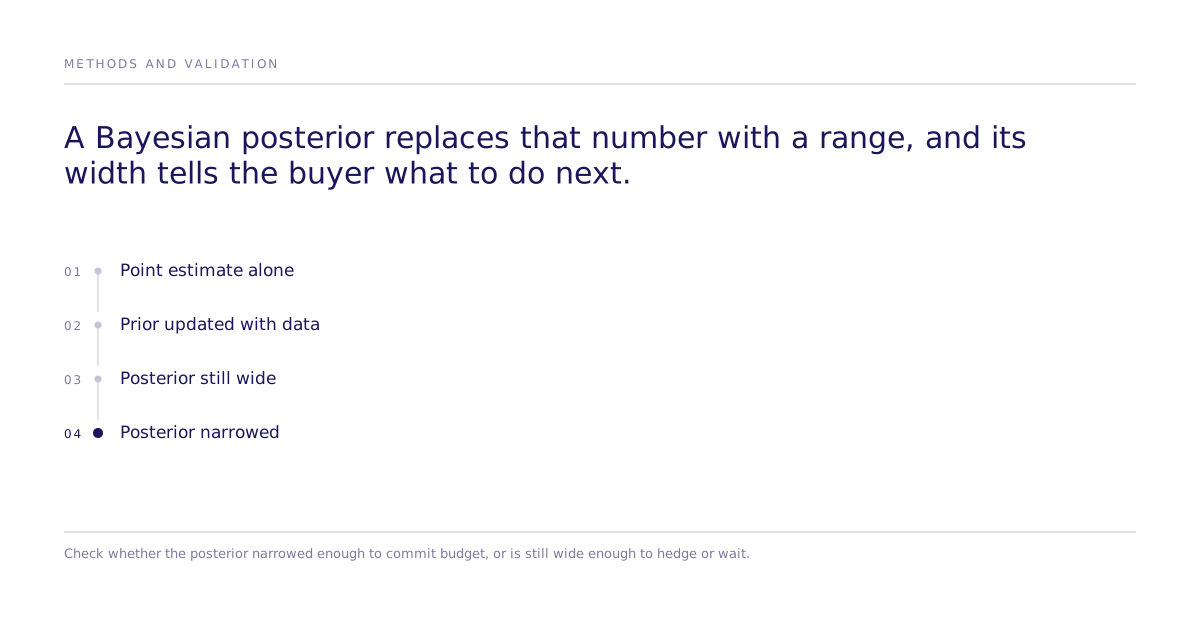
The core Bayesian idea is simple: start with a prior belief about an uncertain quantity, update it with new data through a likelihood function, and arrive at a posterior, an updated belief that blends what was already known with what the data just showed. With little data, the posterior stays close to the prior. With more data, it shifts toward what the data says. Either way, the output is a distribution of plausible values, not a single number.
That distinction matters most when data is scarce: new products, small markets, or infrequent events like churn spikes. A model that requires large samples is the wrong tool there; a Bayesian model that starts from a stated prior and updates as evidence arrives is built for it.
Where the uncertainty comes from
Bayesian models are not automatic. Building one requires specifying, in advance, an assumption about how the data was generated: the process a business believes produces the sales, spend, or churn numbers it observes. That upfront cost is real: a data scientist has to think about the shape of the problem before fitting anything. The payoff is a model that can be interrogated, updated, and reasoned about, instead of a black box that only answers the question it was trained for.
Hierarchical modeling extends the same idea across related groups. Instead of estimating each marketing channel, region, or product line in isolation, a hierarchical model lets information flow between them: a channel with thin data can borrow strength from the pattern across all channels, while still preserving its own individual effect. This is one reason Bayesian methods show up often in marketing attribution and mix modeling: channels rarely have identical data volume, and a hierarchical structure keeps a low-volume channel from producing a wildly unstable estimate.
The decision this changes
Uncertainty quantification is not academic. A posterior that is still wide, spanning a broad range of plausible unit counts, tells a buyer to gather more evidence, hedge the order, or delay the price change. What justifies acting is where the posterior mass sits relative to the decision threshold, not how narrow the posterior is; a narrow posterior can be confidently wrong. A point estimate alone cannot make that distinction; a distribution can.
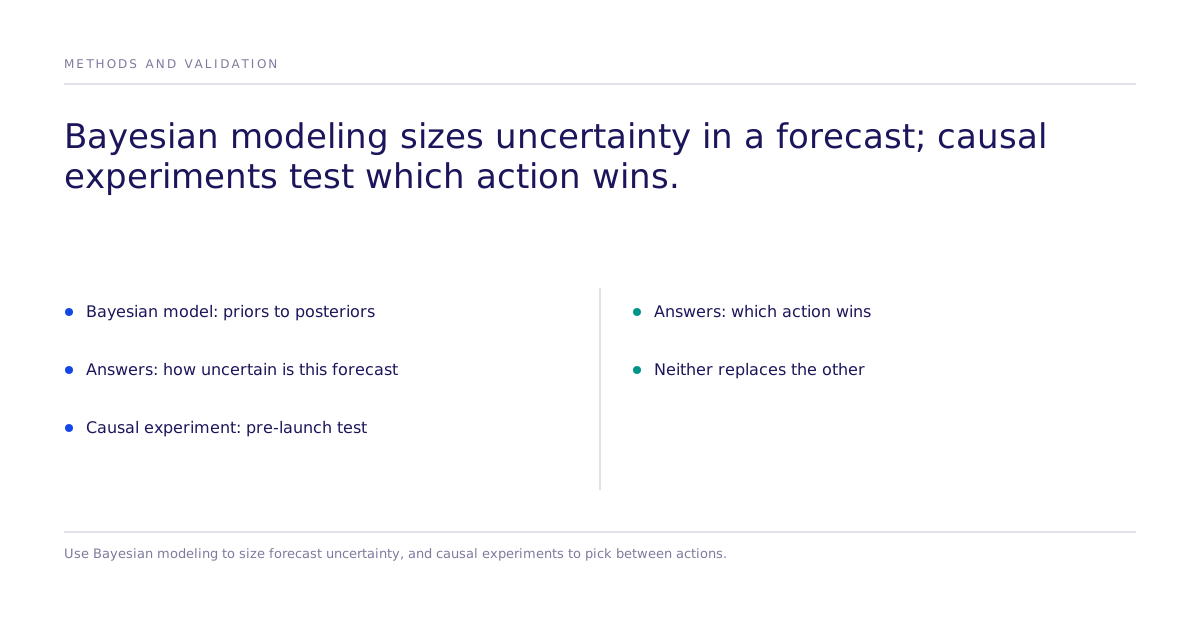
This is the same reasoning that sits behind causal experimentation more broadly. Subconscious runs controlled causal experiments on a simulated population that test product, pricing, messaging, and go-to-market actions before capital gets committed, and returns the resulting effects with confidence intervals attached: not a single predicted lift, but a range produced by a procedure with a stated, pre-chosen confidence level. A capability's boundary belongs next to the claim itself. A team gets confidence intervals around preference and willingness-to-pay parameters from a controlled experiment, not the demand or churn posterior a hierarchical Bayesian model would provide, without first building and maintaining that modeling infrastructure in-house.
When the decision depends on validation beyond a simulated estimate, Subconscious can test or validate studies with real human participants, carrying the same causal question from a simulated experiment into a real-human study rather than switching to an unrelated method.
What this does not replace
Bayesian data science, done properly, is a modeling discipline: specifying priors, checking them against domain knowledge, fitting hierarchical structures, and validating posteriors. That discipline still requires expertise, whether built in-house or brought in as outside modeling help. A causal experimentation platform is a different tool for a related problem: testing which action produces the better outcome, with a confidence interval attached to the result. Naming what a tool does not do lets a buyer check the fit before committing budget. It does not replace an in-house Bayesian modeling team, and it does not treat every study as a fully specified conjoint or MaxDiff design; those are structured techniques within a broader toolkit, not synonyms for it.
A capability claim needs its scope stated alongside it. The audience a causal experiment can reach and the participants recruited for a real-human validation study are two distinct capabilities: reach is not the same claim as recruitment, and neither should be read as a claim about sample size for any specific study design.
The practical takeaway
Recent applied work continues to formalize this approach for marketing decisions specifically. A 2025 paper on Bayesian marketing mix modeling works through building hierarchical structure into channel-level spend and response estimates so that low-data channels do not distort the overall attribution picture (Bayesian Marketing Mix Modeling for Roy Ravid Lemonade, Inc., arXiv). A related 2023 framework addresses cross-channel effects and channel influence bias directly, which is a confounding problem that uncertainty quantification alone does not resolve (A new framework for Marketing Mix Modeling: Addressing Channel Influence Bias and Cross-Channel Effects, arXiv).
The underlying lesson holds whether a team builds the Bayesian model itself or turns to a platform that returns causal effects with confidence intervals: a decision made against a range of plausible outcomes is better-informed than one made against a single number that hides how uncertain it really was. Before committing budget to the next stocking, pricing, or churn decision, ask what the estimate's uncertainty actually looks like, and whether that uncertainty is narrow enough to act on. Explore how Subconscious tests actions under uncertainty.