When a Forecasted-Control MMM Can (and Can't) Answer a Budget Question
A forecasted-control MMM can answer a budget question about known dynamics under expected future conditions, but it cannot tell a team whether an action its historical coefficients have never observed will work. A marketing analytics lead just allocated $30 million for next quarter's campaigns. The allocation plan depends on employment rates, temperature, and other external conditions the underlying Marketing Mix Model needs as inputs, for a quarter that hasn't happened yet.
That's the scenario-planning paradox at the center of most Bayesian MMM work. The model is good at explaining what already happened: how much of past sales each channel is estimated to have caused, once seasonality and other controls are accounted for and given the model's identifying assumptions. It is not, by itself, able to supply the future values of those controls.
Pairing a causal model with a forecasting model
One way to close that gap is to let two different models do two different jobs. A Bayesian MMM (built in a framework like PyMC-Marketing) keeps the causal structure under its identifying assumptions, such as no unobserved confounding and media spend that isn't itself driven by expected demand: it encodes how advertising drives sales through mechanisms like adstock and saturation, and it returns a coefficient for each control variable. A separate time-series foundation model, for example Chronos-2, a transformer-based forecaster Amazon released for general-purpose time series prediction, projects the values of upcoming control variables like temperature or employment from historical patterns (Introducing Chronos-2: From univariate to universal forecasting).
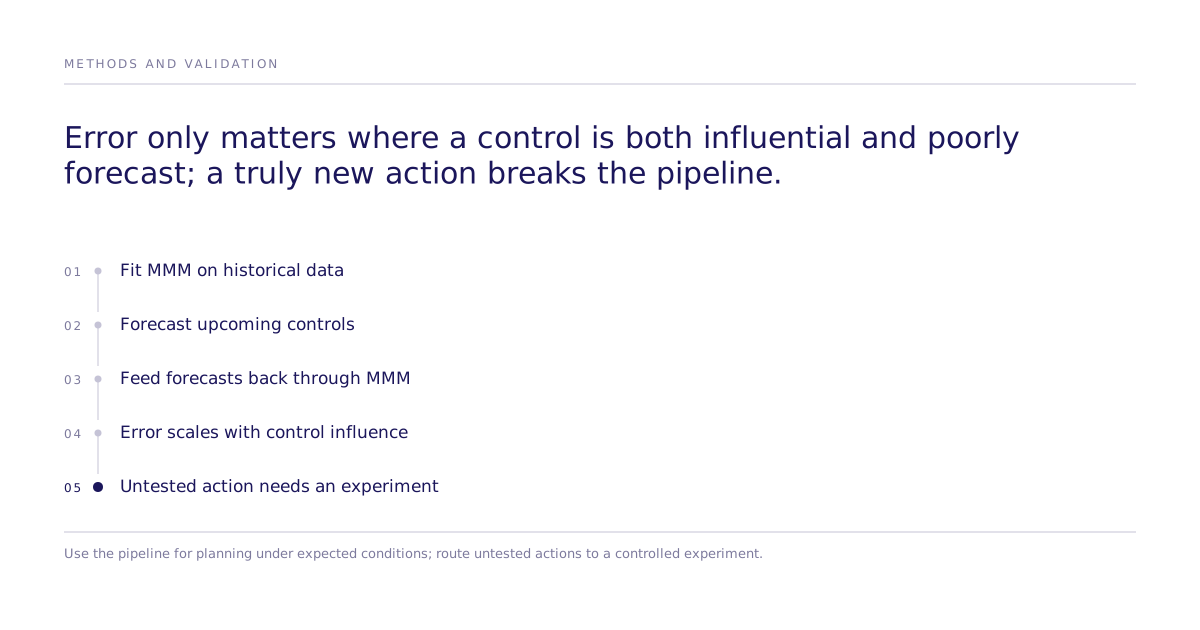
The pipeline runs in three steps: fit the MMM on historical media spend and controls to learn the causal coefficients, forecast the upcoming controls with the foundation model, then feed the planned media spend plus the forecasted controls back through the fitted MMM to get a sales prediction for the future quarter. The MMM's own causal structure, separating channel effects from control effects such as competitive activity, is itself an active area of methods work; a recent framework addresses channel-influence bias and cross-channel effects directly inside the MMM specification (A new framework for Marketing Mix Modeling).
Why doesn't a forecasting error always wreck the prediction?
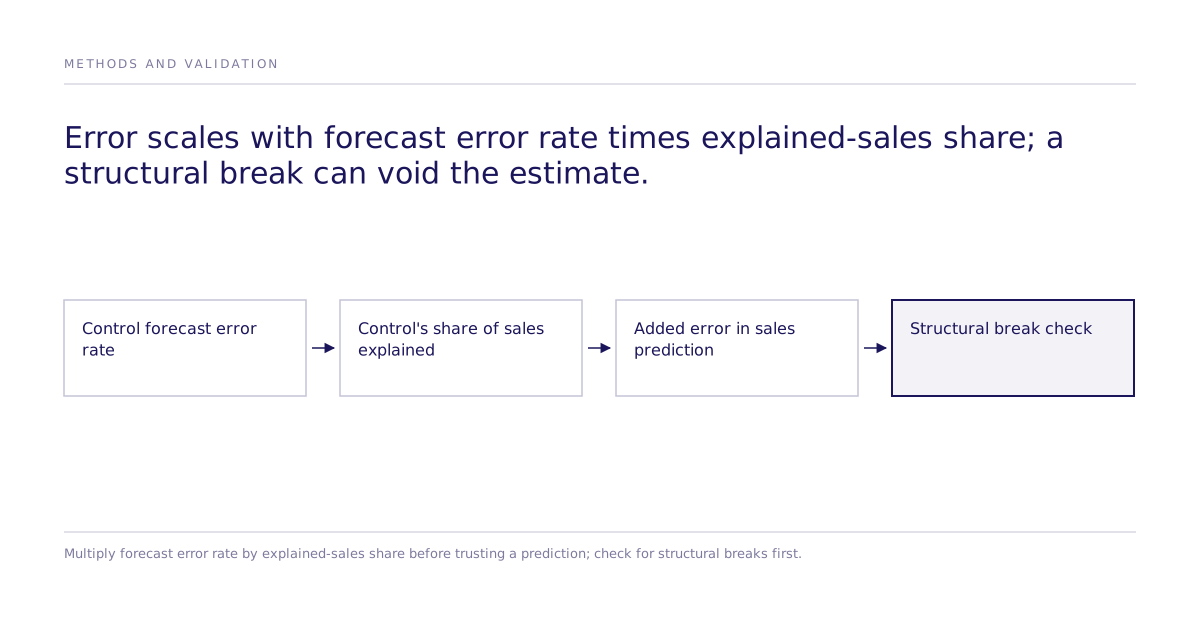
What matters isn't whether Chronos-2 forecasts controls well, but how much a forecasting error in those controls moves the final sales prediction. Each MMM prediction is the sum of a media-channel contribution and a control-variable contribution, where the control contribution is coefficients multiplied by control values. Swap in a forecasted control instead of the true one, and the resulting error in the sales prediction scales with two things: how large the forecasting error is, and how much that control actually matters to the model.
That gives a practical rule of thumb: multiply a control's forecast error rate by its share of the predicted sales level it contributes, and the result approximates the added error in the sales prediction. A control that swings the forecast but barely contributes to predicted sales doesn't matter, and neither does one that contributes to predicted sales but forecasts well. Only a control that is both influential and poorly forecast should worry a planner.
The rule assumes the control variables behave in a relatively stable, well-patterned way. A structural break, such as a pandemic, a policy shift, or a new competitor entering the market, can throw off even a strong forecasting model, and a control with a clean seasonal pattern will forecast far better than one without.
What can and can't this pipeline decide?
The hybrid approach fits a specific set of planning problems: allocating a budget three to six months out under expected market conditions, and running scenario analysis across optimistic and pessimistic economic assumptions to see how conditions shift the forecast, though shifting the optimal media split further extrapolates the media saturation curves beyond their historical spend support.
What it cannot do is tell a team whether an action the historical model has never observed will work. The MMM's coefficients are learned from what already happened. Forecasting the controls more accurately doesn't create a coefficient for entering a market the company has never entered, testing a price point it has never charged, or launching creative unlike anything already in the training data.
Where the decision has to move from forecasting to testing
That's the boundary that separates this pipeline from a controlled experiment. When the question is "how will this quarter's known dynamics play out given expected conditions," an MMM-plus-forecast pipeline that propagates control-forecast uncertainty through the coefficient posterior is the right tool, and a controlled lift-test experiment serves to calibrate the model's coefficients rather than duplicate what it already answers. When the question is "will this untested action work," there is no historical coefficient to extrapolate, and no amount of better control forecasting fixes that.
A controlled causal experiment on a simulated population is built for that second case. Subconscious runs the tested action, such as a new market, a new price, or a new campaign, against a defined simulated population and reads out the effect within that population, rather than projecting a coefficient that doesn't exist yet. Subconscious can test or validate those studies with real human participants as well, moving from a simulated read to a human-validated one without changing the underlying causal question. Teams weighing which side of that boundary a given planning question falls on can see how a study gets designed and run.