An AI Agent's Budget Recommendation Looks Confident. Is It Correct?
A marketing leader gets a channel-reallocation recommendation from an AI analytics agent: shift budget toward the channel with the strongest apparent lift. The charts are clean, the language is decisive, the numbers look plausible. Should that recommendation be funded as-is, or does it need an independent causal check first?
Fund it as-is only when the recommendation already comes with a confidence interval and a description of what was held constant. A single point estimate from a single agent run is not enough to act on, because a wrong answer and a right one can look identical.
The same failure recurs across agent runs
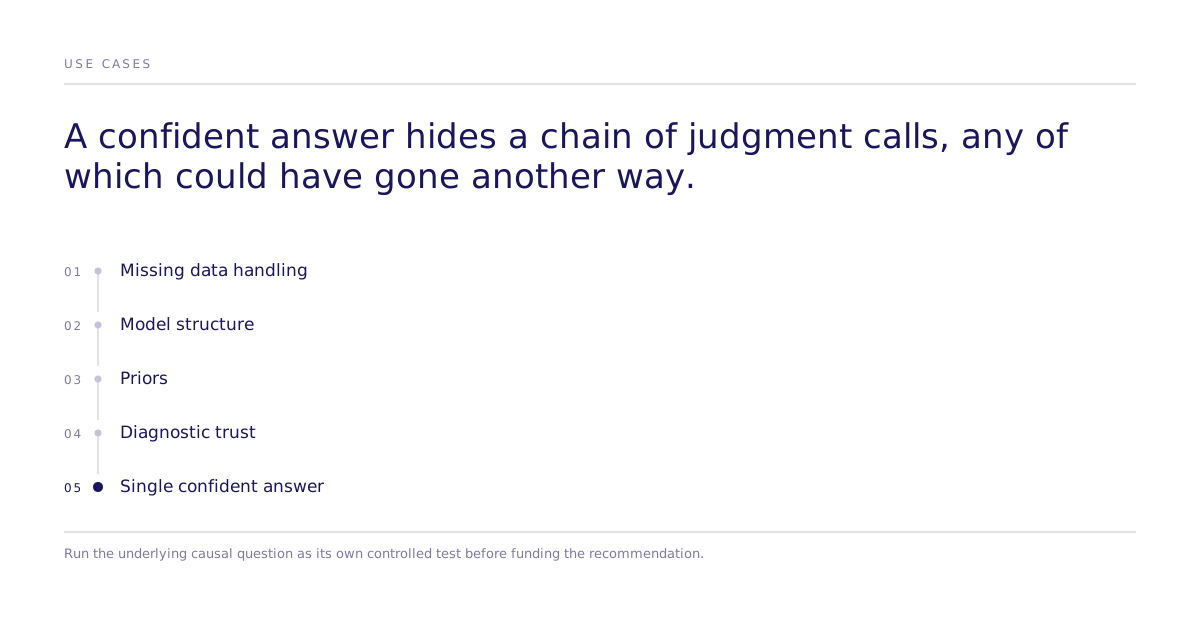
Autonomous coding agents write functioning code with high reliability. That is not the same as making a sound analytical judgment. A 2026 study by Bertran, Fogliato, and Wu gave identical datasets to autonomous agents and found the agents produced divergent conclusions across runs, with some runs reversing whether a hypothesis was even supported (Many AI Analysts, One Dataset: Navigating the Agent-Driven Data Science Multiverse). The code executed correctly every time; the analytical decision, meaning how to treat missing values, which model structure to fit, which priors to assume, which diagnostic to trust, was effectively random from one run to the next.
"Across three datasets spanning distinct domains, AI analyst-produced analyses exhibit substantial dispersion in effect sizes, $p$-values, and conclusions."
Bertran, Fogliato, and Wu, arXiv preprint 2602.18710 (source)
That is the mechanism behind the budget scenario above. An agent deployed for three months of executive reporting can produce fabricated conclusions from flawless code, and nothing in the output signals the difference.
A worked example: identical data, opposite recommendations
One documented test isolated the effect of adding structured domain constraints to an otherwise identical agent and task. Without them, the agent found zero converged models on a stochastic volatility problem. With them, the same agent converged on two of three identical runs.
| Condition | Result |
|---|---|
| Unconstrained agent | 0 of 3 runs converged on the modeling task |
| Agent with structured domain constraints | 2 of 3 runs converged on the identical task |
Nothing changed about the model, the dataset, or the agent running it; the sole difference between the two runs was whether the agent had to stay on methodologically valid paths before it could report a result.
The same pattern shows up in a marketing-mix example: given a noisy dataset with genuinely weak signal, an unconstrained agent recommended reallocating 100% of budget to television. A version of the agent built to check its own uncertainty instead reported that the signal was too weak to support a reallocation decision and recommended gathering more data first. Only one of those outputs was a decision a marketing leader should have acted on.
Why does the recommendation still need an outside check?
An agent engineered to flag its own uncertainty is a real improvement over one that isn't. It is still the same agent grading its own homework. A recommendation carries more weight when its verification comes from an independently run test, not the system that produced it.
Subconscious runs controlled, randomized experiments and reports causal effects with confidence intervals. A team can move from a simulated experiment to real-human validation without changing the causal question, which means the reallocation recommendation above can be tested against real respondent behavior instead of taken on the agent's word (research). Subconscious can also run controlled studies against a person-level audience graph covering 800 million real people, distinct from a recruitable panel of people who agree to participate in a study.
Before funding a reallocation, the practical check is to run the underlying causal question (which channel actually drives the outcome, and by how much) as its own controlled test, and see whether the agent's recommendation holds up against it (demo, how we work, case studies).
What does this analysis not cover?
Subconscious does not build, audit, or certify third-party AI data-science agent frameworks, and an independent causal check does not replace the domain-specific statistical diagnostics, such as convergence checks and residual analysis, that belong inside a modeling pipeline. What an outside causal test adds is a second, independently produced answer to compare the agent's recommendation against, on the specific decision that spend depends on.