AI Audience Simulation Platforms: What the 2026 Buying Wave Actually Tests
The number on the homepage is not the test that matters
By 2026, AI audience simulation split into a real market: synthetic panels, simulated target groups, AI focus groups, and behavioral audience simulation each solve a different buyer problem, and no platform wins every row. Several vendors now publish simulated-agreement figures ranging from roughly 80 percent up to the mid-90s against historical research benchmarks, not a Subconscious result and not an independently verified measurement of the study you are about to run.
The buying decision is narrower than "which platform has the highest accuracy number." It is: does this vendor prove its simulated output against a real human baseline before you commit budget to whatever action the simulation favored? A Tech Xplore report on AI survey respondents found that simulated opinions can diverge from public opinion in ways a self-reported accuracy score does not surface.
What Does a Self-Reported Accuracy Figure Actually Tell You?
A vendor benchmark answers one question: how often did this simulation's output match a past study the vendor had answers for. It does not answer whether the simulation will hold on the next question you ask it, because that requires holding out real human data you have not seen and checking the simulation against it.
Two vendor-published figures illustrate the gap between a marketing number and a validated one. Some platforms cite a correlation of roughly 90 percent to real research from a single partnership case. Others advertise a headline agreement rate stretching from about 80 percent to the mid-90s without stating the benchmark set, sample size, or whether the comparison used a holdout. Neither is proof that a specific study you plan to run will replicate.
What Is the Real Cost of Picking the Wrong Platform?
The cost of picking wrong is not "the simulation was inaccurate." It is committing a launch, price, or message decision to whatever a simulated panel favored, then discovering real customers respond differently once the campaign is live. A simulated agreement score does not tell you which specific choice caused a specific outcome.
Subconscious is the causal AI company. Randomized experiments on a simulation of your market, validated against real human behavior, tell you why people choose and which action drives the outcome. A number about scale is marketing until its limits are published alongside it. Subconscious can run controlled studies against a person-level audience graph covering 800 million real people. That audience graph describes modeling scope, not a recruitable panel of 800 million people available to survey directly. Subconscious can also test or validate studies with real human participants, moving from a simulated experiment to real-human validation without changing the causal question.
A comparison worth making before you buy
| What you are deciding | Vendor self-reported accuracy | Causal experiment with human-baseline validation |
|---|---|---|
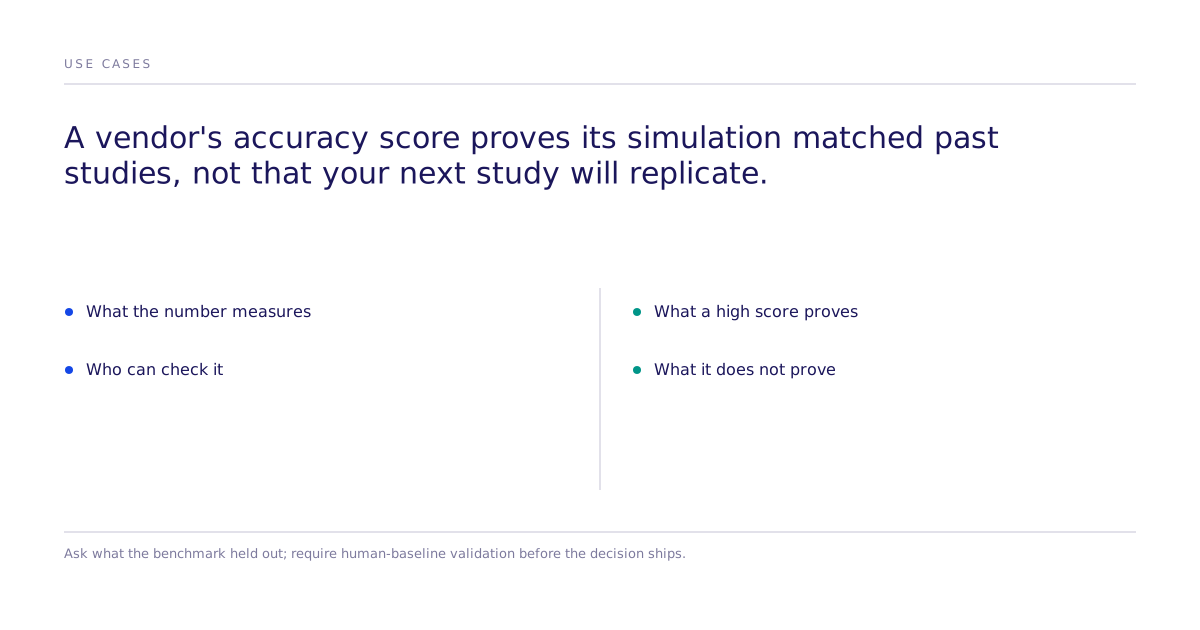
| What the number measures | Match rate against the vendor's own past studies | Whether a specific action changes a specific outcome, checked against real participants |
| Who can check it | The vendor, using benchmarks it selected | An independent replication against a holdout of real human responses |
| What a high score proves | The simulation resembled prior survey answers | The causal claim held when tested against real behavior |
| What it does not prove | Whether your next study will replicate | Nothing left unproven once validation runs before the decision ships |
Simulated reach is not recruited reach
This line is drawn here so a buyer can hold any vendor's claim, including ours, to the same check. Some vendors describe large-scale simulation as if it substitutes for a recruited panel. A simulation covering a large modeled population estimates how that population would respond; it is not evidence that a specific number of real people were asked and responded that way.
Where a simulation still needs a human check
Naming where a method stops is what lets a buyer check it before committing budget to it. Causal experiments on a simulated market do not replace real focus groups, in-person usability sessions, or lived-experience research where the value is qualitative depth rather than a directional answer. A simulation is not a clinical trial and is not automatic proof of market performance once a product ships. It narrows which action to test next and confirms that a causal answer holds before a team commits budget to it.
Next step
Before selecting a vendor on the strength of a self-reported accuracy figure, ask what the number was benchmarked against, whether an independent holdout of real human responses confirmed it, and whether the vendor can test the same causal question with real participants once the simulation points to an action. Review completed comparisons on the leaderboard, read the underlying research, or book time to see how a study moves from simulated experiment to human-validated answer.