AI Pricing Research Tools: How to Choose One for a Price Decision
A pricing study once meant a six-figure line item and a full quarter: staff a panel, commission a van Westendorp or Gabor-Granger exercise, then sit on the answer for three weeks before a price ladder reaches a decision-maker. In 2026, synthetic-audience pricing research compresses that loop to hours: build an audience calibrated to a real ideal customer profile, test price points and packaging, and get a directional read the same day.
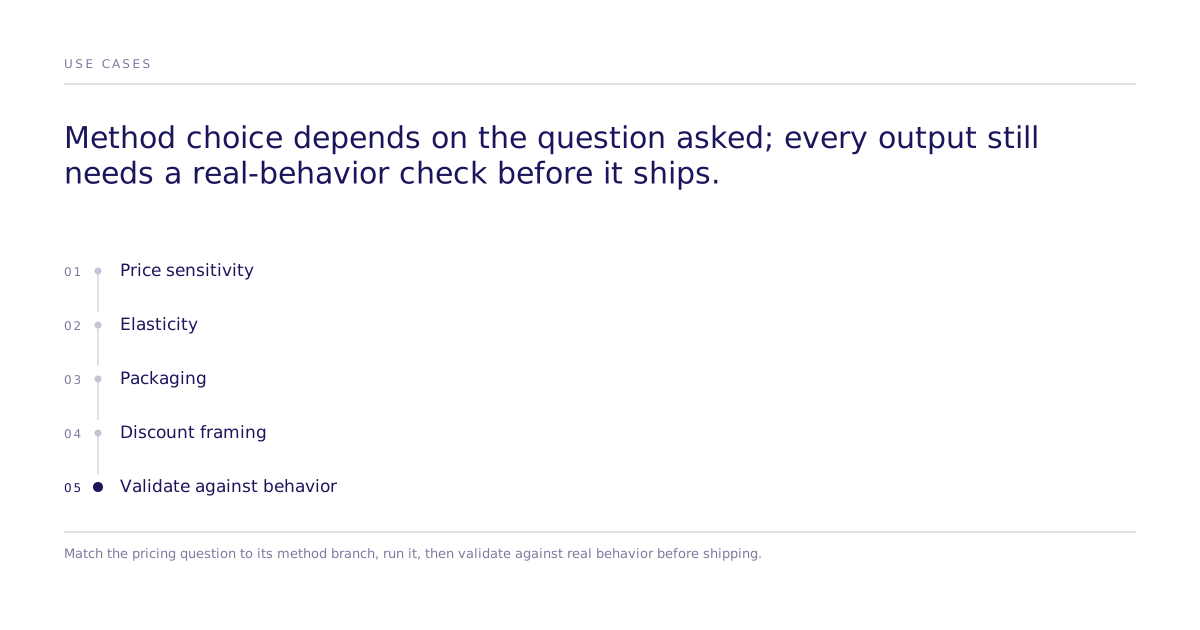
The decision this article answers: which price point, tier structure, or discount framing should ship before a launch or renewal cycle locks it in, and which method actually tests that question rather than just describing it.
Why the Decision Matters
A mispriced launch leaves revenue on the table or suppresses demand outright. A pricing study built on the wrong method wastes the research cycle along with it. A van Westendorp ladder answers a different question than a packaging test, and neither answers what happens when a price changes inside a live market with competitors reacting.
What Causes the Outcome
The tools in this space cover the same core question set that traditional pricing research answered by hand:
- Willingness to pay (van Westendorp). A price-sensitivity ladder built from four questions.
- Gabor-Granger. Direct price elasticity, walking a respondent through a price ladder.
- Conjoint and choice-based conjoint. Tradeoff modeling across price and product attributes; accuracy gets shakier once the category has no close precedent.
- Packaging tests. What a tier is called, how features get split across it, and where the anchor price sits.
- Discount and promotion testing. How big the discount is, how it's framed, and how much urgency the expiry date creates.
- Competitive pricing benchmarking. How an audience reacts to a price against a competitive set, in the audience's own words.
Where this approach breaks down: novel categories with no analog in the underlying training data, very small-segment elasticity (B2B categories with under 1,000 global buyers), and ultra-luxury categories where stated preference diverges from actual purchase behavior.
Evidence
The methods above elicit a stated preference from a simulated respondent rather than observing a real purchase decision, so accuracy depends on how the elicitation is designed and calibrated. Directly asking a model for a numeric price-sensitivity answer tends to produce unrealistic distributions; better methods elicit a fuller response and calibrate against a human baseline. Aggregate patterns (how a segment as a whole responds to a price) are easier to recover than individual-level fidelity. Known failure modes include variance collapse (every respondent converging on the same answer), demographic flattening, and over-rationality relative to how people actually behave.
Vendors in this category report accuracy in the range of 80 to 95 percent against historical research benchmarks on directional pricing tasks. That figure describes the category generally, not a specific tested claim; treat it as a planning reference rather than a guarantee for any single study.
Nine AI Pricing Research Tools Compared
| Tool | Best For | Pricing |
|---|---|---|
| Aaru | Modeling price dynamics | Enterprise, high ACV |
| Evidenza | Enterprise procurement | Enterprise, on request |
| Conjointly | Conjoint specialist | Per-study, subscription |
| Synthetic Users | Pricing-page language | Self-service subscription |
| OpinioAI | Early-stage, solo consultants | From $99/month |
| Electric Twin | Consumer brands, at scale | Enterprise, on request |
| Lakmoos | Regulated compliance | Enterprise, on request |
| Qualtrics XM | Existing Qualtrics stack | Enterprise, high ACV |
| Sanctum | Pre-launch gating | Self-service |
1. Aaru: Behavioral Price-Dynamics Modeling
A multi-agent simulation approach, validated by EY at around 90 percent correlation (EY, "How AI simulation accelerates growth in wealth and asset management"). Models how a price change cascades through an audience, including referral effects and competitive response.
Best for: modeling price like a system, not one fixed number.
Pricing: enterprise, high ACV.
2. Evidenza: B2B Pricing Research
Started by people who ran the LinkedIn B2B Institute. Its synthetic respondents are built to hold up under procurement scrutiny: CFOs and procurement roles, not a generic consumer panel.
Best for: enterprise procurement cycles.
Pricing: enterprise, on request.
3. Conjointly: Specialist Conjoint Research
A conjoint-only platform whose methodology predates AI and is now adding synthetic-respondent capability.
Best for: a conjoint specialist with a track record.
Pricing: per-study and subscription.
4. Synthetic Users: Pricing UX Research
Simulated respondents that react in their own words to pricing copy, plan names, and how a package is laid out.
Best for: refining pricing-page language or tier framing.
Pricing: self-service subscription.
5. OpinioAI: Budget Pricing Research
Runs AI-moderated synthetic focus groups to gauge price reactions.
Best for: early-stage teams or a solo consultant.
Pricing: from $99 per month.
6. Electric Twin: Large Consumer Pricing Studies
Has built synthetic crowds for major media brands, backed by $14M in funding.
Best for: a consumer brand scaling pricing studies.
Pricing: enterprise, on request.
7. Lakmoos: Regulated-Industry Pricing Research
German neuro-symbolic AI with an audit trail, relevant when a price change needs to be defensible, such as in regulated financial products, insurance, or healthcare.
Best for: pricing under real compliance pressure.
Pricing: enterprise, on request.
8. Qualtrics XM: Enterprise Standard With Pricing Modules
Qualtrics now ships dedicated pricing research modules, including van Westendorp and conjoint. It runs slower and costs more than AI-native alternatives, but the platform is already sitting inside most large enterprises' stacks.
Best for: enterprises already running Qualtrics.
Pricing: enterprise, high ACV.
9. Sanctum: Pre-Launch Pricing Validation
Runs pricing options past simulated users before a public launch.
Best for: gating a pricing decision before launch.
Pricing: self-service.
A 15-Minute Workflow for Testing a Price
- Build the audience. Anchor 5 to 10 personas, spanning the segments sold into, to a real ideal-customer-profile.
- Run van Westendorp. Put the four standard price-sensitivity questions to each persona, then aggregate the answers.
- Run Gabor-Granger. Take each persona through a price ladder, step by step, and aggregate the result.
- Test packaging. Show 2 or 3 packaging options and ask which would be bought, and why.
- Cross-validate qualitatively. Take the resulting recommended price to a 1:1 conversation with a key persona, present the price, and capture the objections.
In under 20 minutes, that produces a defensible price recommendation, a packaging recommendation, and the likely objections. The traditional version takes 3 to 4 weeks and runs $30k to $80k.
How to Pick a Method for the Decision
- Behavioral dynamics on a price change: a system-modeling tool like Aaru.
- B2B procurement realism: a specialist like Evidenza.
- Conjoint specialist with an established methodology: Conjointly.
- Lowest entry cost: OpinioAI.
- Regulated pricing: Lakmoos.
None of these tools tests what happens when the price actually changes in front of a defined audience under controlled conditions. They describe stated preference. A causal experiment fills that gap.
Where Does Subconscious Fit Into Pricing Research?
Subconscious runs a controlled, randomized experiment comparing defined price and packaging alternatives across precisely defined buyer segments, so the price decision is backed by a measured behavioral comparison rather than a single ranked number from a stated-preference survey. See current research methodology for how the experiments are structured, and case evidence for how the results have held up.
Subconscious can also validate a study with real human participants without changing the underlying causal question. That step matters most when the price decision is large enough, or novel enough, that a stated-preference read alone is not sufficient evidence to act on.
What Are the Limitations of AI Pricing Research?
A pre-launch price experiment does not replace a live A/B pricing test, sales and renewal negotiation evidence, or judgment calls in novel categories and very small B2B segments where no comparable behavioral data exists. Treat a synthetic-audience pricing read as evidence that narrows the decision, not the final word. Book a working session to scope which stage of that process fits the current decision.