Choosing AI Feature Disclosure Wording Before It Ships
A product or trust-and-safety leader signing off on a new AI feature must choose the exact sentence beside the activation control: which verb voice describes the data use, whether a retention window is stated, and how visible the opt-out is. That choice should be tested before the feature flag flips. Once the sentence ships to the full user base, reversing a poor choice is expensive.
The decision comes down to a few specific wording choices
The same underlying data-use fact can be written several ways, and each version lands differently with a reader deciding whether to trust the feature.
| Wording choice | What a reader takes from it | Risk if the choice is wrong |
|---|---|---|
| "We use your data to improve the product." | Direct, ongoing use, no conditionality. | Reads as broader than intended if the actual use is narrow. |
| "We may use your data to improve the product." | Conditional, possibly evasive. | Can read as a hedge that avoids naming a specific data flow. |
| "Your data is used to improve the product." | Passive voice, no stated actor. | Obscures who is doing the using, which a compliance-minded reader notices. |
| No retention window stated | Reader assumes the longest plausible retention. | The omission itself functions as disclosure of an unbounded default. |
| Opt-out named and reachable from the same screen | Reader can act on the disclosure immediately. | Absence drives away a reader who would otherwise adopt the feature. |
Publishing what each review method covers, and what it leaves untouched, is what lets a buyer check the fit before relying on it. Legal review can determine whether each statement is complete and true. It does not by itself estimate how a reader will interpret each version or how that interpretation will affect opt-in behavior. Those are behavioral questions.
Getting the wording wrong is costly in both directions
The Federal Trade Commission says required disclosures must be clear and conspicuous, taking into account their placement, proximity, prominence, and whether their language is understandable to the intended audience (FTC, How to Make Effective Disclosures in Digital Advertising). Federal agencies have also stated that existing consumer-protection law applies to automated systems and their marketing (FTC AI Policy Statement).
Wording that under-discloses invites regulatory attention and, separately, drives complaint volume and feature abandonment once users feel misled after the fact. Wording that over-discloses, by hedging or stacking qualifiers out of caution, can suppress adoption of a feature people would otherwise use. Both failures are hard to walk back once the copy is live in front of every user, which is why the specific wording deserves a causal answer before launch rather than a legal read followed by silence until support tickets arrive.
What does disclosure copy do?
Most product copy does one job: it explains a feature. Disclosure copy does two jobs in the same sentence: it informs the reader about a data practice, and it asks the reader to decide whether to keep using the feature next to it. Research on how users perceive and respond to manipulative interface language in AI products shows why technically truthful wording can still feel evasive or coercive to the person encountering it (The Siren Song of LLMs: How Users Perceive and Respond to Dark Patterns in Large Language Models).
How do you test wording before it ships?
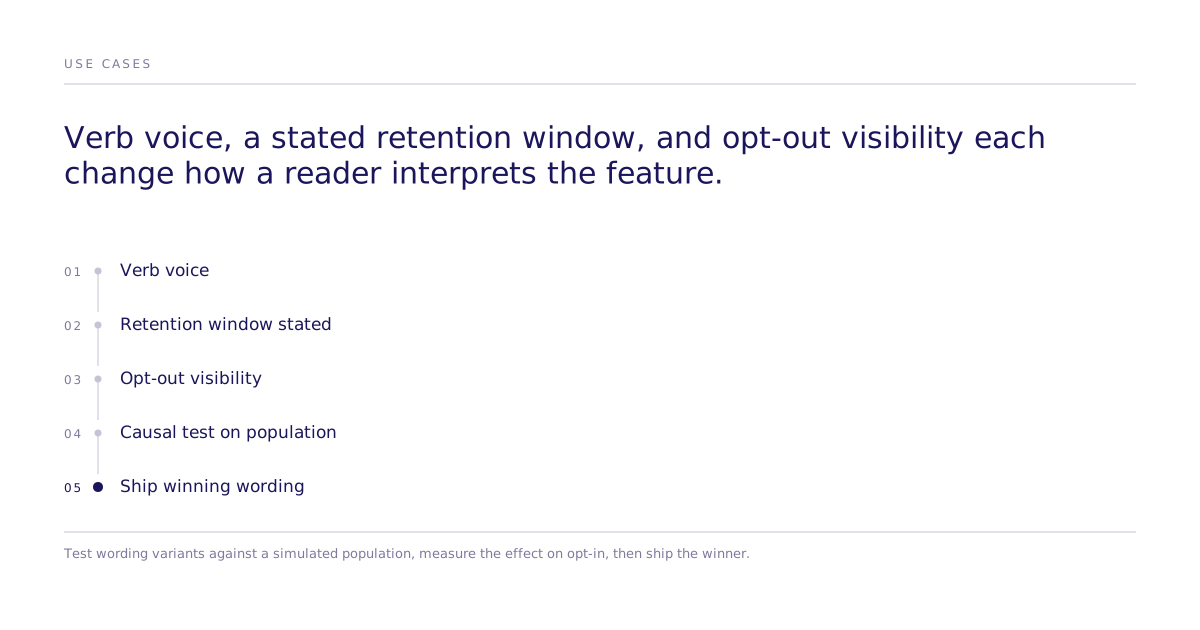
Subconscious can run a controlled experiment comparing the exact disclosure-copy variants a team is deciding between, such as the verb-voice options above, against a simulated population, and measure the behavioral effect on an outcome like opt-in rate. The causal question, which wording moves the outcome and by how much, gets set up before the copy goes live. This is a message-comparison study: it estimates which specific alternative performs better and reports the uncertainty around that estimate.
That comparison runs against a person-level audience graph covering 800 million real people. A reach number needs its limits stated next to it, or it reads as marketing rather than a method description. This is a statement about experimental reach, not a claim that all 800 million form a recruitable pool for interviews (research). When a decision is high-stakes enough to warrant it, the same causal question can move from the simulated comparison to a study with real human participants without changing what is being measured, so the team is not re-deriving the question from scratch at the higher-stakes stage (how we work).
What does this kind of test not replace?
Naming exactly what a test does not cover is what lets a buyer check for the gap before relying on the result. A behavioral comparison of wording variants measures how a specific population responds to specific sentences. It does not substitute for legal or compliance review of procedural completeness: whether a stated retention window matches the real practice, whether every third-party processor is correctly named, or whether the disclosure meets requirements in every jurisdiction where the feature ships. Legal sign-off is still required regardless of which wording performs best in the comparison. The two reviews answer different questions, and skipping either one leaves a gap the other was never designed to close.
Where to start
Most product teams have at least one AI feature moving toward a launch decision, and it ships with disclosure copy that has to make a specific wording choice. Reviewing case studies of how a causal comparison is set up, or booking a demo to walk through a specific disclosure decision, is a reasonable next step before that copy goes into the screen.