Market Research Automation: What to Automate and What Still Needs a Causal Test
A VP or Director of Consumer Insights weighing AI-driven research automation faces one real decision: which parts of the workflow are safe to automate, and which decisions require a controlled experiment before the team commits capital. Automating logistics and validating an answer are not the same problem; treating them as interchangeable is where the risk lives.
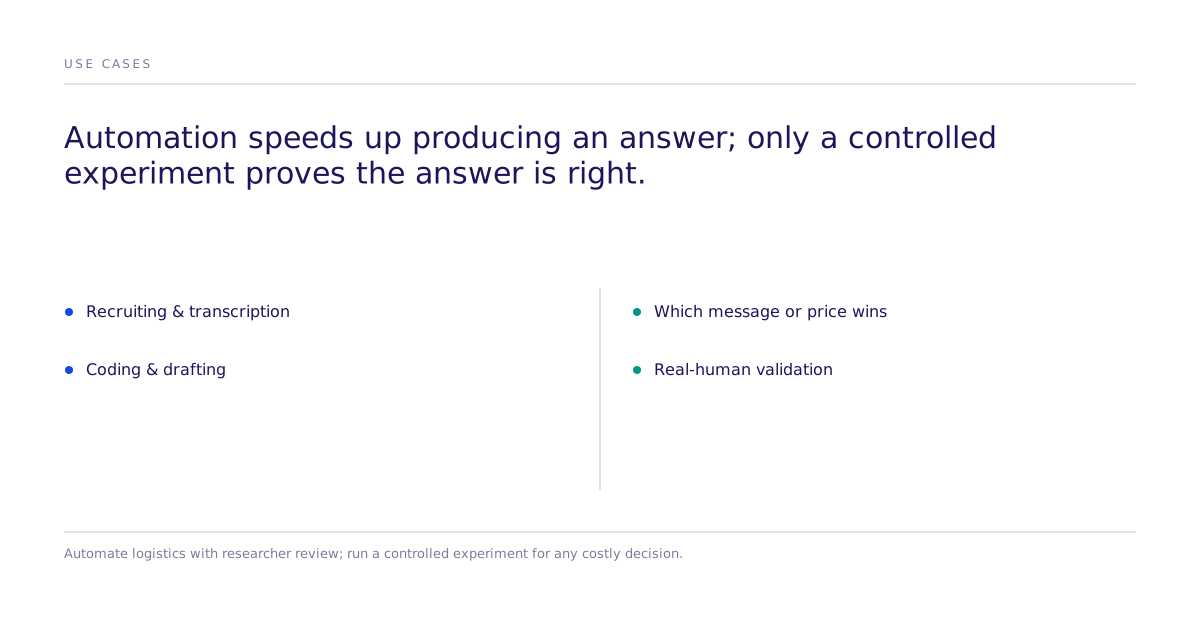
What automation actually removes from the workflow
These logistics tasks now run through AI tools competently:
- Transcription and speaker separation. Automated tools produce a searchable transcript from a recorded interview without manual typing.
- First-pass qualitative coding. AI can tag transcripts against predefined codes or surface emergent themes, giving an analyst a starting point.
- Survey drafting. AI can draft a survey's question types, wording, and skip logic from a research question and target audience, for researcher review.
- Report drafting. AI can synthesize findings from multiple sources into a structured first draft for a researcher to edit.
- Screener and recruitment messaging. AI can draft participant screeners and scheduling messages, cutting fieldwork's administrative overhead.
Listing what a tool does without its ceiling is marketing copy. None of this changes what the research found. It changes how much labor it took to produce the write-up.
What automation does not remove
A tool's task list means little without the tasks it skips listed too. Four things stay with the researcher regardless of tooling:
- Strategic question formulation. Knowing what to research, which hypotheses matter, and what decision it needs to inform requires organizational context automation doesn't have.
- Insight interpretation. Software can surface a pattern; deciding whether it's meaningful and what to do about it is a judgment call.
- Stakeholder buy-in. Getting a finding to change a decision requires navigating organizational politics, not just producing an accurate report.
- Direct behavioral observation. Ethnographic and in-context usability work requires physical presence and human perception. It cannot be simulated.
What gap does automation not close?
Automating logistics answers how fast a project moves. It does not answer whether the underlying method produces a causally valid answer about what customers will do. A team that treats every research question as safe to automate can ship a pricing, launch, or messaging decision a controlled experiment against real behavioral outcomes would have contradicted. The cost is the wrong action taken, not the hours saved on transcription.
The 2026 GRIT Insights Practice Report and Greenbook's coverage of AI adoption in qualitative research both track this split: research teams are automating operational overhead faster than they're changing how they validate a decision before it ships.
When is a controlled experiment the better tool?
For decisions with real cost if the team is wrong, such as a pricing change, launch message, or positioning shift, the question isn't "can we produce an answer quickly" but "does the answer describe what a real audience would actually do." Subconscious runs controlled experiments on a simulated market to estimate which action moves a specific behavioral outcome, then validates that study with real human participants when the decision warrants it. Subconscious also runs controlled studies against a person-level audience graph covering 800 million real people; that reach describes the scale for comparison, not a recruitable panel.
This is a different layer from logistics automation: it addresses whether the answer itself would hold up against real behavior before the team acts on it.
| Workflow stage | What automates it | What still requires a causal test |
|---|---|---|
| Recruiting, scheduling, transcription | Automation tools | n/a |
| First-pass coding, survey drafting, report drafting | Automation tools, reviewed by a researcher | n/a |
| Which message, price, or concept wins | n/a | A controlled experiment against a defined behavioral outcome |
| Whether the result holds with real people | n/a | Real-human validation of the same study |
Limitations
A method's reach means little without its limits attached, and naming them here is what lets a buyer check the method before staking a decision on it. An 800-million-person audience graph is not a recruitable participant pool. A simulated experiment is a first pass on a causal question, not a replacement for real-human validation on a high-stakes decision. Subconscious does not automate strategic question formulation, insight interpretation, or stakeholder buy-in. Those stay human judgment calls regardless of method.
Where should a team start?
Sort the research backlog into two piles: logistics work automation can absorb today, and decisions that carry real cost if the team gets the causal question wrong. For the second pile, see how Subconscious runs a study or book a walkthrough against a specific pricing, launch, or messaging decision.