What to Run Before a Qualtrics Survey When You Need the Why
A CMO or VP of Consumer Insights fielding a large Qualtrics wave has one decision to make before launch: whether the concept, message, or driver about to be measured is the right one to test. Skipping that check risks a clean, statistically valid survey that answers a question the business didn't need answered.
Why a survey-first sequence backfires
Qualtrics Core XM is built for structured data collection: fixed questions, closed-ended or Likert responses, and large respondent counts. That makes it a strong choice for employee-experience surveys, customer-satisfaction tracking, and large academic-style studies. A tool's blind spots belong in the open, next to what it does well. Qualtrics Core XM also can't explain why a score moved. A "somewhat dissatisfied" rating flags a problem area. It doesn't reveal the underlying driver, the alternative the customer considered, or whether the issue is a deal-breaker or a minor annoyance.
Committing budget and a multi-week fielding cycle before that driver is known risks discovering the concept or question set was misspecified only after the field window has closed.
The exploratory step, and where it can go wrong
The usual fix is an exploratory step before the quantitative wave: something that generates a hypothesis about why, so the survey can be built to confirm or reject it. Three approaches are common, and each answers a different question.
| Method | What it answers | Where it fails for a "which action moves behavior" question |
|---|---|---|
| Asynchronous qualitative platforms (video, photo, diary formats) | How customers behave in daily workflows and context over time | Not built to isolate which specific concept, message, or action moves an outcome |
| Live moderated interview and usability sessions | How a specific customer reacts to a screen, flow, or prototype in real time | Observes reactions one at a time; doesn't randomize alternatives against each other |
| A randomized, causal experiment on a simulated market | Which concept, message, or action is more likely to move a defined outcome, for a defined audience | Doesn't replace daily-workflow observation or screen-level usability testing |
Asynchronous qualitative and live-interview tools are strong at what they're built for: contextual habits, workflow understanding, and screen-level usability. The risk is asking either one a causal question they weren't designed to answer. What someone says about a concept in an interview isn't the same as which concept actually changes their choice.
Where does a causal experiment fit before the field window opens?
Subconscious is a causal behavioral platform: randomized experiments on a simulation of a target market, validated against real human behavior, test which concept, message, or action drives an outcome for a defined audience before a team commits to a full quantitative fielding plan. This is a controlled experiment design, not open-ended conversation with a generated character. The value is comparing alternatives against each other and estimating which one moves the outcome, so the resulting hypothesis gets built into the survey instrument instead of guessed at.
Subconscious can run controlled studies against a person-level audience graph covering 800 million real people. That audience graph describes reach, not an on-demand recruitable pool for a given study. When a finding needs confirmation with recruited participants, Subconscious can test or validate studies with real human participants without changing the underlying causal question, so the exploratory hypothesis and the quantitative confirmation stay comparable.
What does a causal experiment not replace?
Naming where a method stops is what lets a buyer check it against their own use case. A causal experiment on a simulated market is not a diary study or an asynchronous ethnographic tool, and it does not replace live moderated interview or usability-testing sessions for screen-level observation of an interface. It does not price, schedule, or guarantee delivery time. The exploratory step is decision-specific experiment design, not an automated optimizer.
A practical sequence
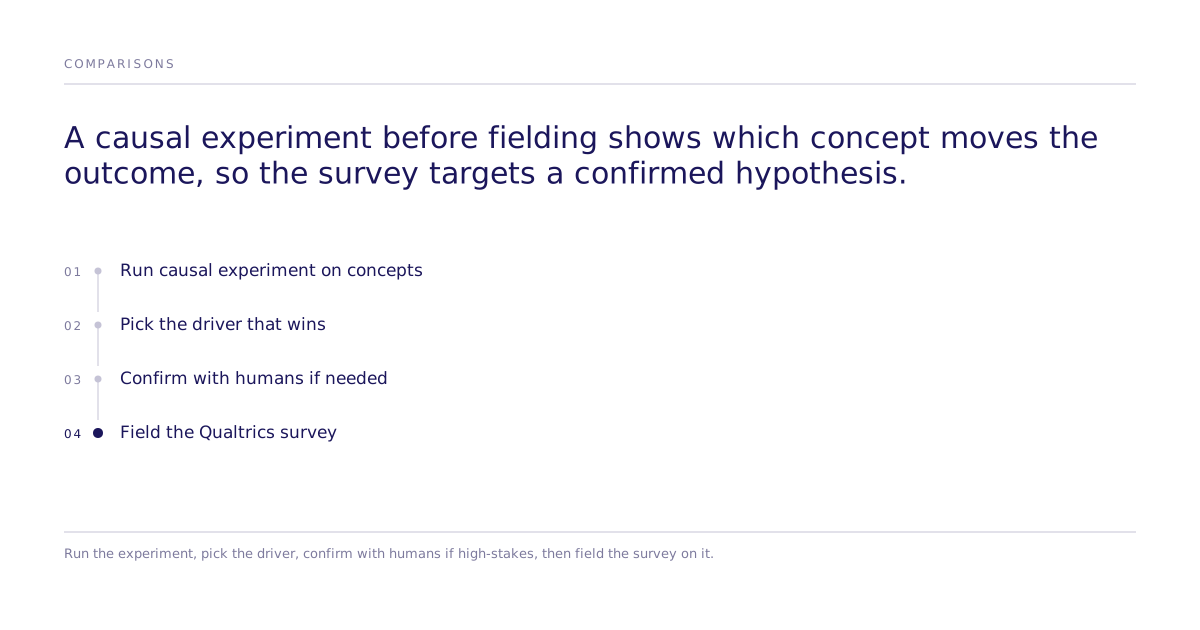
- Run a randomized experiment on the concepts, messages, or actions in question, on a simulated population matched to the target audience.
- Use the result to decide which concept or driver deserves a full Qualtrics wave, and write the survey instrument around that hypothesis instead of an open-ended one.
- Where the decision is high-stakes enough to need it, confirm the finding with real human participants before committing further budget.
- Reserve moderated interviews or asynchronous qualitative platforms for the workflow- and screen-level questions a causal experiment isn't built to answer.
Read how these experiments are designed, see how the process fits an existing research stack, or book time to walk through a specific decision. Related decision write-ups are collected in case evidence.