Where CPG Product Decisions Break Before They Ship
CPG product decisions break at the stage-gate where a choice locks in before it's tested against real consumer behavior, and the mismatch surfaces only after development or media budget is spent. A CPG innovation team rarely fails from a lack of ideas. It fails when a concept, a package design, or a price point locks in before anyone tests it against real consumer behavior, and the mismatch only surfaces after development or media budget is already spent.
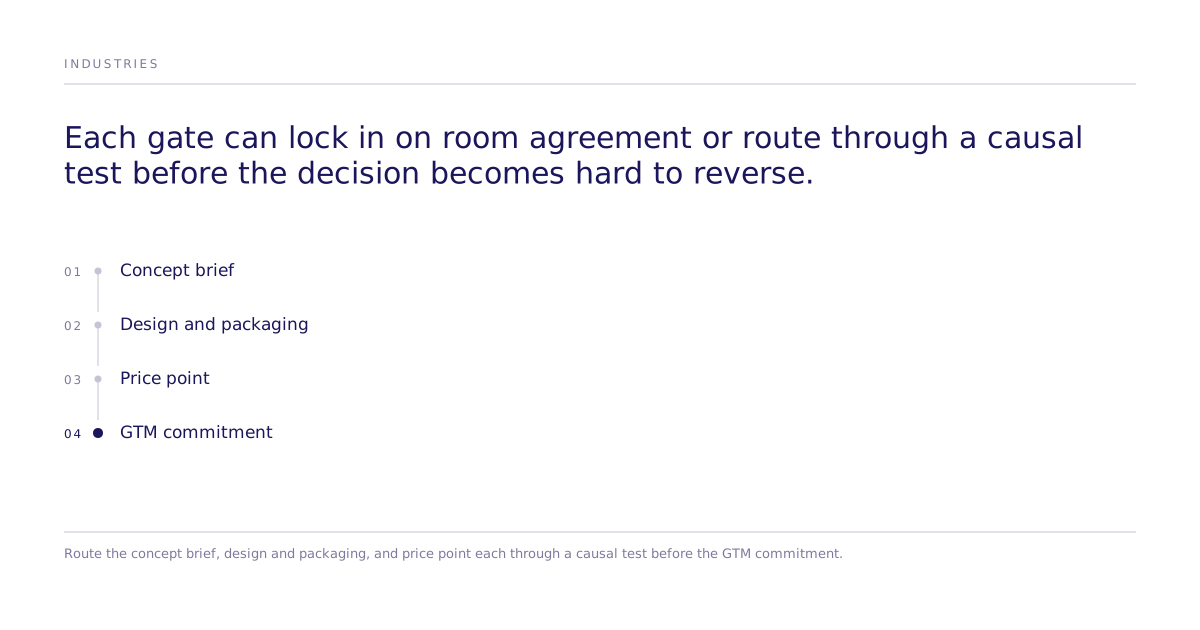
The decision: test before the stage locks, or trust internal alignment
Every product moves through stages: concept brief, design and packaging, price point, then go-to-market commitment. At each stage, a team can run a controlled causal test against a defined population, or rely on the people in the room agreeing the idea feels right.
Internal alignment is not evidence. The cost of skipping the test is not visible until the product ships and the numbers do not match what the room expected.
Why the break happens at every stage
Why do concept decisions run on gut instinct?
Early-stage concepts can lean on fragmented trend reports and internal opinion rather than a controlled read on consumer behavior. Insight is sometimes pulled in only after the concept is locked, which weakens the decision at the point where evidence would matter most.
Why do feedback loops arrive too late to change anything?
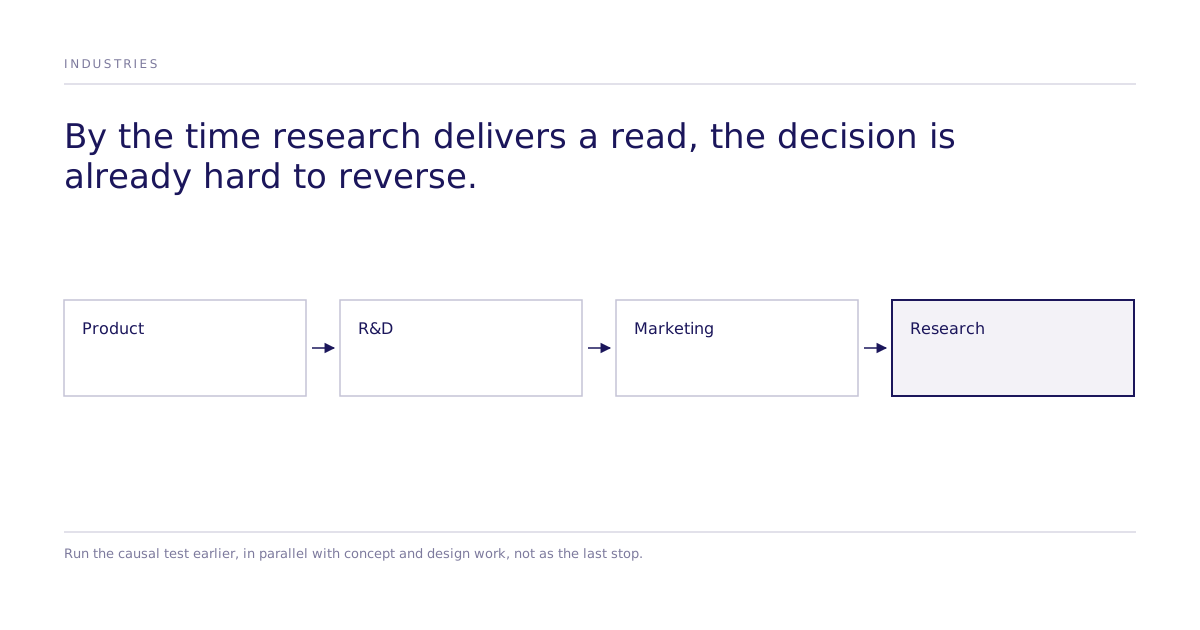
A brief moves from product to R&D to marketing to research in sequence, each function working in isolation. By the time research delivers a read, the decision is already hard to reverse.
Design gets tested after it is already fixed
Packaging can be the first, and sometimes the deciding, interaction a shopper has with a product on shelf. Yet visual identity (packaging, typography, imagery, color) is frequently finalized only after the core product decision, when budget and flexibility are constrained.
Why is pricing set on benchmarks instead of a test?
Price shapes demand, positioning, and how much of the market a product can reach, but it is often tested late, after the options are already locked. Without a way to see how demand shifts at different price points before launch, a team risks a price that is too high, too low, or out of step with what the category will bear.
Testing the decision instead of the room
A controlled experiment against a defined population gives each of these stage-gate decisions the same kind of evidence: not "does the room like it," but "how does a relevant population respond when the choice is real." Subconscious runs controlled discrete-choice experiments on simulated populations, and the same causal question can extend into real-human validation without changing what is being asked.
That matters most for CPG stage-gate decisions: a concept test, a packaging comparison, or a price-sensitivity read all fit the same test-before-commit pattern, run before development or media dollars are locked in rather than after.
What the research literature says about this approach
Independent research gives some support to the idea that carefully elicited model-based ratings can approximate how real people respond, without that being a Subconscious-run study or benchmark. A 2025 arXiv study on semantic-similarity elicitation of Likert ratings tested this approach against 57 personal-care surveys and 9,300 human responses, finding that careful elicitation and calibration can approach human rating reliability (LLMs Reproduce Human Purchase Intent via Semantic Similarity Elicitation of Likert Ratings, arXiv, 2025-10). Treat this as directional research context on the method's ceiling, not as a delivered outcome for any specific brand or category. Planning examples like this one describe what the literature shows, not what any given engagement will replicate.
"SSR achieves 90% of human test-retest reliability while maintaining realistic response distributions (KS similarity > 0.85)."
Maier and colleagues, arXiv preprint 2510.08338 (source)
Where this fits and where it does not
A causal test against a simulated population is a decision-stage tool: it tells a team whether a concept, design, or price direction holds up against a population's actual choices before the budget commits. It is not a substitute for shelf-level sales data, a clinical or usability study, or a guarantee that a launch will perform. Real-human validation on the same causal question narrows that gap, but it does not turn a controlled choice experiment into an observed in-market result.
Limitations
Treat any inherited benchmark or replication figure from prior research, including the study cited above, as a historical or planning example for a specific category and dataset, not as a current Subconscious claim, guarantee, or client-validated result. Every stage-gate decision needs its own test against the population and question that matters for it.
Next step
Teams evaluating this for a CPG portfolio can see the underlying method at /research, review how a stage-gate test is scoped at /how-we-work, or look at the industry fit at /cpg. Prior test outcomes across categories are documented at /case-studies.