Are My New Product's Sales Incremental or Cannibalistic?
A new product launch into a saturated category can grow share, or it can just move units the company already had. A toothpaste line adding a whitening variant, a beverage brand adding a flavor, a household-goods company adding a size: the sales figure at the end of the quarter looks the same whether those units came from a competitor's shelf or from the company's own existing product. The decision that matters happens before launch, when the spend, shelf space, and trade dollars are still committed but the answer is not yet known.
Why doesn't the sales number alone answer the question?
Say a new product sells 100,000 units in its first year. Some of those units are incremental: they came from a competitor or from buyers new to the category. Some are cannibalistic: they came from the company's own existing lineup. A portfolio leader who only watches total sales volume cannot tell the two apart, because both cases produce identical top-line growth.
Telling them apart requires a counterfactual: what would the existing products' sales have been if the new product had never launched? That is not a number that exists in the sales data. It has to be estimated, and how it is estimated changes the answer.
Why the obvious model breaks
The simplest approach treats this as an interrupted time series: fit a baseline for the company's and competitors' sales before the launch, then measure how far actual sales fall below that baseline afterward. The gap belonging to competitors is incremental; the gap belonging to the company's own other products is cannibalistic.
A method that hides where it breaks is not one a buyer can trust with a launch decision. That approach works only when nothing else changes in the market during the same window. Real categories don't hold still. A competitor launching its own new product a few months earlier, a withdrawal, a price change, a second internal launch: any of these shifts the pre- and post-launch baselines the simple model depends on, biasing the incrementality estimate once more than one product move happens in the same period. Most consumer packaged goods categories have that kind of turnover, which breaks this method more often than it holds.
Two other constraints compound the problem in practice:
- The question usually needs answering at the product level, not just the portfolio level: whether a new whitening product displaces other whitening products more than children's or cavity-protection lines is a product-level pattern that a model capturing differential substitution across products can surface, and that a single net incrementality number for the whole category cannot.
- A single point estimate ("12% incrementality") understates how much uncertainty is in play; a workable estimate needs a range, not a single figure.
How do you test the decision before the data exists?
The retrospective approach above is only available after a product has shipped and months of sales data have accumulated, by which point the launch spend is already gone. The alternative is to test the launch decision itself before committing to it: define the launch as one action and no-launch (or an alternative attribute set) as a second action, run both as a scenario on a simulated buyer population, and compare the resulting share of choice, including an outside or no-purchase option, across the company's own portfolio and its competitors' products.
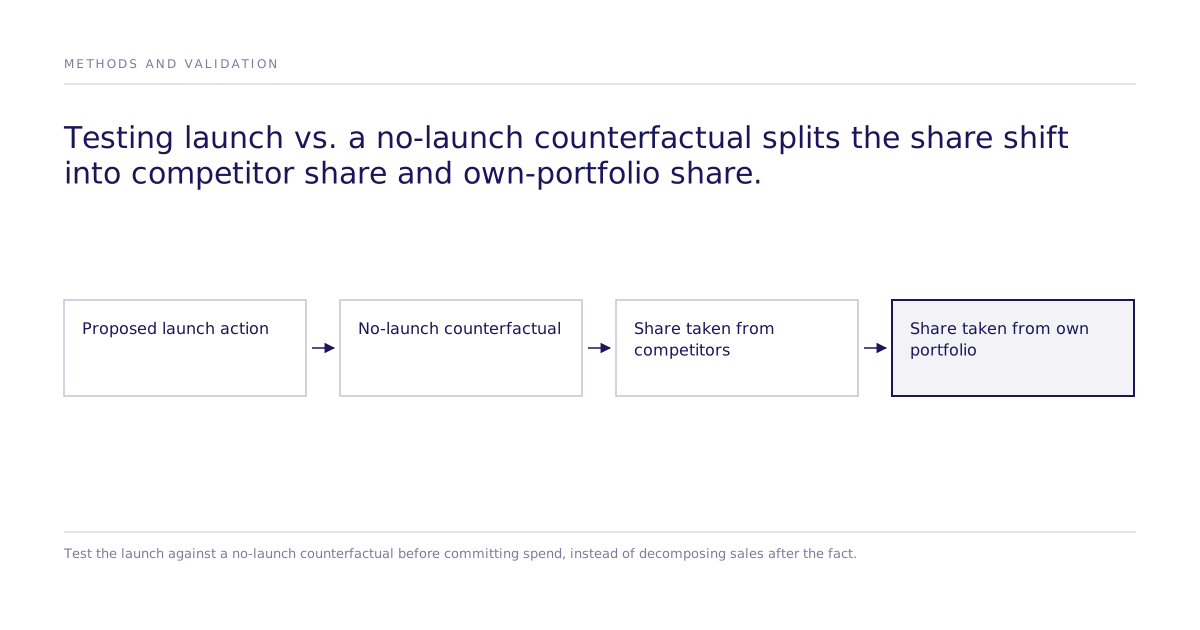
This is decision-specific scenario testing, not a packaged cannibalization-matrix output. Subconscious tests product and portfolio actions, including a proposed launch against a defined alternative, through controlled experiments on simulated populations, and reports directional comparisons in choice share.
What this method can and can't tell you
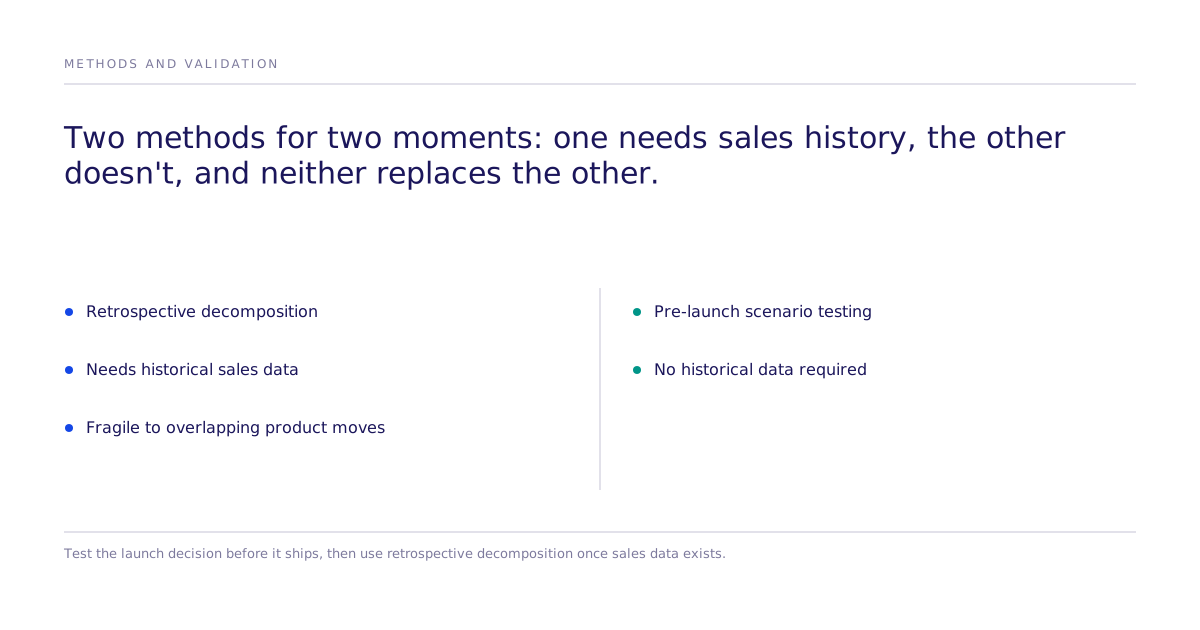
A pre-launch scenario test answers a different question than the retrospective decomposition described above, and the two shouldn't be confused:
- Retrospective decomposition (the interrupted-time-series family of methods) needs real historical sales data across multiple products and time periods, and it estimates where sales already went. It is fragile to overlapping product moves in the same window, as covered above.
- Pre-launch scenario testing compares a proposed action against a counterfactual action before either has shipped. It does not require historical sales history for the new product, because the product doesn't exist in the market yet. It also does not replace the retrospective view once real sales data exists: the two answer adjacent but different questions, at different points in the product's life.
Naming exactly what a method requires is what lets a buyer check it before relying on it. A cannibalization or substitution comparison is study-specific: it needs the competing products and attributes defined explicitly as part of the scenario design, not delivered as a standard, always-on output. Where the decision is high-stakes enough to justify it, a team can move from a simulated scenario test to validating a study with real human participants without changing the underlying causal question being asked.
Where to take this next
A portfolio or revenue-growth-management leader deciding whether a proposed launch is worth the shelf space can test the launch scenario against a no-launch counterfactual before committing budget. For the category context this kind of decision usually sits in, see how Subconscious approaches CPG portfolio decisions and how a study like this gets structured.
Causal quantification of promotional cannibalization has also been studied directly in grocery retail settings; see Causal Quantification of Cannibalization During Promotional Sales in Grocery Retail for a peer-reviewed treatment of the same underlying problem.