Why Insights Teams Lose Influence When They Avoid AI
Insights teams lose influence when they avoid AI because stakeholders then adopt ungoverned tools on their own and treat unvalidated synthetic output as settled evidence, leaving the team without ownership of the evidence boundary. A stakeholder wants an answer before the evidence is ready. A manager asks whether the team can skip the disciplined first pass. A draft report appears before the researcher has finished reading the data. The insights leader decides one request at a time: build a governed evidence path for AI-assisted exploration, or let stakeholders turn unvalidated output into strategy.
Influence is lost at the evidence boundary
The demand for research is not disappearing. The U.S. Bureau of Labor Statistics expects roughly 7% growth between 2024 and 2034 for two roles, marketing specialists and market research analysts, plus about 87,200 average yearly openings across that span. The projection appears in the BLS Occupational Outlook Handbook. This labor-market projection is historical planning context, not a current Subconscious or vendor performance claim.
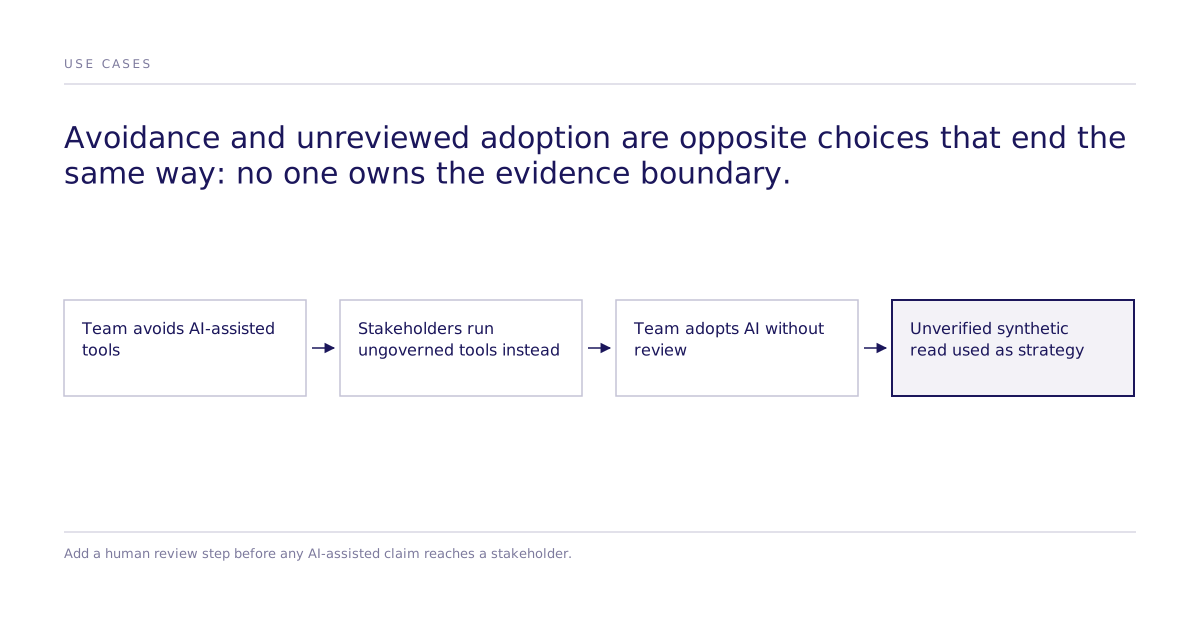
The practical risk is organizational. If an insights team ignores AI-assisted exploration, stakeholders may adopt ungoverned tools and treat their output as settled evidence. If the team adopts those tools without review and validation, the business may base a launch, price, or public claim on an unverified or biased synthetic read. In both cases, the team loses influence because nobody owns the boundary between a directional answer and a defensible one.
What are the four layers of a governed answer?
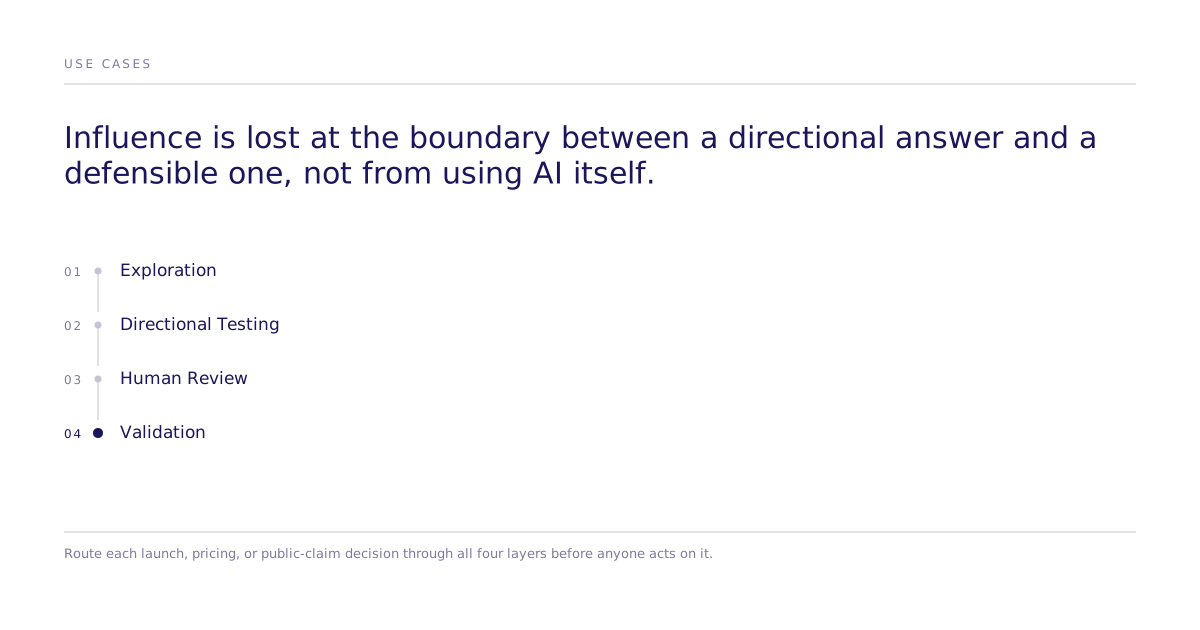
The operating question is where synthetic exploration ends and validation begins. A useful evidence system separates four layers:
- Exploration: generate hypotheses, objections, and alternative explanations.
- Directional testing: use a synthetic population to compare controlled options.
- Human review: confirm the audience is defined correctly, prompts stay neutral, sources are grounded, and business context is accounted for.
- Validation: draw on real-participant or observed behavioral evidence when a decision is high-stakes or public.
Research expertise no longer rests only on access to study design, data cleaning, or reporting. Its value is the judgment to define the causal question, test plausible actions, and decide what level of evidence the decision requires. A fluent synthetic answer remains an output until that judgment is applied.
How does the handoff from direction to proof work?
Subconscious provides a defined handoff between those stages. Teams can run controlled experiments on simulated populations, then validate the same study with real human participants without changing the underlying causal question. The output can therefore carry an honest evidence label: directional synthetic read or real-participant validation. The research approach explains the method, while case studies show the kinds of decisions it can support.
The boundary that protects credibility
This framework does not mean synthetic populations replace fielded research, and no single accuracy figure applies to every study. Aggregate pattern matching is easier to support than individual-level fidelity. Segment-level conclusions and high-stakes external claims still need validation with real participants before they become business evidence.
Validation does not convert a causal action test into a usability session, clinical trial, or automatic forecast of market performance. It answers a narrower question: whether the tested pattern holds with the recruited participants under the study design.
An operating loop that keeps research in the decision
- Select a live launch, pricing, positioning, or public-claim decision.
- State the causal question in one sentence.
- Define the audience and the consequence of acting on a wrong answer.
- Use synthetic exploration for hypotheses and controlled directional testing.
- Review the study design, audience, prompts, and result before anyone acts.
- Name the evidence level and the condition that triggers real-participant validation.
Applied across recurring decisions, this loop becomes an evidence system rather than a collection of tools. The insights team stays influential by owning the question, the test, and the standard of proof. How we work describes that operating model, and about Subconscious explains the company behind it.