Does a Simulated Population Reproduce a Published Refugee-Preference Study? The Adida Replication
A policy researcher, DEI research lead, or research methodologist weighing a simulated discrete-choice experiment for a sensitive, non-commercial topic needs more than a commercial pricing test to trust it. The check that matters: whether the simulated population reproduces a preference pattern a published, peer-reviewed human study already established, before that method is applied to a new question on similarly sensitive ground.
What Did the Published Study Find?
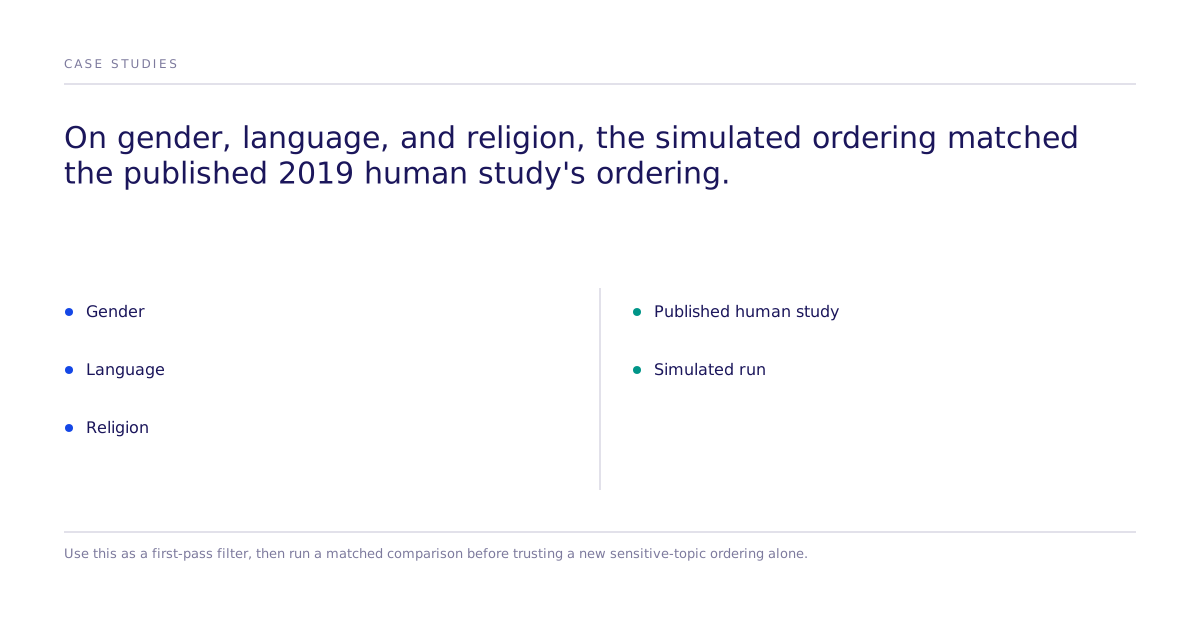
Adida, Lo, and Platas (2019) ran a conjoint analysis in 2016 asking Americans to choose between hypothetical Syrian refugees who varied by attributes including gender, language, and religion. Their published result: Americans preferred refugees who were female, English-speaking, and Christian.
"The most consistent and substantive determinant is religion: Muslim profiles rate on average 0.5 points lower than do Christian profiles, a substantive difference for a scale that runs from 1 (the respondent believes the United States should absolutely not admit the refugee) to 7 (the respondent believes the United States should definitely admit the refugee)."
Adida, Lo, and Platas, PLOS ONE (2019) (source)
What Did the Replication Compare?
A matched run against a simulated population used the same attribute set (gender, language, and religion) and produced its own preference ordering over refugee profiles. The comparison of interest: whether the simulated ordering lines up with the published human ordering on these shared attributes, not whether the simulation invents a new result.
| Attribute | Attribute included in published human study | Attribute included in simulated run |
|---|---|---|
| Gender | Yes | Yes |
| Language | Yes | Yes |
| Religion | Yes | Yes |
The simulated preference order tracked the published order across these attributes. A preference match without its scope stated reads as marketing. That is the evidence reported here, not a claim that the simulation reproduces Adida, Lo, and Platas's underlying respondent-level data, nor evidence about a different topic, population, or experiment type.
Why Does a Sensitive Topic Change the Stakes?
A commercial product test that misses the mark wastes a study budget. A misread preference on immigration, refugee policy, or discrimination carries reputational and ethical stakes beyond that: a recommendation built on a simulated population that quietly diverges from real human attitudes can do harm before anyone catches the gap. Checking a simulated run against a published academic result on this kind of topic, before extending the method to a new sensitive question, catches that divergence early at lower cost.
Where a validation path fits
A team does not need to commit to full human fielding before learning whether its simulated design is pointed in the right direction. Subconscious can move a study from a simulated experiment to real-human testing or validation without changing the underlying causal question, so a researcher can use a replication check like this one as a first-pass filter before deciding whether a new sensitive-topic study needs its own fielded validation. Related replication comparisons are collected in case studies; the underlying method is documented on the research page.
What this replication does not establish
Stating the scope of a single result is what lets a buyer check it before relying on it. This is one historical replication against a single study fielded in 2016 and published in 2019, not a live customer engagement, a benchmark run, or evidence about commercial pricing or product decisions. It does not establish accuracy across other topics, populations, or experiment types, and should not be read as a named customer outcome or a dollar-figure result. A team applying this approach to a new sensitive-topic question needs its own matched comparison before treating a simulated ordering as a substitute for fielded research.