NielsenIQ vs Causal Testing: Choosing Before You Ship a CPG Change
A VP of Consumer Insights at a CPG or retail company already has NielsenIQ panel and point-of-sale data. The open question is what to do about a price change, a new claim, or a packaging update that has never run in-market: greenlight it on historical panel trends, or test the specific action first.
What does NielsenIQ measure?
NielsenIQ aggregates retail sell-through, point-of-sale, and omnichannel purchase data. It tells a category team what already moved: which SKUs sold, at what price, through which channel, over what period.
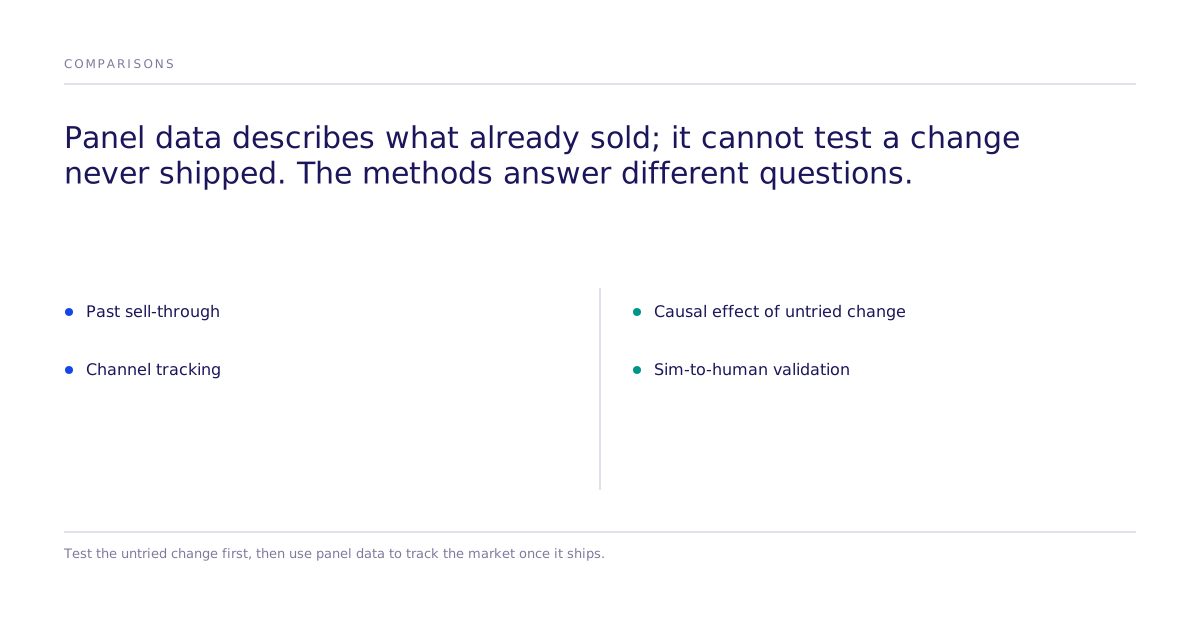
That is a different question from what would happen if a team changes something it has never tried. Panel and point-of-sale data describe the market as it existed. They do not run a controlled comparison of an untried price point, claim, or pack design against an alternative.
What is the cost of greenlighting on panel data alone?
Historical trends can look stable right up until a price move, reformulation, or claim underperforms in a way the panel never observed. The write-off shows up at the scale of a go-to-market cycle, not a study fee: a national rollout, a shelf reset, or a season of trade spend built around a launch that missed.
Testing the specific action before it ships
Subconscious runs controlled discrete choice experiments on synthetic populations to estimate the causal effect of one proposed action, such as a specific price point, claim, or pack change, before it launches, using discrete choice and Mixed Logit-style modeling rather than aggregating what already happened. When the decision calls for it, a team can move from a simulated experiment to real-human validation on the same causal question.
This does not replace NielsenIQ's ongoing category measurement. It answers a narrower question: which of the specific alternatives under consideration is more likely to move the outcome, before any of them ship.
Where each method fits
| Question | NielsenIQ | Subconscious |
|---|---|---|
| What sold, and where, over the last period? | Yes, panel and point-of-sale data | Not the method's purpose |
| Ongoing category and channel trend tracking | Yes | No |
| Causal effect of a price, claim, or pack change never tried before | No, historical data only | Yes, controlled discrete choice experiment |
| Move from a simulated result to real-human validation on the same question | Not applicable | Yes, when the decision calls for it |
Proof and its limit
The causal-effect estimates rest on discrete choice experiments and Mixed Logit and ICLV modeling, validated against real human studies. Our best configuration reaches 87% of the measured human ceiling on one study: 0.832 rank correlation against the published human result, where two independent samples of real humans reach 0.959. Across all 43 studies that pass design filters the mean is 0.73, detailed in the causal fidelity paper. It is a validation result, not a claim about any single CPG pricing or claims decision.
Subconscious does not aggregate historical retail sell-through or omnichannel purchase data the way NielsenIQ's panel does. It answers the causal effect of one proposed action, not a continuous read on category performance.
Which method should a team run first?
A team with an untried price point, claim, or pack change to evaluate before committing capital should test that specific action first, then use NielsenIQ's panel and point-of-sale data to track how the market responds once it ships. Teams already running category decisions in CPG can review past decisions tested this way or see how a study is structured before scoping a specific decision.
Read more about the underlying causal research methods.